Pulse24 Original
Samsung and SK Hynix Shed $753 Billion in a Month. This Week's Earnings Decide Who Was Right.
October 26, 2026
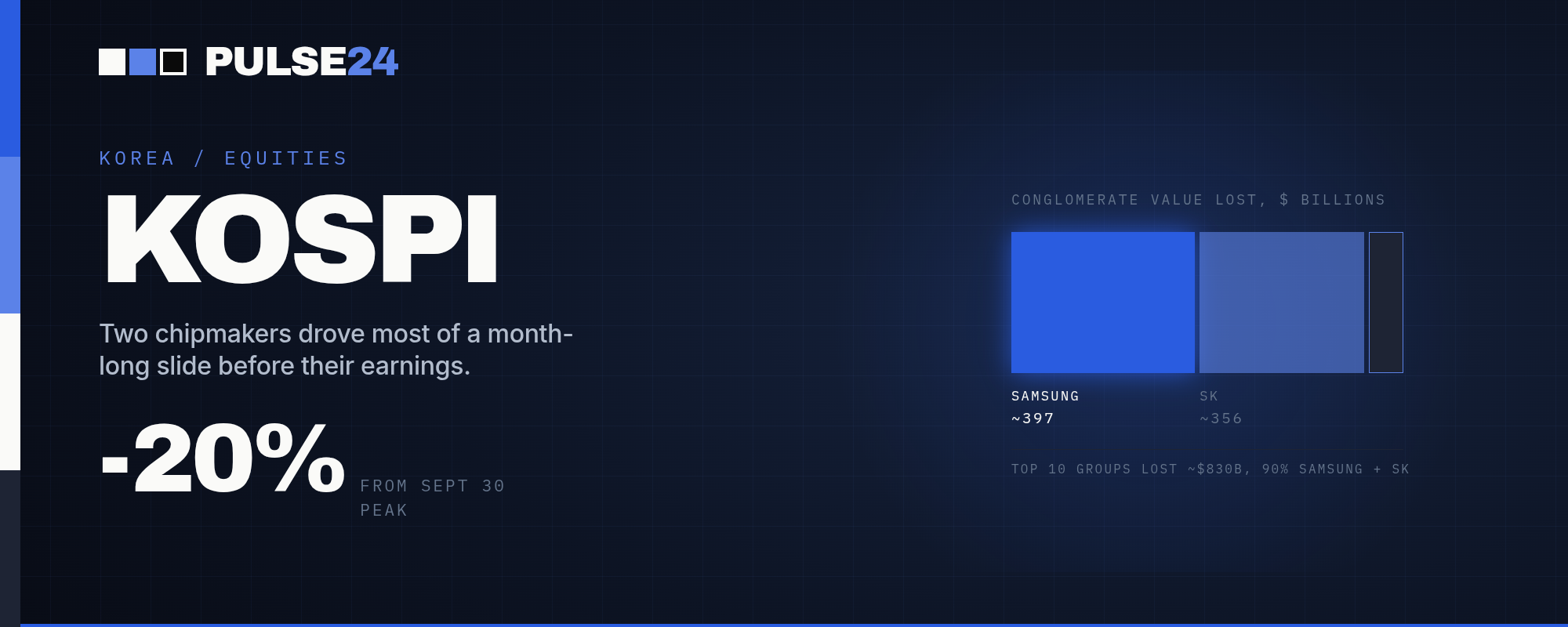
South Korea's Kospi has lost about 20% of its value since late September, erasing roughly $830 billion across the country's biggest conglomerates, even as Samsung and SK Hynix head into earnings this week on track for record profit. The gap between the stock reaction and the numbers is this week's real test for the AI trade.
5,469.47. That's where South Korea's Kospi closed on Monday, down 1.46% on the day and down roughly 20% from the 6,838.04 level it hit at the end of September. Foreign investors sold a net 6.96 trillion won of local shares in the session alone, according to Korea Times reporting, even as institutional and retail buyers stepped in on the other side.
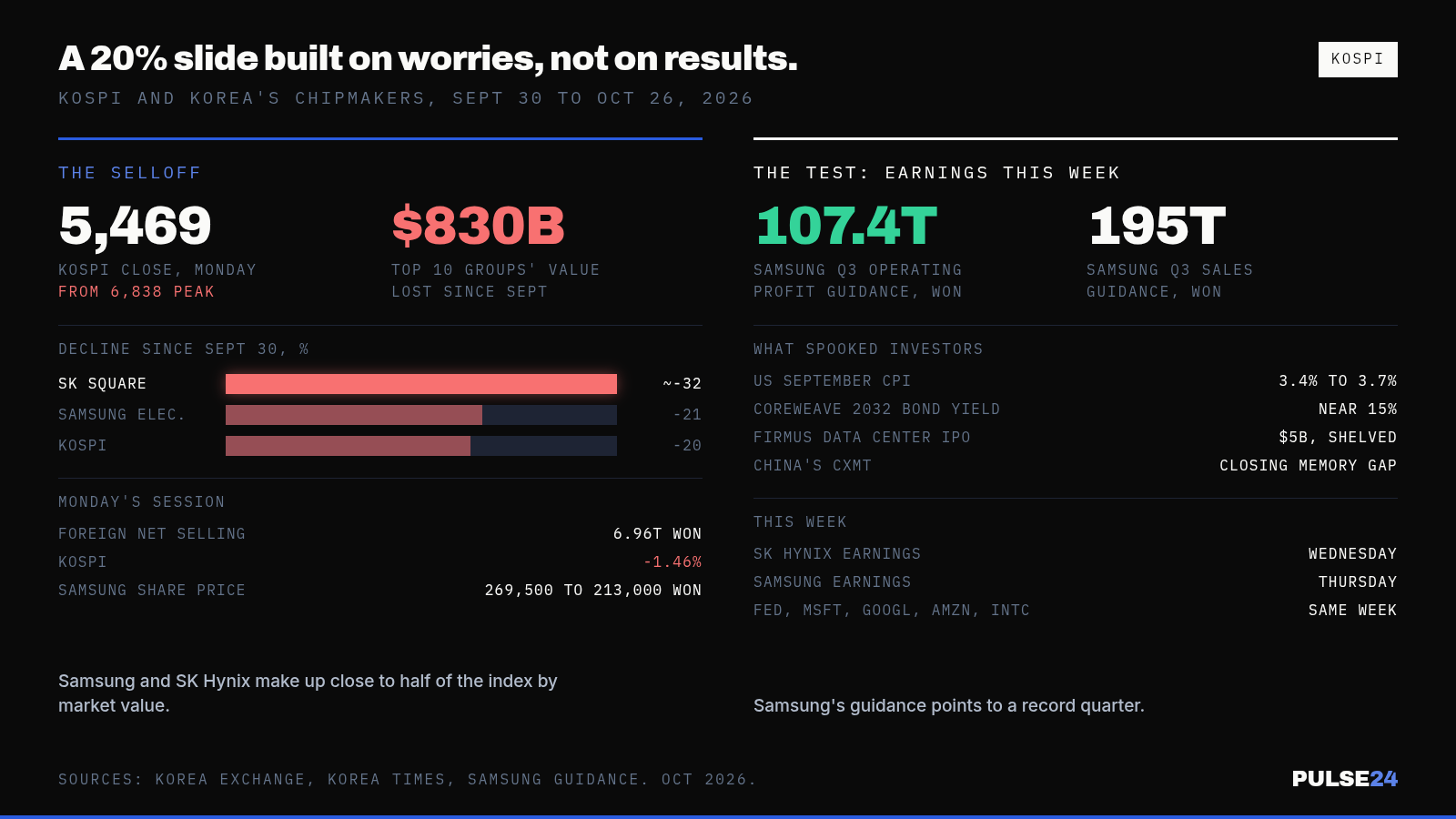
The one-month math is unusual for a market this size. Combined, South Korea's ten largest business groups have lost about 1,101 trillion won, roughly $830 billion, in stock market value since September's close, a steeper percentage drop than the index itself. Samsung Group alone is down close to $397 billion. SK Group, parent to SK Hynix, has fallen even harder in percentage terms, with SK Square, Hynix's largest shareholder, down nearly 32%. Between them, Samsung and SK account for about 90% of the total conglomerate losses, roughly $753 billion.
What Changed
Korea's stock market has always leaned on two companies more than almost any other major index leans on two companies. Samsung Electronics and SK Hynix together make up close to half of the Kospi's total market capitalization, and for most of this year that concentration paid off. High-bandwidth memory orders tied to AI servers piled up faster than either company could fill them, and Samsung's quarterly profit jumped 783% earlier this year even as broader PC demand fell. That's the backdrop that makes the past month's reversal so jarring.
The reversal traces to several places at once. September's US inflation data ran hotter than expected, with headline CPI rising to 3.7% from 3.4% the month before, reviving worries that the Federal Reserve might need to hike again rather than hold. A credit scare at CoreWeave, the AI cloud provider whose bonds and shares sold off sharply despite no earnings miss, pushed its 2032 bond yields toward 15% and raised a harder question: if a company that central to the AI buildout can wobble on debt concerns, how secure is the spending behind it. Weeks earlier, Firmus, an Australian data-center operator, had shelved a planned $5 billion IPO entirely. Separately, reports that China's CXMT is closing the technology gap in memory chips gave investors another reason to doubt that Samsung and SK Hynix's pricing power holds indefinitely.
Why It Matters
None of this shows up in either company's numbers yet. Samsung's own guidance, filed October 8, points to about 195 trillion won in quarterly sales and 107.4 trillion won in operating profit, a record. SK Hynix is tracking toward similarly outsized results. Both report this week: SK Hynix on Wednesday, Samsung on Thursday. By every public indication, the headline figures will be strong.
The gap between the stock reaction and the business results is the real story. Roughly 9.2 trillion won of Korea's 33.4 trillion won in outstanding margin debt sits concentrated in just these two stocks, as of the end of September, which means the same leverage that amplified gains on the way up is now amplifying losses on the way down. Analysts quoted by local outlets also point out that with so much good news already priced in, strong results do little to move the stocks further, while any hint of softness lands hard.
What's actually being tested is bigger than Korea. The question is whether the AI capex cycle that has driven memory prices, chip capacity, and a meaningful share of global tech earnings can keep converting spending into revenue, or whether markets priced in more certainty than the underlying economics support. Samsung and SK Hynix didn't do anything wrong here. They're simply the most liquid, most concentrated way for global investors to express a view on that question, which is part of why doubts about AI-linked financing elsewhere tend to show up first in their share prices.
What to Watch Next
This week doubles as a stress test for the AI trade well beyond Korea. SK Hynix reports Wednesday morning in Seoul, Samsung follows Thursday. The same week, the Federal Reserve delivers its own decision on Wednesday afternoon in Washington, with markets largely pricing in a hold. Microsoft and Alphabet report Wednesday afternoon in the US, with Amazon, Intel and Sandisk following Thursday. If capital spending guidance from the US hyperscalers comes in soft in the same week Korea's memory giants post record profit, that combination would settle more of this argument than any single data point could on its own.
The Pulse24 Take
Markets have a habit of overshooting in both directions on questions this binary. A 20% monthly drop concentrated in two stocks says as much about leverage and crowded positioning as it does about any real change in memory chip demand, especially with both companies walking into record quarters. At the same time, record profits landing into a falling stock price is exactly the pattern you'd expect if investors have started to doubt that today's pace of AI spending can keep paying for itself, whatever one quarter's numbers show. The number worth watching this week isn't the profit figure everyone already expects. It's the guidance Samsung and SK Hynix give for 2027 memory pricing and capacity, since that's the number actually pricing in how much further this AI buildout has to run.
How we read the data
Curious how we get from raw data to a take like this? Our Trader's Toolkit walks through the tools we lean on.
Explore the Toolkit