Pulse24 Original
China's Chip Export Volumes Rose 1.2% in September. The Dollar Value Rose 136%.
October 21, 2026
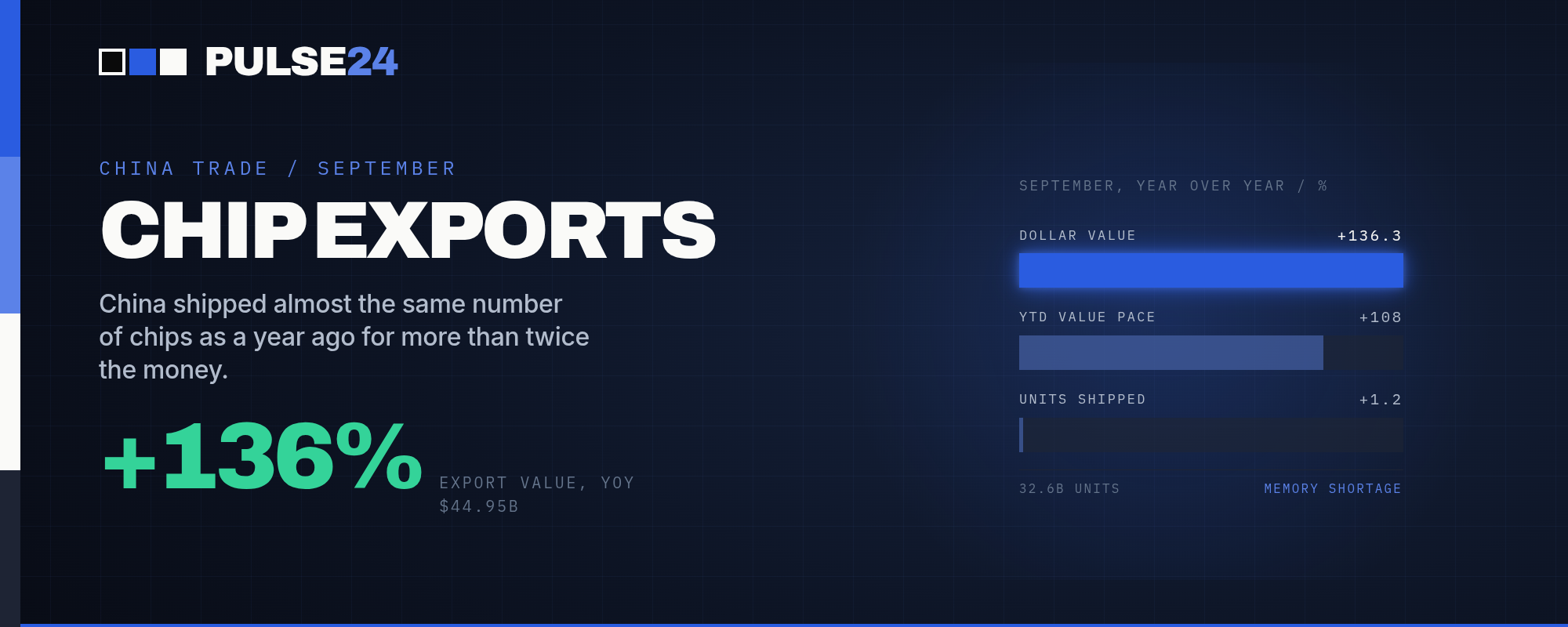
China's September trade data shows chip export revenue up 136% year over year while the number of chips shipped barely moved, hard confirmation of what the memory shortage has done to prices this year. The gap traces to AI's demand for DRAM and NAND, and Wall Street doesn't expect it to close before 2028.
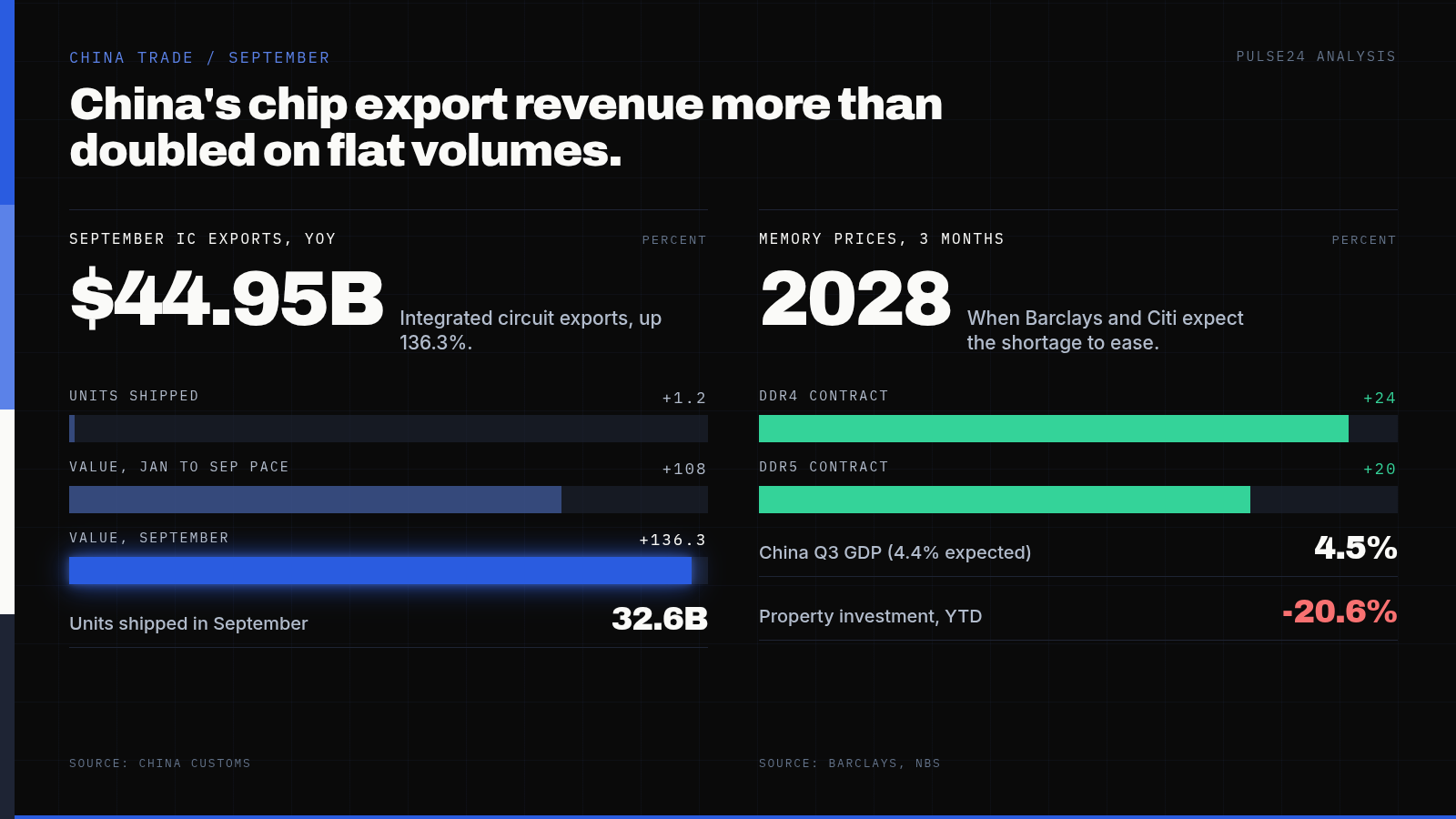
Thirty-two point six billion. That's how many integrated circuits China exported in September, up just 1.2% from a year ago. The bill for those chips came to $44.95 billion, up 136.3% over the same month. A nearly flat number of units produced more than double the revenue.
That divergence is the cleanest piece of hard trade data yet confirming what chipmakers have been saying anecdotally for most of 2026: the global memory chip shortage is now showing up directly in the price of silicon crossing China's ports, not just in boardroom commentary. Export growth in ICs has actually been accelerating. The 136% jump in September outpaced the 108% growth rate recorded over the first nine months of the year, and China's overall exports, up 36.3% in September to $447.18 billion, grew far slower than its chip exports did.
Why Chip Prices Are Outrunning Chip Supply
Micron, SK Hynix, and Samsung control more than 95% of global DRAM production, and all three have been reallocating wafer capacity toward high bandwidth memory, the stacked chip format that feeds Nvidia's and other companies' AI accelerators. HBM manufacturing runs through a base-die yield process that's harder to scale than it looks, and every wafer diverted toward it is one that isn't making conventional DRAM or NAND for laptops, phones, and servers. That tradeoff is the mechanical core of why the shortage keeps spreading across product categories instead of staying contained to one.
The price data backs up the squeeze. Barclays tracked DDR4 contract prices rising roughly 24% over the three months through October, with DDR5 up about 20% over the same stretch. SK Hynix has said its DRAM, NAND, and HBM output for 2026 is already sold out. Wall Street isn't forecasting quick relief either: Barclays and Citi both expect the DRAM and NAND deficit to persist into 2028, since memory executives don't anticipate meaningful new fabrication capacity coming online before late 2027 at the earliest.
The Squeeze Is Already Reaching Store Shelves
Consumers are starting to feel this before most of them understand why. Laptop and phone bills of materials have already been reshaped by rising memory costs, and the pattern appears to be repeating elsewhere: Apple's component costs for its next flagship iPhone are reportedly following a similar curve, with DRAM projected to roughly quadruple and memory's share of the phone's total component cost potentially climbing from about 10% today to more than 45% by 2027. Storage drive makers are facing a comparable supply crunch, which suggests this is a capacity problem spanning memory types, not a DRAM-specific pricing anomaly.
What China's Export Data Adds to the Growth Story
The chip numbers arrived three days before China's broader data, and they help explain how the world's second-largest economy hit its growth target despite a housing market that's still shrinking. Third-quarter GDP grew 4.5% year over year, beating the 4.4% consensus in a Reuters poll and accelerating from 4.3% in the second quarter, keeping growth for the first three quarters at 4.6%, inside Beijing's 4.5%-to-5% target range. Industrial output rose 5.1% in the third quarter, picking up pace from the second quarter, and September retail sales grew 1.1% year over year, the fastest since March, after a soft summer.
Investment tells a less flattering story. Fixed-asset investment is down 7.2% for the year, and property investment has fallen 20.6%, both largely unchanged from where they've sat since the spring. China is effectively leaning on exports and manufacturing, including unusually price-inflated chip sales, to carry growth while domestic investment keeps contracting, a trade-off that's becoming more visible every quarter this cycle runs.
What to Watch Next
The next data points worth tracking are capacity, not price. Samsung, SK Hynix, and Micron all report earnings in the coming weeks, and any update on when new DRAM and HBM fabrication capacity actually comes online will matter more than another quarter of record margins. Analysts generally don't expect that relief before late 2027, so the shortage is likely to keep working through contract negotiations and consumer electronics pricing well into next year. On the China side, economists surveyed after the GDP release expect fourth-quarter growth to pick up further, with one forecast near 4.7%, but that call assumes the chip-export tailwind doesn't fade and that Beijing follows through on its stated plans to support consumption and investment more directly.
The Pulse24 Take
Trade data rarely settles an argument this cleanly. For most of 2026, the memory chip shortage has been described mostly through anecdotes, a sold-out capacity announcement from one chipmaker or a price-target hike from an analyst covering another. China's September customs numbers turn that into an arithmetic fact. Shipping a nearly identical number of chips for more than double the money is what a genuine supply shortage looks like once it shows up in a government ledger instead of an earnings call.
What should concern anyone watching inflation more broadly is how far this has already spread beyond AI hardware itself, into PCs, phones, and now the trade accounts of the world's largest exporter. Wall Street doesn't expect this shortage to ease before 2028, which makes it a multi-year cost input working its way into a wide swath of consumer electronics, arriving at a moment when central banks are already trying to figure out how much of this year's price pressure is temporary and how much is structural. China's chip export data didn't answer that question, but it made the stakes considerably harder to ignore.
How we read the data
Curious how we get from raw data to a take like this? Our Trader's Toolkit walks through the tools we lean on.
Explore the Toolkit