Pulse24 Original
Strip Out AI Stocks and the S&P 500 Is Up 5% Since Earnings Season Began. With Them, It's Down 3%.
November 3, 2026
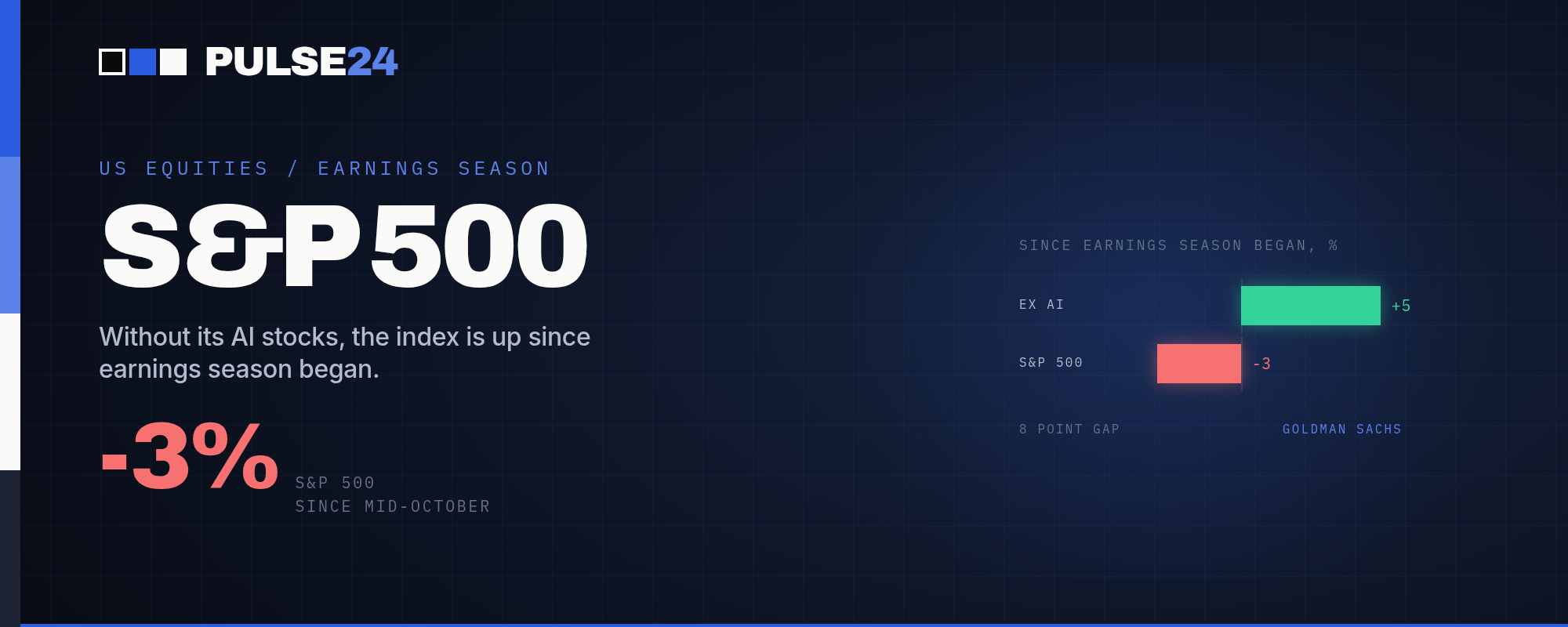
The S&P 500 has fallen 3% since earnings season started, but strip out AI stocks and it is up 5%. Bank of America calls a prolonged AI correction a major risk to the global economy, right as 41 local ballot measures take aim at the data centers funding the boom.
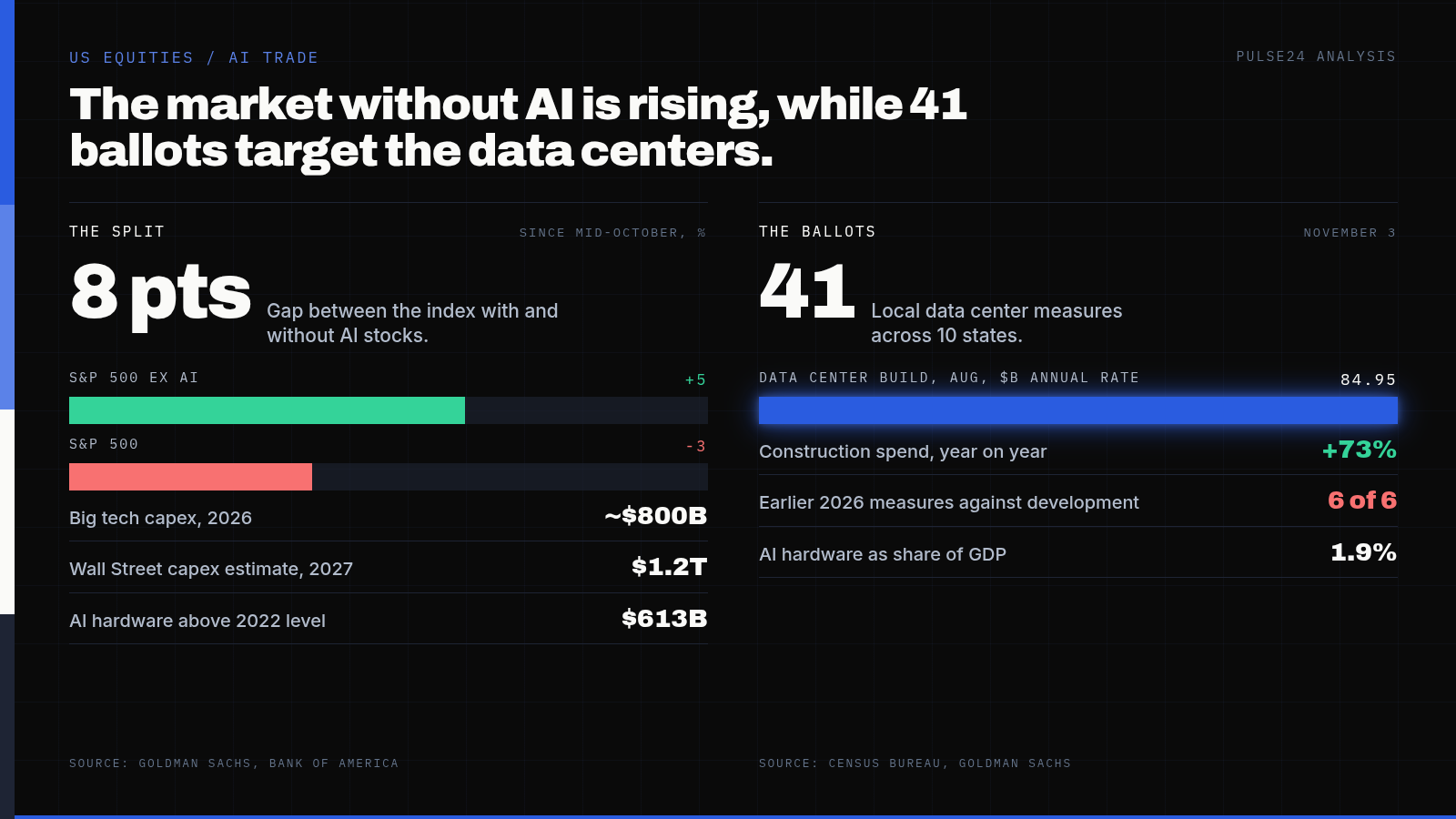
Pull the handful of AI-linked megacaps out of the S&P 500 and the index has gained 5% since corporate earnings season kicked off in mid-October. Leave them in, and the same index is down 3% over the identical stretch. That gap, now one of the widest divergences investors have tracked all year, is the clearest sign yet that Wall Street's confidence in the broader economy has held up better than its confidence in the companies spending hundreds of billions of dollars to build it an artificial-intelligence future.
Bank of America's economists put a number on that nervousness Monday. In a note dated November 2, they wrote that a sustained correction in the AI trade now ranks as a major risk to the global economy, not just to the handful of stocks that have carried the market's gains for two years running. Their logic runs through more than stock prices. Rising capital spending has pushed up borrowing, some of that borrowing has filtered into interest rates more broadly, and the wealth created by AI-driven stock gains has been propping up consumer spending well beyond Silicon Valley. Pull any one of those threads and, in BofA's telling, the knock-on effects reach further than a single sector correction.
What Changed
What's shifted is where the AI story is being contested. For most of the past two years, the debate over artificial intelligence investment played out almost entirely on earnings calls and in stock charts. Tuesday changes that. Voters in ten states are deciding the fate of 41 local data-center measures on the same day control of Congress is up for grabs, a scale of direct democratic input into AI infrastructure that simply didn't exist a year ago. Ballotpedia's count, cited by Axios, shows the proposals range from new permitting and environmental-review requirements to outright bans on new construction.
The early returns on these fights aren't encouraging for the industry. Every one of the six data-center ballot measures already decided earlier this year, in New Hampshire, Wisconsin, Michigan, and California, went against development. In Texas, Governor Greg Abbott halted new data-center approvals pending an audit, while his Democratic challenger backs an outright moratorium. Ohio has 21 separate data-center measures on its ballot alone, enough that Senator Jon Husted has had to actively defend his past support for the industry rather than simply campaign on other issues.
Goldman Sachs, for its part, thinks the politics will cool off faster than the market reaction suggests. Strategist Alec Phillips wrote in a November 1 preview that data centers rank low among voter priorities nationally despite emerging as a theme in some campaigns, and that a national moratorium looks unlikely under any outcome Tuesday night. Congress might trim data-center tax breaks, he wrote, but broad restrictions would need bipartisan appetite that doesn't currently exist. Prediction markets, as of Monday, implied Democrats retake the House with roughly 236 seats, with the Senate considerably closer.
Why It Matters
The reason local ballot measures can move a national stock story comes down to how much money is now riding on data centers getting built on schedule. The Census Bureau's preliminary estimate puts data-center construction spending at an $84.95 billion annual rate in August, up 73% from a year earlier. Goldman Sachs economists Sarah Dong and Joseph Briggs estimate AI-related hardware investment is now running $613 billion above its 2022 level, equivalent to roughly 1.9% of GDP. Strategist Ben Snider projects the largest technology companies will spend close to $800 billion on capital expenditures this year, a 96% increase from last year, and that Wall Street already expects $1.2 trillion in 2027.
That spending has increasingly been financed with debt rather than cash on hand, a shift Pulse24 has tracked as private equity firms took stakes in close to 30% of America's AI data centers and the debt behind those deals began showing stress. It also sits on top of a stock market that's become unusually dependent on a small number of AI-exposed names. Two companies alone accounted for 36% of the S&P 500's third-quarter earnings growth, a level of concentration Goldman has compared to the peak of the dot-com bubble. When that much of the market's earnings growth, capital spending, and now political risk all run through the same handful of companies, a local zoning vote in suburban Ohio stops being a local story.
There's a labor-market wrinkle too. Goldman's Census-based tracking shows 24.6% of U.S. businesses now use AI in at least one function, up 0.8 points in a single month, with adoption in finance, information, and professional services approaching half. AI-attributed layoffs reached roughly 4,000 in September and 207,000 since May 2023, even as data-center-linked construction employment has risen by about 315,000 jobs since 2022. Those two trends, AI displacing some white-collar roles while generating a separate boom in construction jobs, are part of why the debate over data centers has become harder to cleanly separate into pro-growth and anti-growth camps.
What to Watch Next
The most immediate test is Tuesday's results themselves. If most of the 41 local measures go against data centers, expect lawmakers in both parties to point to it as cover for tighter federal oversight, regardless of which party wins the House. A result closer to the six measures decided earlier this year, a mixed bag rather than a rout, would support Goldman's view that this is a sharp but contained local fight rather than the start of national AI-infrastructure regulation.
Beyond election night, the number worth tracking is that 3-point gap between the headline S&P 500 and the index without AI stocks. Goldman's own Analyst Index, a survey-based measure of business activity, fell 6.5 points to 49.1 in October, its first sub-50 reading since April 2025, while new orders dropped to the lowest level since May 2020. Should that broader softening start showing up in AI-adjacent earnings too, the market won't need a ballot measure to reprice the trade; absent that, Tuesday's results may end up mattering more for Ohio and Texas politics than for Nvidia's valuation.
The Pulse24 Take
The AI buildout has survived plenty of skepticism over the past two years, mostly from investors questioning whether the spending would ever pay for itself. What's new is that the questioning has spread to people whose houses sit near where the spending actually happens, and who vote regardless of what quarterly earnings show. That's a different kind of pressure than a disappointing guidance number, and it doesn't resolve itself the way a stock selloff does.
Goldman is probably right that no single election fully derails a buildout this large. But BofA's warning deserves to be taken at face value precisely because it isn't really about AI stocks falling. It's about an economy where capital spending, consumer wealth, and now local politics have all become more tied to one investment theme than at almost any point in recent memory. A correction doesn't need a trigger as dramatic as a market crash when the underlying support has this many separate threads running through it. It just needs one of them to fray.
How we read the data
Curious how we get from raw data to a take like this? Our Trader's Toolkit walks through the tools we lean on.
Explore the Toolkit