Pulse24 Original
US Business Activity Is Growing Near a Five-Year High. Selling Prices Are Rising at Their Fastest Pace Since 2022.
October 27, 2026
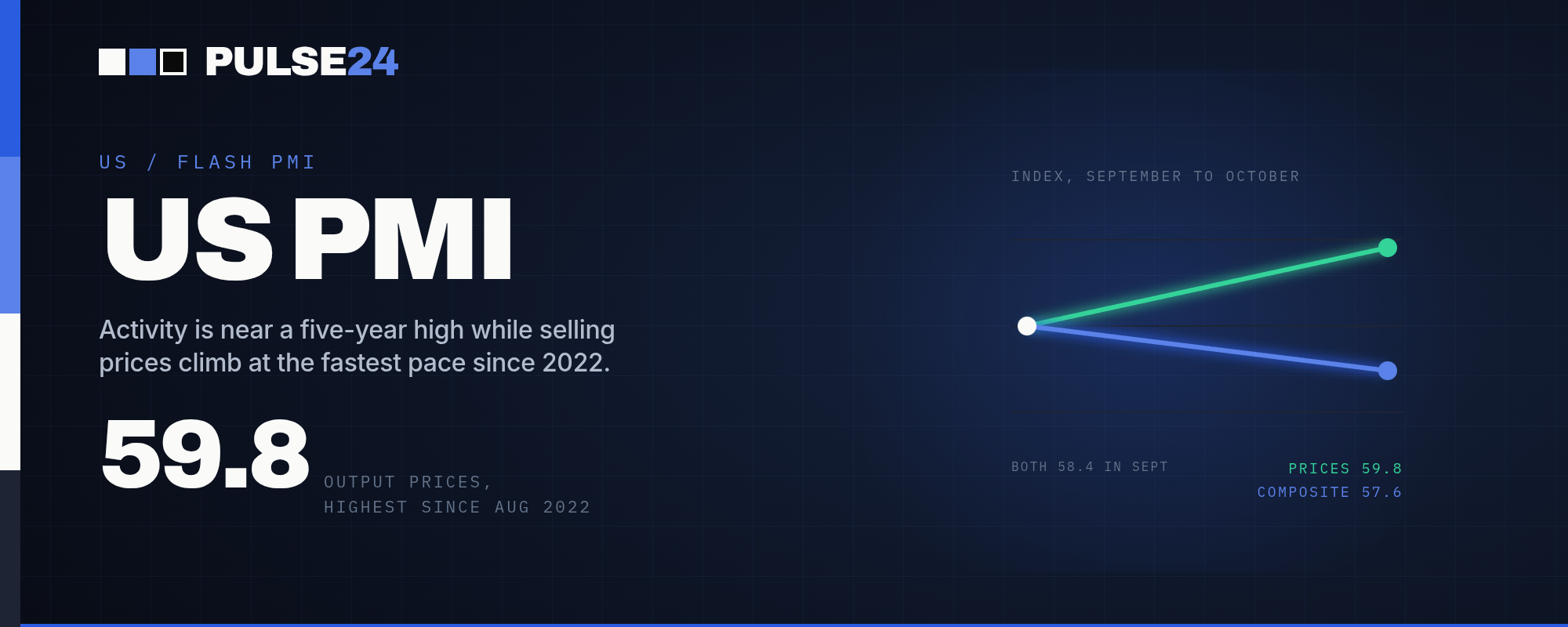
A fresh flash PMI reading shows US business activity still running near a five-year high, while the report's price gauge jumped to its highest level since August 2022. That combination lands five days before the Fed's October decision, and it is already complicating the case for ending the hiking cycle.
Fifty seven point six. That is where S&P Global's flash composite PMI landed for October, a step down from September's 58.4 but still deep in expansion territory, the 45th straight month of growth for US businesses. Buried in the same report is a less comfortable number. The survey's gauge of selling prices jumped to 59.8, up from 58.4, its highest reading since August 2022.
Growth and inflation pressure showing up in the same report, five days before the Fed meets, is not a combination policymakers wanted to see this week.
What Changed
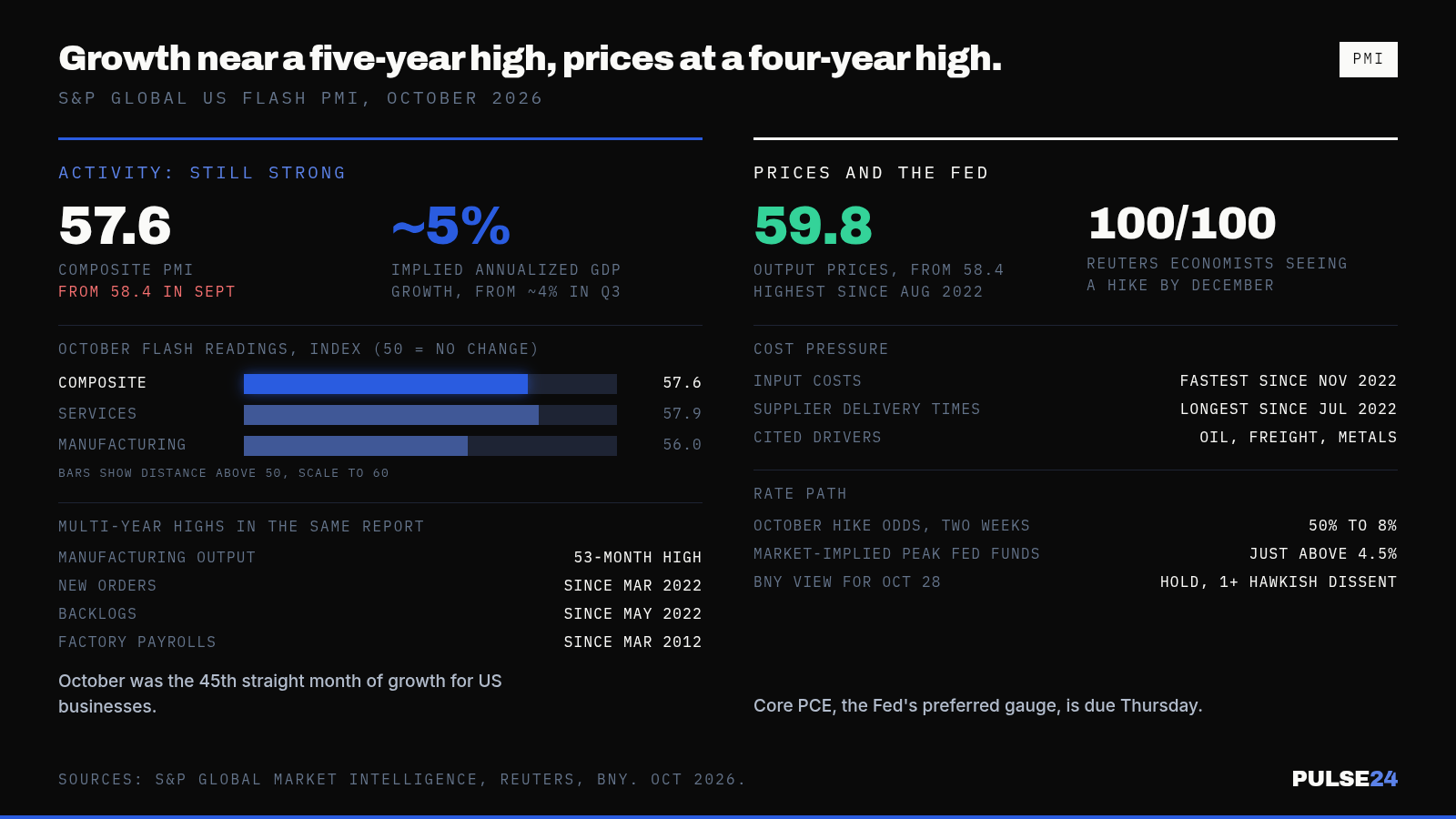
Manufacturing output came in at 56.0, a 53-month high, while services slipped to 57.9 from 58.8. Combined, the reading points to roughly 5% annualized GDP growth at the start of the fourth quarter, up from around 4% in the third, according to Chris Williamson, chief business economist at S&P Global Market Intelligence. New orders climbed to their highest level since March 2022, with services new business growing at its fastest pace since that same month. Backlogs grew at their fastest pace since May 2022 in both sectors, which gives firms cover to keep raising prices rather than compete on them.
The price side of the report is where the story turns. Selling prices rose at their sharpest rate since August 2022, a broad-based increase across both goods and services. Input costs climbed at their fastest pace since November 2022, with firms pointing to oil-linked inputs, freight, and metals including steel, aluminum, and copper. Supplier delivery times lengthened the most since July 2022 amid material and labor shortages. Williamson's own read on it was direct: the pace of selling-price increases points to consumer inflation drifting further above the Fed's target in the months ahead.
Hiring moved in the same direction. Employment grew at its fastest pace since June 2022 outside of September's jump, and manufacturing payrolls rose at their fastest rate since March 2012. None of this looks like an economy losing momentum.
Why It Matters
This data landed just as the Fed's rate path was already shifting under traders' feet. October hike odds collapsed from roughly 50% to 8% in the space of two weeks, and jobless claims sitting at a 57-year low have kept the labor market looking tight even as the Fed debates when to stop. A Reuters poll found all 100 surveyed economists expecting a hike by December, a near-unanimous view that would have seemed unlikely a month earlier. Add a price index at a four-year high and new orders at a similar extreme, and the case for an extended pause gets harder to make, not easier.
BNY's economists, writing ahead of Wednesday's meeting, expect no hike at this week's decision but see at least one dissenting vote in favor of one, which markets would likely read as hawkish. Market pricing currently has the fed funds rate eventually peaking just above 4.5%, with roughly three more hikes priced in through late 2027, though BNY itself is not convinced the Fed delivers all of that tightening unless inflation broadens into more cyclical categories. Consumer inflation expectations were already sitting at a five-month high before this report, so the PMI's price gauge arrives as confirmation of a trend rather than a surprise on its own. The surprise, if there is one, is how little slack shows up anywhere in the data at once: orders, backlogs, hiring, and prices are all pointing the same way.
A growing economy with firming prices is a different problem than a shrinking one, and arguably a harder one to manage from the Fed's seat. Officials can cut into a slowdown with little controversy. Raising rates further into what still looks like a 5% growth quarter risks being blamed for choking off an expansion that, on paper, does not look like it needs rescuing. That tension is likely to show up in Wednesday's statement and in Chair Kevin Warsh's press conference, whichever way the vote goes.
What to Watch Next
Core PCE inflation data, the Fed's preferred gauge, is due Thursday and will either support or undercut the flash PMI's price signal. Wednesday's statement and vote count matter beyond the headline decision. A dissent in favor of a hike would likely be read as confirmation that December is close to locked in, while a unanimous hold could ease some of the pressure building in rate markets. Watch, too, whether oil and freight costs keep climbing into November, since those were the inputs firms named most often for the jump in prices, and a reversal there would undercut the inflation case faster than any single Fed meeting could.
The Pulse24 Take
It is tempting to read this report as one more data point in an already crowded week, but the combination is unusual enough to sit with. An economy growing near 5% annualized, with backlogs and new orders both near multi-year highs, is not the environment in which central banks normally worry about overdoing it on rate hikes. Yet that is roughly the position the Fed finds itself in, with a labor market still adding jobs at pace and a price gauge that just posted its fastest climb in over four years. The easy narrative, that strong growth and high rates eventually break something, has not played out yet in this data. What has shown up instead is an economy absorbing higher borrowing costs while still generating enough demand to let businesses raise prices and still see order books grow. Whether that holds through the holidays, with oil and freight both doing a lot of the pushing, is the real test. For now, the data gives the hawks on the committee more to point to than the doves, and Thursday's PCE report will say whether that lead holds.
How we read the data
Curious how we get from raw data to a take like this? Our Trader's Toolkit walks through the tools we lean on.
Explore the Toolkit