Pulse24 Original
Jobless Claims Fell to a 57-Year Low. Continuing Claims Hit a Six-Week High.
October 24, 2026
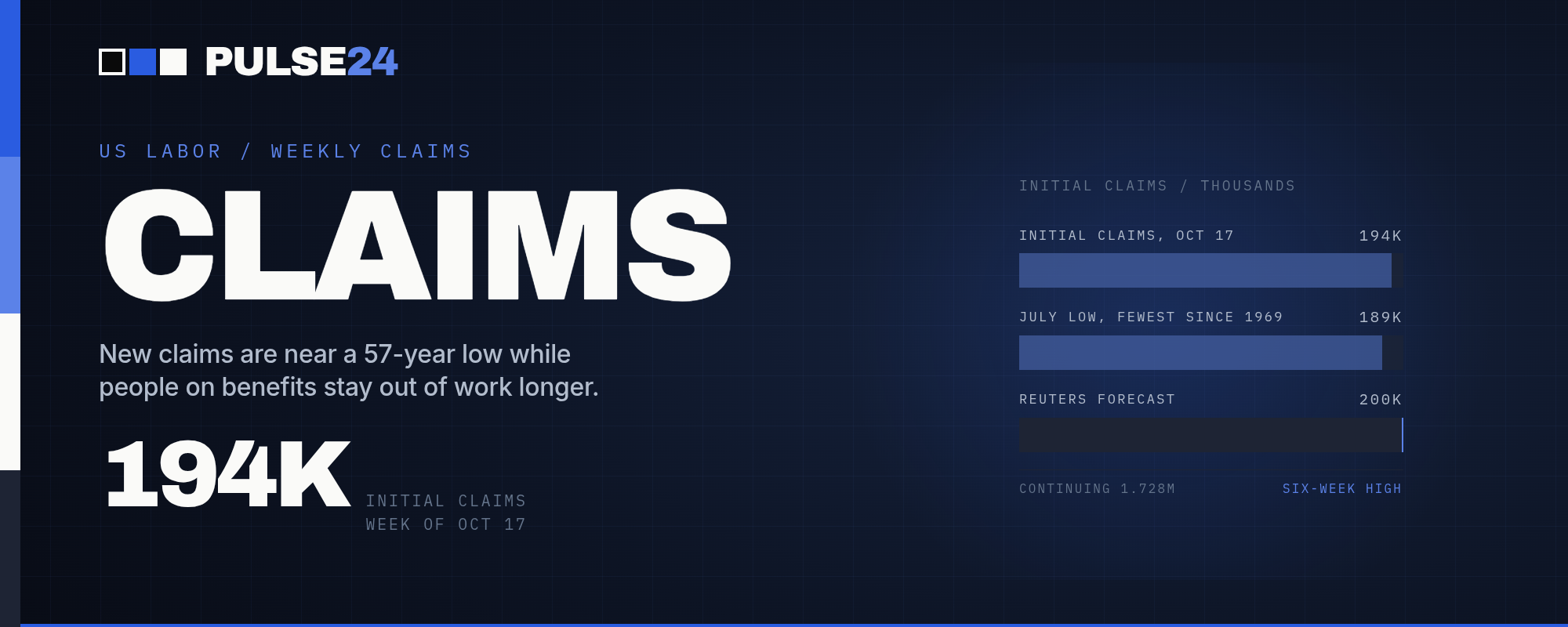
Weekly unemployment claims hit their lowest level since 1969, but continuing claims jumped to a six-week high and unemployment duration hit a four-and-a-half-year peak. The Fed's own Beige Book blames part of this on AI, and the layoff data tells a messier story than that.
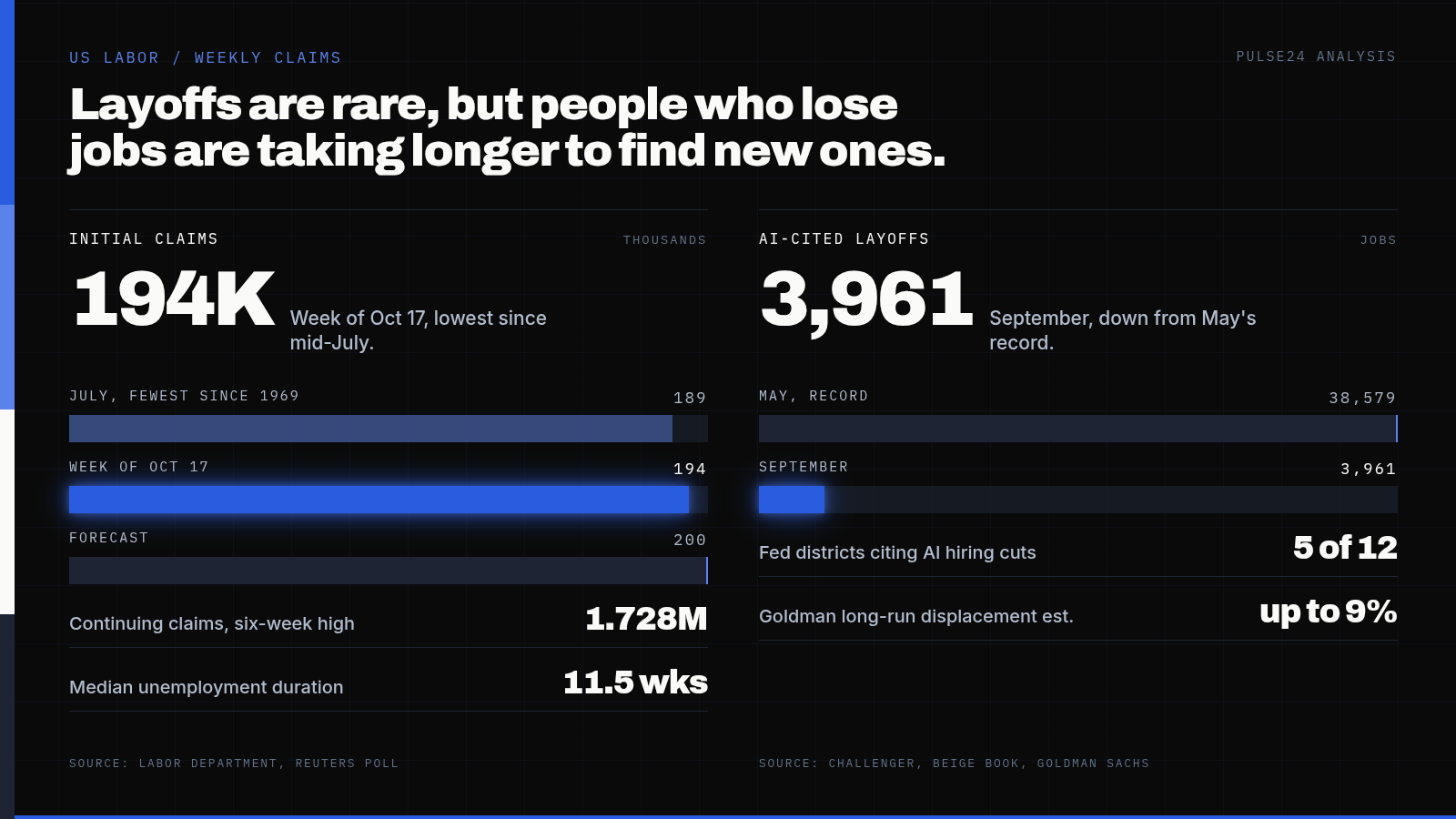
Initial claims for unemployment benefits fell to 194,000 last week, a drop of 6,000 from the prior week and the lowest total since mid-July. Economists polled by Reuters had expected 200,000. Stack that number against history and claims are now within five thousand of July's 189,000 print, the fewest since 1969. By the headline alone, American employers are simply not letting people go.
What Changed
A second figure released the same morning complicates that read. Continuing claims, the running tally of people still collecting benefits, rose by 25,000 to 1.728 million for the week ended October 10, a six-week high. Median unemployment duration climbed to 11.5 weeks in September, close to its highest mark in four and a half years. Economists have landed on a label for this combination: a low-hire, low-fire labor market. Companies have mostly stopped firing. They have also mostly stopped hiring, and the two trends are not canceling out the way they used to.
The Fed's own October Beige Book, published ten days ago using data collected through October 5, offers a partial explanation. Five of the central bank's twelve districts reported that some firms had reduced staffing through attrition, delayed hiring, or now expect to create fewer jobs, specifically because AI investment had already lifted productivity. Minneapolis Fed contacts were careful to draw a distinction: AI was not necessarily triggering layoffs, it was suppressing the creation of new ones. Dallas Fed contacts described a staffing firm running AI agents through more than 180 hours of candidate interviews in two days, with people only reviewing the output afterward.
The job-cut data tells a messier story than a straight line from AI investment to pink slips. Challenger, Gray and Christmas tracked a record 38,579 AI-cited layoffs in May, the highest monthly total since the firm started tracking the category in 2023. By September that number had collapsed to just 3,961, barely a tenth of May's figure and only the fifth most-cited reason for job cuts that month. Total layoff announcements in September came to 43,281, the lowest for any September since 2022. Andy Challenger, the firm's own labor economist, put it simply: companies are in a wait-and-see period.
Goldman Sachs economist Joseph Briggs has been tracking a similar pattern from a different angle. Job growth in the most AI-exposed industries has run roughly 10,000 positions a month below its long-run trend over the past three months, Briggs found, which looks more like hiring reluctance than active firing. He puts eventual AI-driven displacement at up to 9% of the workforce, around 15 million people over a decade, assuming AI lifts productivity by 15% across developed economies. Briggs argues the bulk of that reckoning tends to arrive during an economic downturn rather than during an expansion. Only 23% of U.S. establishments have built AI into their regular workflows so far, and this year's labor market has stayed resilient enough that employers have little reason to force the issue now.
Why It Matters
None of this happens in a vacuum. The Fed raised rates 25 basis points in September to a 3.75% to 4.00% target range, and every economist Reuters polled now expects another hike in December, with Wednesday's meeting expected to end in a hold. A low-hire, low-fire labor market hands the Fed exactly the kind of cover a hawkish central bank wants: nobody is losing a paycheck in large numbers, so there is little labor-market pain pushing policymakers toward easing even as inflation keeps running hot.
For companies, the arithmetic looks more flattering than it does for workers. If AI lets a business handle more revenue without adding headcount, profit margins expand without wage costs rising to match, which is the same mechanism behind the capex boom at the hyperscalers. Meta's own capex guidance jumped to $135 billion to $145 billion for 2026 even as its free cash flow turned negative for the first time in a decade, a bet that heavier AI spending now buys leaner headcount later. The risk sits on the other side of that trade: slower hiring and flat wage growth, spread widely enough across the economy, eventually shows up as softer consumer spending, and consumer spending is most of what moves GDP.
Fed Chair Kevin Warsh has already shown he is paying attention to this exact intersection. An October speech of his specifically about artificial intelligence knocked the odds of an October hike down to 15% overnight, a reminder that AI's economic effects, not just its stock-market ones, are now squarely part of how this Fed thinks about policy.
What to Watch Next
The next initial claims print arrives Thursday, and a reading that breaks meaningfully below 189,000 would put the lowest level since 1969 squarely in the headlines. More telling will be November's Beige Book, due in early December, which will show whether the AI-and-hiring language spreads beyond five districts or fades the way May's AI-layoff spike did. Challenger's October report, out in the first days of November, is the next chance to see whether AI's share of job cuts ticks back up now that the holiday hiring season is underway.
Wage growth deserves at least as much attention as the headline claims numbers. A labor market that keeps shedding almost nobody but hiring almost nobody new tends to show up first in slowing wage growth, well before it shows up in the unemployment rate. September's wage data and the upcoming October payroll report, due the first Friday of November, are the cleanest early signals of whether that slowdown has started.
The Pulse24 Take
It is tempting to read the Fed's Beige Book line about AI and hiring as confirmation that the machines have arrived for white-collar jobs. The actual data pushes back on that story a little. AI-cited layoffs peaked in May and have mostly faded since, and Goldman's own research suggests the big displacement wave is more likely to hit during the next recession than during this expansion. What is happening right now looks smaller and slower: businesses leaning on AI to avoid adding headcount they would otherwise need, which keeps layoffs low but leaves fewer doors open for anyone trying to get back into the workforce. That is a genuinely different problem than mass layoffs, and arguably a harder one for the Fed to see coming, because it never shows up as a spike. Instead it shows up as a slow drift in how long it takes someone to find their next job, and by the time that drift is obvious in the aggregate numbers, it has usually been building for a year.
How we read the data
Curious how we get from raw data to a take like this? Our Trader's Toolkit walks through the tools we lean on.
Explore the Toolkit