Pulse24 Original
Consumer Sentiment Sits 3.2 Points From an All-Time Low. Inflation Expectations Hit a Five-Month High.
October 24, 2026
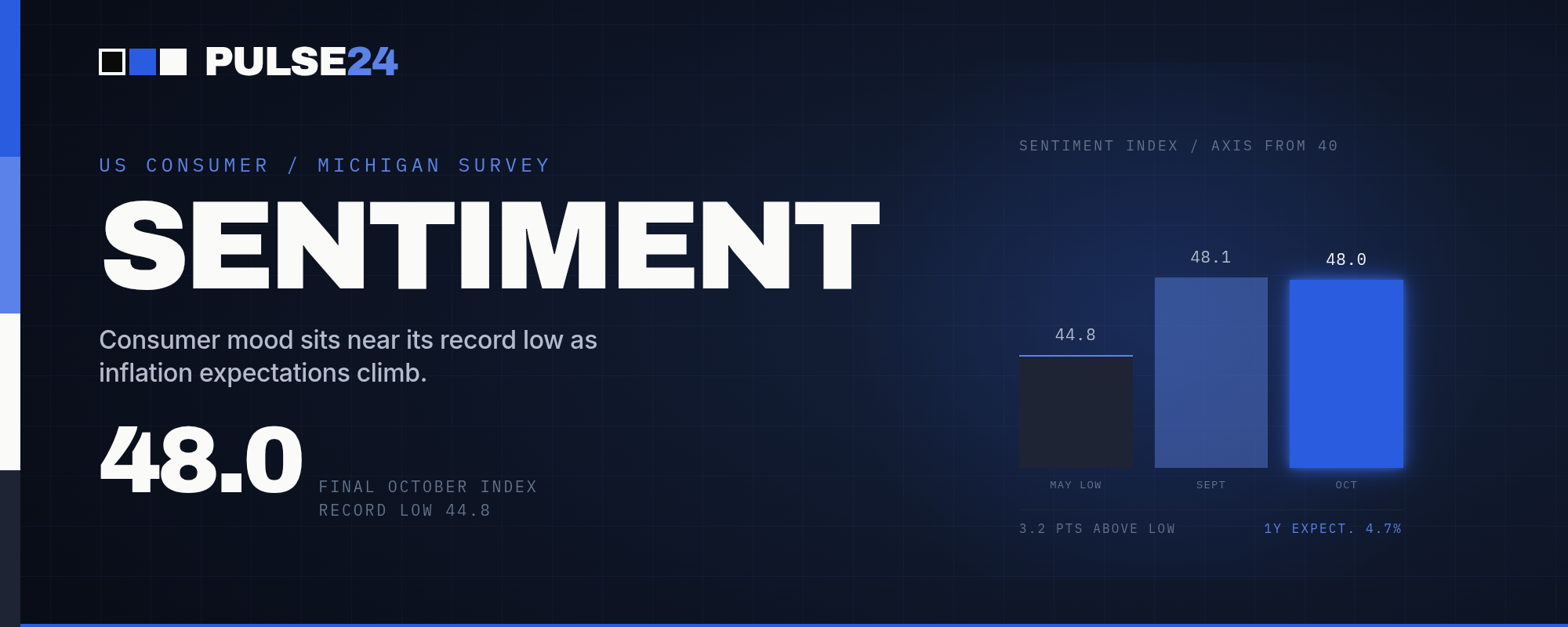
Consumer sentiment is sitting almost exactly where it bottomed out in May, and household inflation expectations just climbed for a second straight month. The gap between that mood and a stock market near its highs matters heading into Wednesday's Fed meeting.
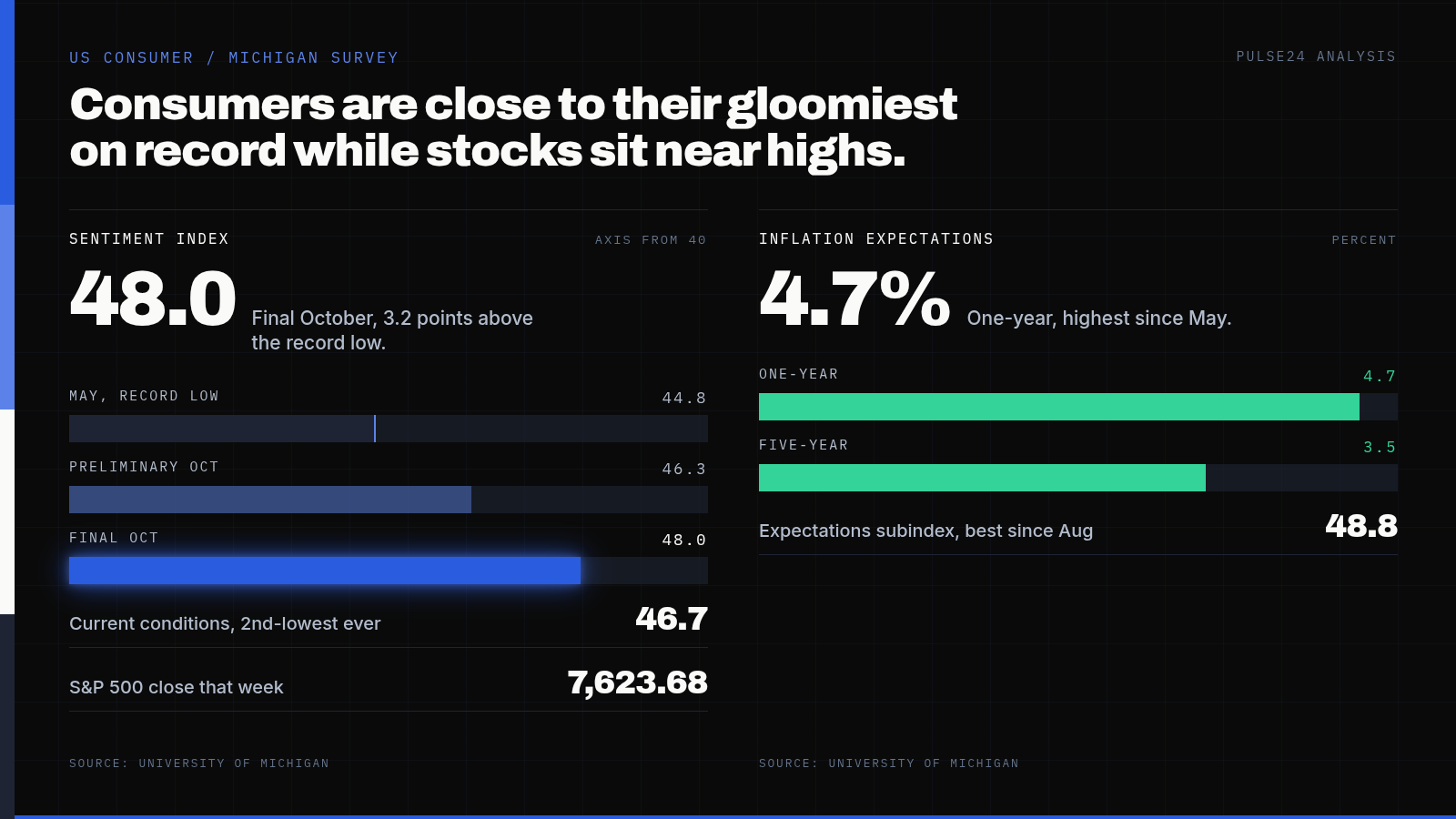
Forty-eight. That is where the University of Michigan's final October consumer sentiment index landed on Friday, a hair above September's 48.1 and just 3.2 points removed from the lowest reading the survey has ever produced. The all-time low, 44.8, came only five months earlier, in May. Economists at JPMorgan and Goldman Sachs had both been bracing for something closer to 46.0, after a preliminary reading of 46.3 two weeks prior, so the final number landed as a modest upside surprise.
What Changed
The headline number hides a split verdict. Current conditions, how households feel about their finances and the economy right now, fell to 46.7, the second-worst reading on record behind only this past May. Expectations for the future actually rose to 48.8, the strongest since August. Consumers, in other words, think today is nearly as bad as it gets, but they are marginally less pessimistic about where things go from here.
Inflation expectations moved the other direction entirely. Households now expect prices to rise 4.7% over the next year, up from a revised 4.6% in September, and 3.5% over the next five to ten years, up from 3.4%. Both measures have now risen for two consecutive months and sit at their highest levels since May. Neither is anywhere near last year's extremes, when one-year expectations peaked at 6.6% in May 2025 and five-year expectations topped out at 4.4% that April, but the direction matters more than the level right now. Economists watch these numbers closely because expectations have a way of becoming self-fulfilling: workers who expect higher prices push for higher wages, and businesses that expect higher costs raise prices preemptively.
Why It Matters
Markets have mostly shrugged off the consumer gloom. The S&P 500 closed Friday at 7,623.68, down just 0.5% for the week, while the Russell 2000 gained 2% over the same five sessions. That gap between a resilient stock market and a demoralized household sector is not new, but it keeps widening, and it tends to resolve in one of two ways. Either consumers eventually catch up to the market's optimism and spending holds in, or the market eventually catches up to the consumer's pessimism and spending slows enough to show up in earnings.
A similar pattern showed up in last month's housing data, where builders cutting prices at a record pace still weren't enough to lift confidence off a 14-year low. Affordability, not availability, is the common thread. Rates have stayed high enough for long enough that big-ticket purchases like homes and cars keep getting pushed out, even when sellers are cutting prices to move inventory.
The rising inflation expectations also feed directly into the Fed's calculus heading into this week's meeting. Wholesale prices already rose at their hottest pace since 2022 last month, and now consumers are bracing for more of the same. A central bank trying to declare victory over inflation has a harder time doing so when the people buying groceries and filling gas tanks do not believe the fight is over.
What to Watch Next
The Fed's rate decision lands Wednesday, October 28, followed a day later by September's PCE and core PCE inflation readings, the Fed's preferred gauge. A hot PCE print paired with rising household inflation expectations would make it harder for policymakers to frame any pause as the start of an easing cycle. November's preliminary sentiment reading, due in two weeks, will show whether this month's inflation anxiety was a blip or the start of something stickier.
Retailers have the most to lose from a sour consumer mood heading into the holiday season. Independents' sentiment fell for a third straight month in October, even as Republicans and Democrats both grew modestly more upbeat, a split that suggests some of the gloom reflects real financial strain rather than purely partisan noise.
The Pulse24 Take
Consumer sentiment surveys get criticized for measuring vibes more than wallets, and there is something to that complaint. People who feel bad about the economy do not always spend like it. But the inflation expectations component is harder to wave away. When one-year and five-year expectations both climb for a second straight month, from a population that lived through the real inflation shock of 2022, that is not noise. It is households updating their forecasts based on what they are actually paying at the register and the pump. Fed officials can look at their own models and see progress. The question going into Wednesday's meeting is whether they can afford to ignore a public that increasingly does not believe the progress will last.
How we read the data
Curious how we get from raw data to a take like this? Our Trader's Toolkit walks through the tools we lean on.
Explore the Toolkit