Pulse24 Original
ServiceNow Fell 27% on an Earnings Beat. Fortinet Fell 20% on One, Too.
October 30, 2026
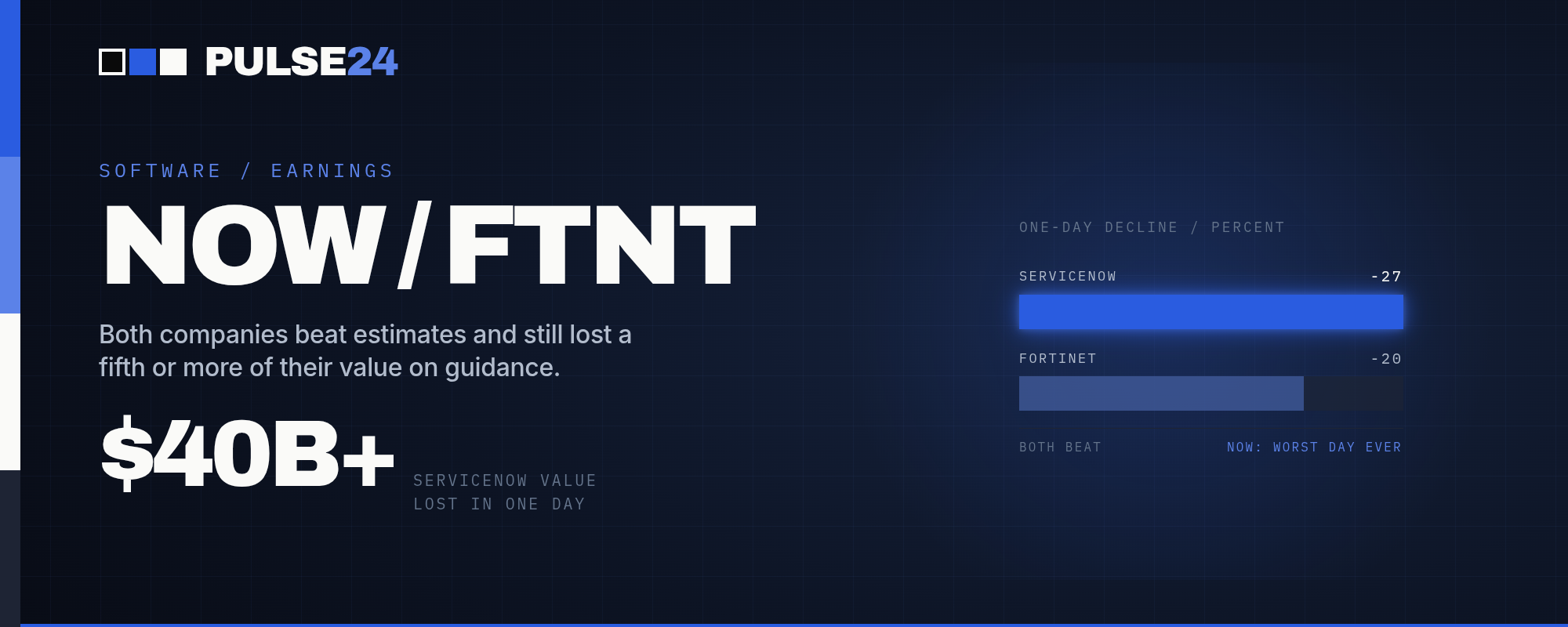
ServiceNow had the worst trading day in its history on Thursday, and it beat Wall Street's revenue estimate. Fortinet beat on revenue, earnings and billings and still dropped 20%, and in both cases the damage came from a few lines of guidance feeding a market-wide fear that AI might be coming for software demand itself.
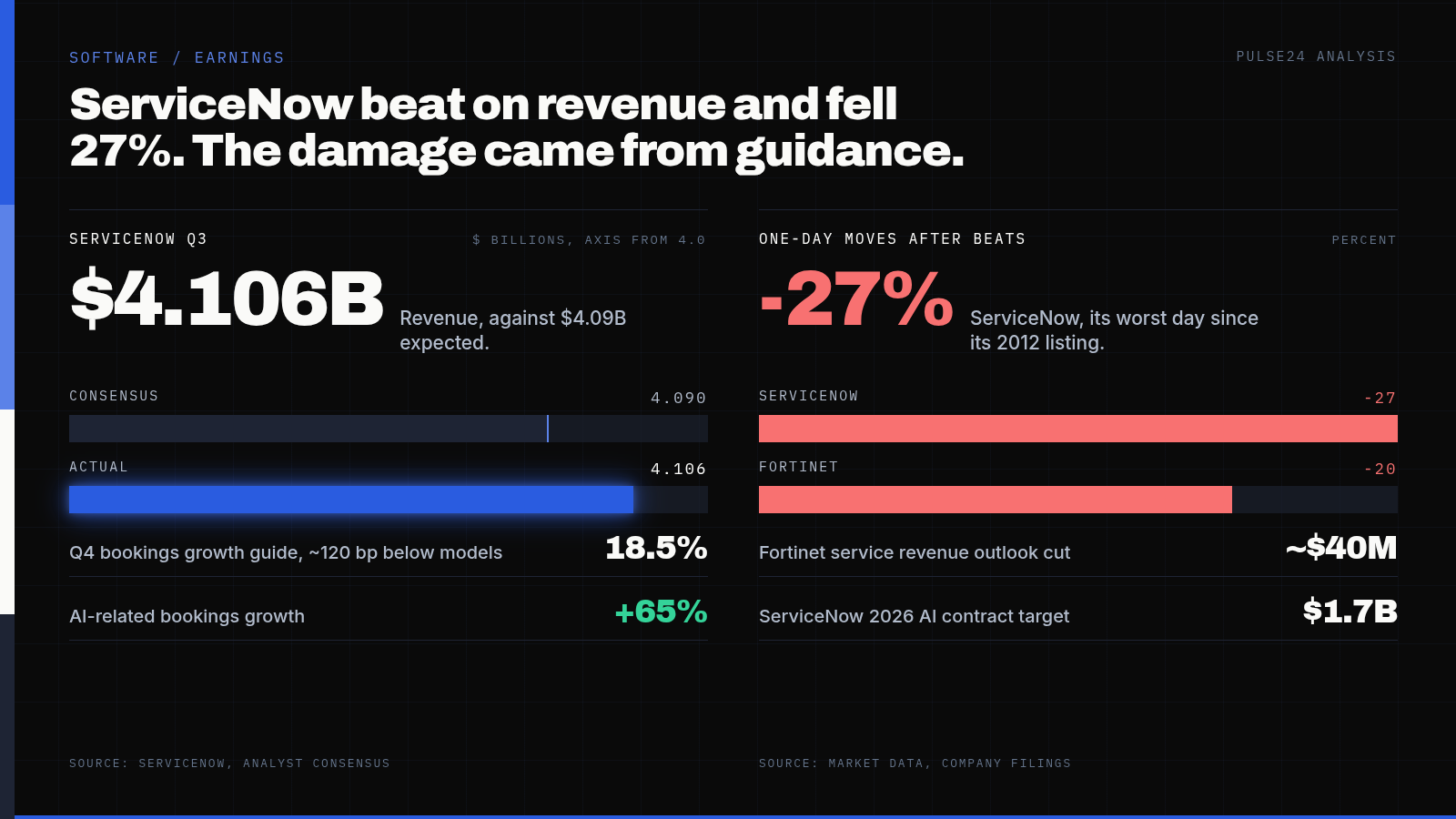
ServiceNow went public in 2012. Thursday was the worst trading day it has had since. Shares fell roughly 27%, closing near $110 and erasing more than $40 billion in market value in a single session, by far the sharpest one-day move in the company's history as a public stock.
The quarter itself held up fine. Revenue came in at $4.106 billion, ahead of the $4.09 billion Wall Street had modeled and up 20.5% from a year earlier. Subscription revenue rose 21%. Adjusted operating margin landed at 32.5%, about a point and a half above expectations. Current remaining performance obligations, the bookings measure investors watch most closely, grew roughly 21% in constant currency in the third quarter, also ahead of plan. None of that explains a drop this size.
What Changed
The damage sat in guidance, not results. ServiceNow pointed fourth-quarter cRPO growth at 18.5%, versus a consensus closer to 19.7%, a gap of about 120 basis points. Adjusted earnings per share came in at $1.00 against an expected $1.02. Free cash flow landed near $822 million, well short of the roughly $963 million analysts anticipated. Management pointed to three technical factors: a batch of contracts renewed earlier than usual in the third quarter, contract clauses that exclude certain revenue from the cRPO calculation, and an accounting change shifting some AI deployment work into professional services, a shift expected to shave about 50 basis points off subscription growth next quarter. Wall Street's price targets split on what to make of it. Citi cut its target to $157 from $170, even as other desks argued the guidance still looked soft once those technical adjustments were stripped out.
Fortinet told a similar story a day earlier. Its adjusted earnings of $0.91 per share beat the $0.85 estimate, revenue of $2.08 billion topped $2.06 billion expected, and total billings rose 29%. Investors sold it down 20% anyway, to around $139, because full-year service revenue guidance slipped to $5.15 billion to $5.17 billion from a prior $5.18 billion to $5.22 billion range, a cut of roughly $40 million at the midpoint against a Street estimate near $5.2 billion. Bloomberg Intelligence read the cut as a sign of lower attach rates on bundled services sold alongside Fortinet's firewalls. The company's finance chief described it instead as a timing issue, with large new customers buying hardware first and layering on services later. The selling spread well beyond Fortinet: Palo Alto Networks slipped about 5%, CrowdStrike fell roughly 4%, and Zscaler and Okta each dropped about 7%, even though none of them had reported a thing that day.
Why It Matters
Two fears are loose in software stocks right now, and they contradict each other. One says AI agents and coding tools are starting to erode demand for the licensed software sitting on top of enterprise workflows, the fear that hit ServiceNow and, by extension, Salesforce, Adobe and other subscription names. The other says the hyperscalers and infrastructure companies pouring hundreds of billions into AI data centers are overbuilding, a worry that showed up a day earlier in Microsoft and Alphabet's capital spending reaction. J.P. Morgan's private bank diagnosed this same contradiction back in February, during an earlier software selloff, calling it "broken logic" because software cannot be dying from AI disruption at the same moment AI infrastructure is dying from overinvestment. Eight months later, both stories are getting priced into the same stocks again, which is less a forecast than a market that has stopped waiting to find out which fear is real before selling.
The numbers inside ServiceNow's own results cut against the disruption story it got punished for. AI-related net new annual contract value grew 65% year over year, and management raised its 2026 AI contract value target to $1.7 billion, up from $1 billion at the start of the year. That is a company getting paid more, not less, for AI work, even as its stock priced in the opposite. It is also not an isolated pattern this earnings season. CoreWeave and Nebius both fell sharply on weeks when neither missed on earnings, and Netflix watched its stock fall almost as much as its profit beat over a guidance gap measured in tens of millions of dollars. Across several unrelated sectors, the market has been punishing the gap between a guide and a forecast far more than it rewards the quarter that was actually delivered.
What to Watch Next
More software earnings are still due this quarter, and each one will now be read as a referendum on whether cRPO deceleration is company-specific or sector-wide. Hedge fund positioning in the group is worth tracking too: a sell-off this sharp, spread across firewalls, identity management and workflow software at once, usually reflects crowded longs unwinding as much as it reflects new information about demand. On the macro side, San Francisco Fed President Mary Daly and St. Louis Fed President Alberto Musalem are both scheduled to speak Friday, and their tone on the path for rates matters more than usual with risk appetite already thin in software and the broader growth and inflation picture from Thursday still being digested. A bounce in beaten-down names like ServiceNow and Fortinet over the next week would suggest Thursday was a positioning flush. A continued slide would suggest investors are genuinely repricing what AI does to recurring software revenue, not just trimming exposure after a good run.
The Pulse24 Take
The quarters ServiceNow and Fortinet reported were good by almost any normal measure, and the market punished both anyway over single-digit percentage gaps in forward guidance. That asymmetry is the real story here, more than any one company's bookings math. When a sector starts getting marked down on good results because of what might happen to demand two or three years out, that's a market pricing a structural fear, not a quarterly disappointment, and structural fears take quarters, not days, to confirm or disprove. The AI-disruption and AI-overbuild narratives can't both be the dominant story at once, which is exactly the kind of tension worth sitting with rather than trading around on a single afternoon's price action. Investors chasing Thursday's move in either direction, buying the dip on the belief AI fears are overblown or shorting the group on the belief this is the start of something bigger, are both making a bet the next two quarters of earnings haven't actually confirmed yet.
How we read the data
Curious how we get from raw data to a take like this? Our Trader's Toolkit walks through the tools we lean on.
Explore the Toolkit