Pulse24 Original
Netflix's Profit Beat Estimates by 6%. Its Stock Fell Nearly as Much Over a $70 Million Guidance Gap.
October 21, 2026
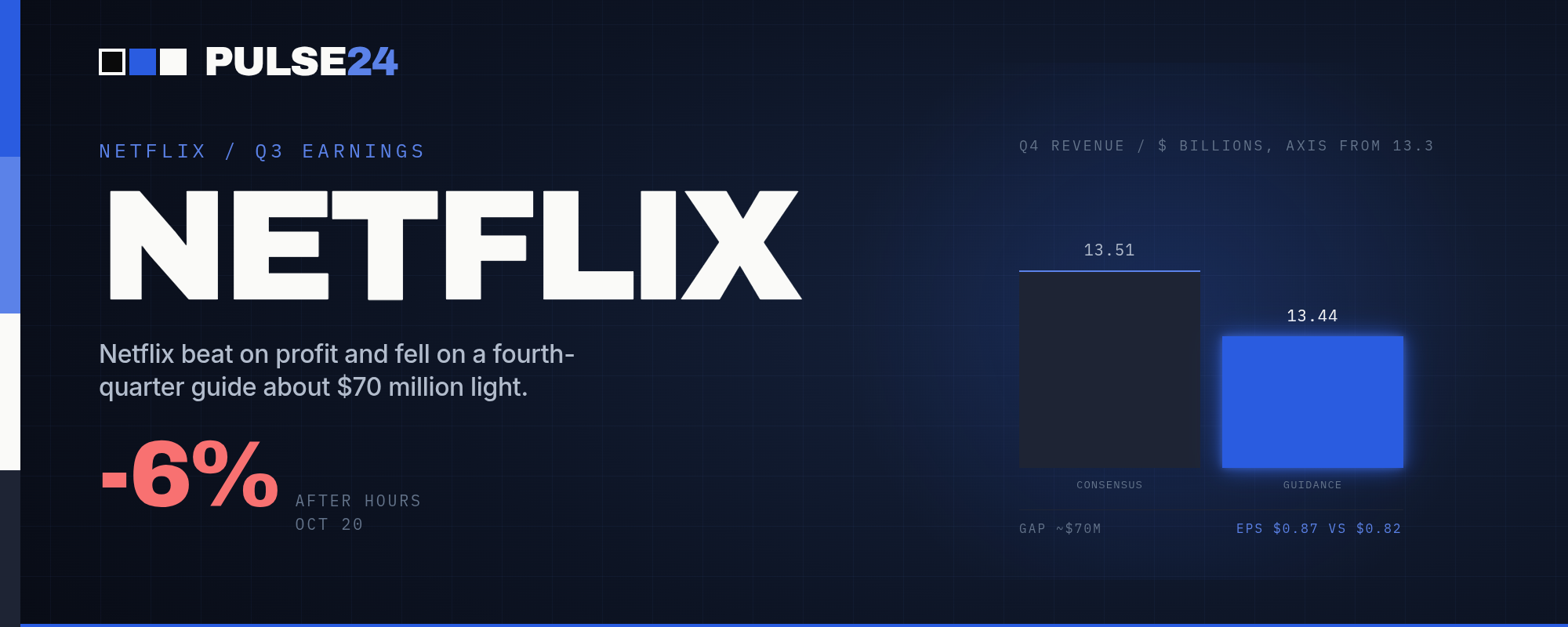
Netflix beat Wall Street's profit estimates but still sold off nearly 6% after guiding fourth-quarter revenue about $70 million below consensus. The reaction says as much about elevated rates and stretched valuations as it does about Netflix's own slowing growth.
Netflix earned five cents more per share than Wall Street expected on Tuesday. Investors sold the stock anyway, sending it down nearly 6% in after-hours trading once the company's fourth-quarter revenue forecast came in about $70 million light of consensus. The reaction looked disproportionate next to the actual numbers. Revenue of $12.87 billion was in line with estimates, up nearly 12% from a year earlier, and operating margin expanded to 34.6% from 28.2%. None of that mattered once management guided fourth-quarter revenue to $13.44 billion, a shade under the $13.51 billion analysts had modeled.
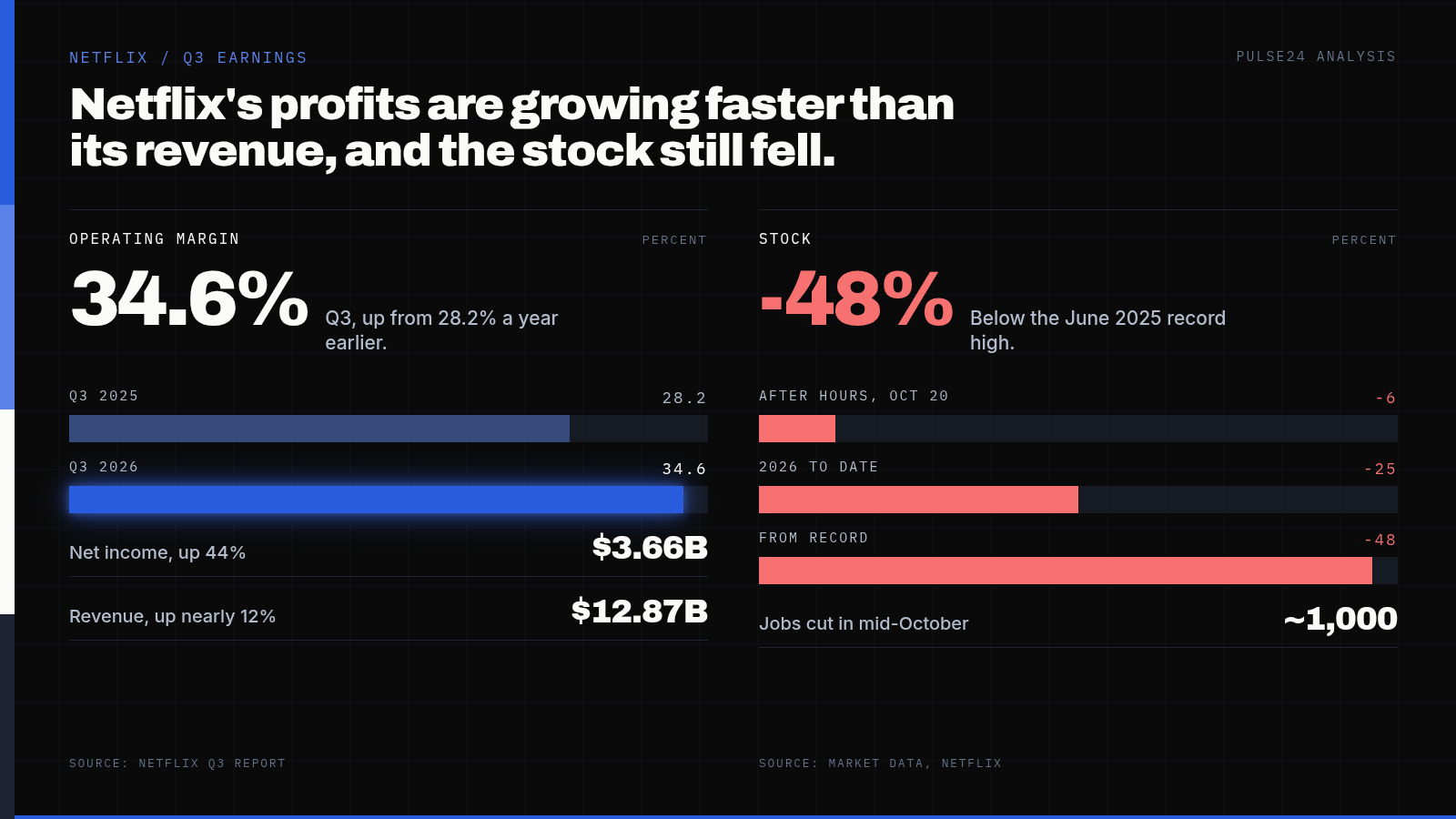
What Changed Netflix's Q3 2026 report landed after the closing bell Tuesday, closing out a quarter where profit outpaced forecasts across nearly every line. Net income climbed 44% to $3.66 billion. Free cash flow came in at $2.88 billion, and the company used some of it to retire 63.9 million shares for $4.8 billion, leaving $22.3 billion still authorized for buybacks it hasn't spent yet.
The problem showed up in the forecast, not the results. Fourth-quarter revenue guidance of $13.44 billion came in below the $13.51 billion Wall Street wanted, a gap of roughly $70 million, or about half a percentage point. Operating margin guidance for the quarter, 26% versus 24.5% a year ago, was still an improvement. The shortfall was small in dollar terms but large enough to reset how investors are pricing Netflix's growth trajectory.
The guidance didn't arrive in isolation. Earlier in October, Netflix cut about 1,000 jobs, 6% of its global workforce, its deepest round of cuts since 2022, and replaced longtime content chief Bela Bajaria with Peter Rice, the former Disney television executive. Management framed both moves as a response to intensifying competition for viewers' attention rather than a sign anything was broken internally, but the timing, just days before an underwhelming revenue forecast, made the moves read differently to some investors.
Shares had already closed Tuesday's regular session down 1.66% at $68.69, before the earnings landed. Once the numbers came out, Netflix fell another 5.8% in after-hours trading to $64.69. That extends a rough year for the stock, now down roughly 25% in 2026 and about 48% below the record high it set in June 2025.
Why It Matters Wall Street's read leaned less on the quarter itself and more on what it signals about where growth comes from next. Bloomberg Intelligence analyst Geetha Ranganathan described the outlook as evidence of "a slowing growth algorithm," a way of saying the easy gains from price increases and global subscriber additions are running out. Piper Sandler's Tom Champion pointed to a more specific culprit: viewers, especially younger ones, are spending more of their attention on short-form video from TikTok, Instagram Reels, and YouTube, platforms Netflix doesn't compete in directly. Netflix also lost a bidding war to Paramount for Warner Bros. Discovery earlier this year, closing off one path to buying its way into more content supply.
Context matters here as much as Netflix's own numbers do. The 10-year Treasury yield closed at 5.15% this week, up from the mid-4% range it held through much of the year, and higher long-term rates raise the bar for any stock still priced for rapid growth. The S&P 500 is trading near its second-priciest valuation in 145 years, which leaves less room for a company like Netflix to disappoint on a single forward-looking number, even when the quarter that just ended beat estimates comfortably.
Netflix isn't a pure AI-capex story the way some of this year's other high-multiple selloffs have been, but it rhymes with them. A richly valued company posts solid numbers, guides only slightly below an aggressive consensus, and still gets sold off. That pattern has surfaced across growth stocks this earnings season, and it tends to appear more often once the risk-free rate sits comfortably above 5%.
What to Watch Next The next real test for Netflix is whether Peter Rice's content slate can reverse the engagement slide analysts are describing, and whether the company's advertising business, guided to roughly $2.7 billion in 2026 revenue, below the roughly $3 billion it had previously targeted, can pick up the slack from slowing subscriber growth. Management's decision to stop publishing detailed viewing-hours data starting in 2027 will make that harder to track from the outside, which itself may become a point of friction with investors who are already nervous about growth.
More broadly, Netflix's reaction is worth watching as a signal for how the market treats the rest of this earnings season. With Tesla scheduled to report Wednesday and more large-cap earnings due across the rest of this week, a market already sensitive to valuation and higher rates may keep punishing good-but-not-great guidance more harshly than it would have a year ago.
The Pulse24 Take A profit beat that still gets sold off says less about the number itself than about where investor expectations have drifted. Netflix delivered a genuinely strong quarter by almost any traditional measure, yet the stock still fell because the forecast implied growth is decelerating at a company still priced for the opposite.
The more interesting question is whether Netflix is a one-off story about streaming competition, or an early read on how markets will treat richly valued stocks generally as rates stay elevated and valuations sit near historic extremes. Watch whether other growth names get the same treatment this earnings season before concluding this is just a Netflix problem.
How we read the data
Curious how we get from raw data to a take like this? Our Trader's Toolkit walks through the tools we lean on.
Explore the Toolkit