Pulse24 Original
China's AI Stocks Erased $480 Billion in Four Months. Nasdaq's Own AI Trade Is Down 6% From Its Record.
October 28, 2026
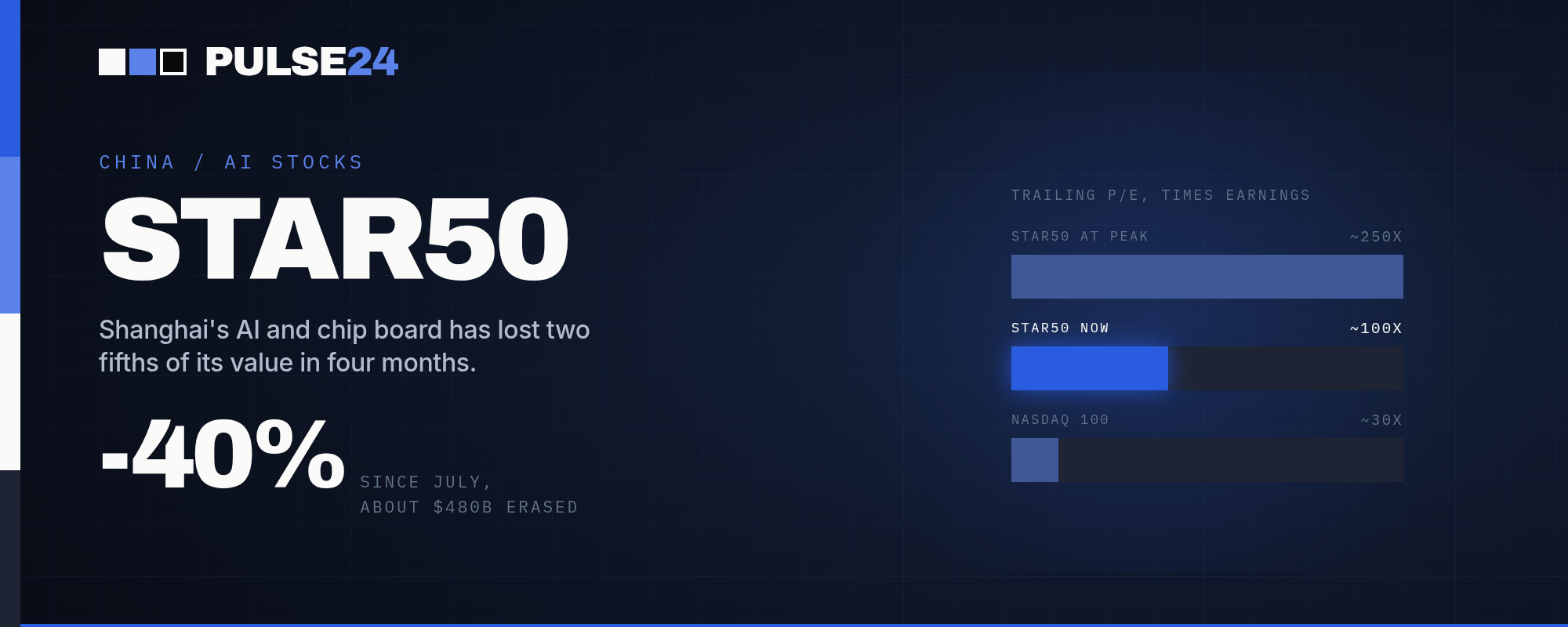
China's STAR50 index has lost 40% of its value since July, wiping out roughly $480 billion as its most hyped AI and chip stocks come back to earth. The selloff raises an uncomfortable question for Wall Street: how much of America's own AI rally rests on a similar story.
$480 billion. That's roughly how much has vanished from China's STAR50 index since July, as the Shanghai exchange's answer to a Nasdaq style tech board fell 40% in under four months. Dong Baozhen, a Beijing based fund manager, put it bluntly to Reuters this week. "And now we see the bubble bursting," he said.
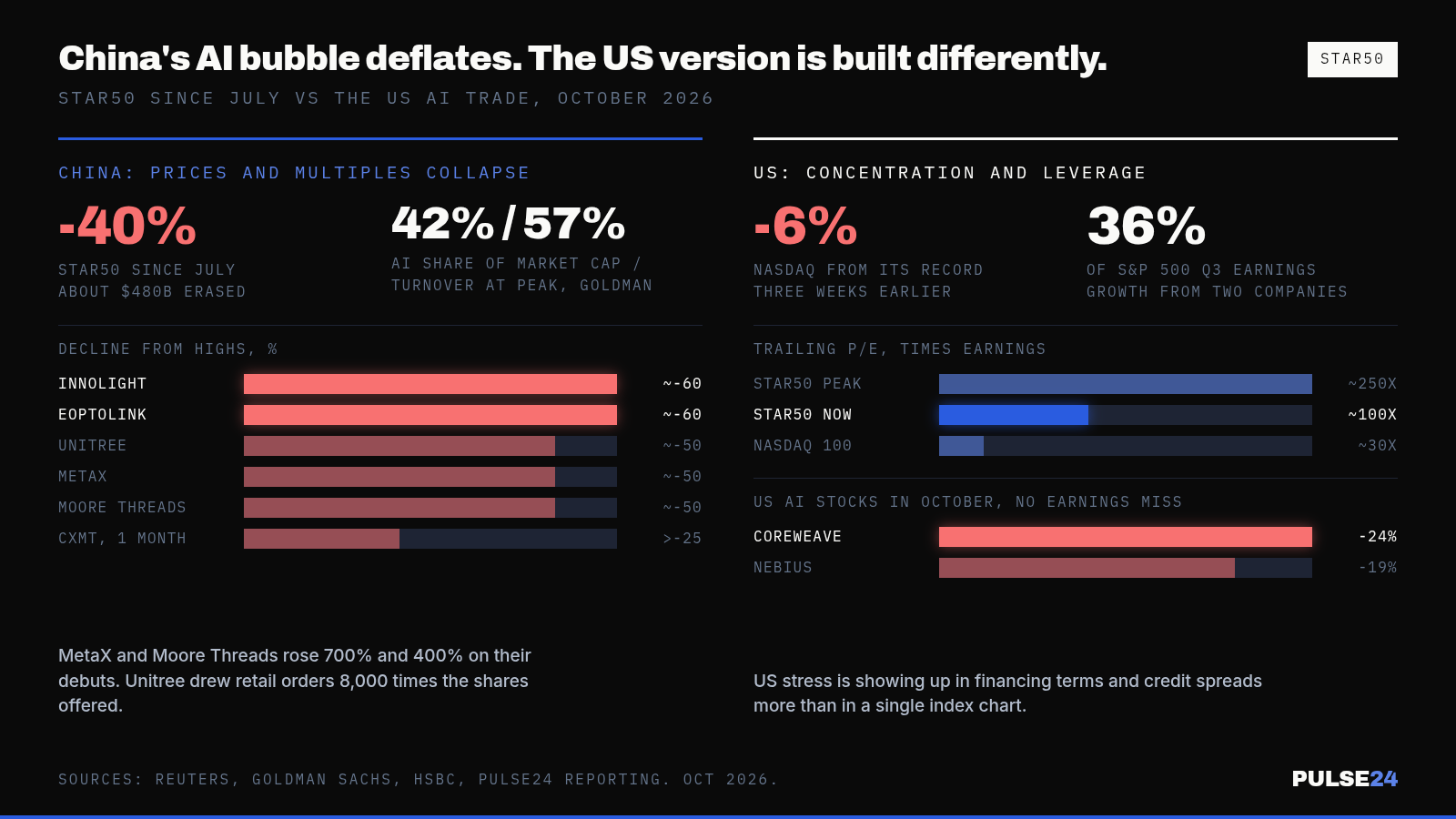
He isn't alone in that read, and the numbers back him up more than most hot takes do. The STAR50 became the proving ground for China's AI ambitions over the past year, and retail money piled into anything connected to robotics, chips, or AI software. Unitree, the robot maker that listed in August, drew retail order books 8,000 times larger than the shares on offer before its first trade. The stock has since been cut in half.
What Changed
Valuation is where this story gets concrete. The average stock on the STAR50 traded at close to 250 times trailing earnings near its peak this year. It now trades closer to 100 times, still rich by almost any standard, but a collapse of more than half from where it stood a few months ago. Goldman Sachs estimated that AI related companies accounted for 42% of combined market capitalization across mainland A-shares and Hong Kong H-shares at the top, and 57% of trading turnover, meaning more than half of all the buying and selling in those markets was happening in a narrow slice of stocks.
The individual names tell the same story with more texture. CXMT, a memory chipmaker, is down more than a quarter in the past month alone. MetaX Integrated Circuits and Moore Threads Technology, two chip designers that rose 700% and 400% respectively on their market debuts last year, have both given back roughly half their value since July. Zhongji Innolight and Eoptolink, which make optical components for data centers, have fallen about 60% from their June and July highs, a decline sharpened by reports that Washington is moving toward restricting their ability to supply US data center customers.
Not everyone treats this as a straightforward unwind. Hong Hao, managing partner and CIO at Lotus Asset Management in Hong Kong, said the selloff will likely freeze many companies' listing plans for a while. Leo Wang, a partner at Beijing's Qianchuang Capital, pointed to how China's major indexes weight companies by market value: overemphasizing "technology content" that way, he argued, created a severe bubble in certain sectors and a serious drain on capital elsewhere. Wang Zhuo of Shanghai Zhuozhu Investment Management offered the shorter version: all bubbles inevitably burst. Meanwhile Goldman Sachs published an updated recommendation list earlier this month that still includes Innolight and CXMT, and HSBC research notes that Asia funds have been net sellers of the group over the past three months while remaining overweight China overall. Conviction and caution are sitting side by side here, not replacing each other.
Why It Matters
The obvious question for anyone watching from outside China is whether the same setup exists in the US AI trade, and the honest answer is: partially. No real American equivalent to a 100 times earnings multiple exists among large AI-linked names right now. Nasdaq 100 stocks trade closer to 30 times, a fraction of what mainland retail investors were paying for Unitree or Moore Threads. That gap matters. Multiple compression from 250 times to 100 times is a different kind of event than multiple compression from 30 times to 25 times, even if both get described as an "AI selloff" in headlines.
What does translate is the concentration problem. More than a third of the S&P 500's entire third quarter earnings growth came from just two companies, and the index's top 15 stocks are now more concentrated than they were at the 2000 peak. China's market got top heavy on AI enthusiasm; America's got there through genuine earnings growth concentrated in a handful of names. Different paths, similar vulnerability: when so much of an index's return depends on so few stocks, a wobble in any one of them moves the whole market more than it used to.
Leverage is the other shared thread. CoreWeave fell 24% and Nebius fell 19% this month without either company missing on earnings, a sign that investors are repricing the risk in AI infrastructure financing rather than reacting to actual results. Broadcom's own $63 billion financing deal for Anthropic's chip buildout reportedly needed last minute concessions before nervous banks would stay in it, and that kind of friction tends to show up before a market correction, not after one. China's bubble burst mostly in equity prices because so much of the buildout there was funded by retail stock buying. The US version is more leveraged and more institutional, which could mean it moves slower, or it could just mean the stress shows up somewhere other than the stock chart first.
Bitcoin is one place that stress has already shown up. It broke below its 50-day moving average for the first time since August right after its ETFs logged their worst outflow since June, and this week's China headlines gave it another reason to stay soft even as broader risk assets wobbled. That cross-asset reaction, a crypto market trading on AI valuation headlines out of Shanghai, is itself a small data point about how tightly the AI trade and broader risk sentiment have become linked.
What to Watch Next
The Fed's rate decision lands Wednesday afternoon, with Microsoft, Alphabet, and Amazon all reporting earnings in the same 48 hour window. None of those events are about China's chip stocks directly, but all of them will shape how much appetite investors have left for paying up for AI exposure anywhere in the world. A dovish Fed and strong hyperscaler capex guidance could let US valuations keep drifting higher even as China's unwind continues. Soft guidance from any of the three, paired with a hawkish surprise from Powell, could turn "China's bubble popped" into "the AI trade's multiple compression," full stop, no geography attached.
Watch China's regulators too. The China Securities Regulatory Commission has stayed quiet publicly, but its chairman met with market participants earlier this month, before this latest leg down. If Beijing moves to support listings or cool retail speculation through policy rather than letting prices find their own level, that would say something about how much political weight is riding on the AI buildout staying a success story domestically.
The Pulse24 Take
It's tempting to read China's STAR50 collapse as a preview of what's coming for Nvidia, Microsoft, and the rest of the US AI complex. The valuation math doesn't support that read cleanly. A market that fell from 250 times earnings to 100 times earnings was pricing something closer to pure speculation than anything trading in the S&P 500 or Nasdaq 100 today. What the math does support is a narrower, more useful lesson: markets that get this concentrated in one theme, whether through retail mania or institutional capital spending, eventually have to answer for how much of that enthusiasm was backed by cash flow versus narrative. China's answer came fast and showed up in equity prices. America's version of that reckoning, if it comes, is more likely to show up first in credit spreads, financing terms, and guidance calls than in a single index falling 40% in a quarter. The STAR50 chart is a warning about what happens when a market runs out of greater fools. It isn't yet evidence that America's AI trade has.
How we read the data
Curious how we get from raw data to a take like this? Our Trader's Toolkit walks through the tools we lean on.
Explore the Toolkit