Pulse24 Original
Bitcoin Is Down 4% in October. The Last Time It Had Two Losing Octobers in a Row Was More Than a Decade Ago.
October 29, 2026
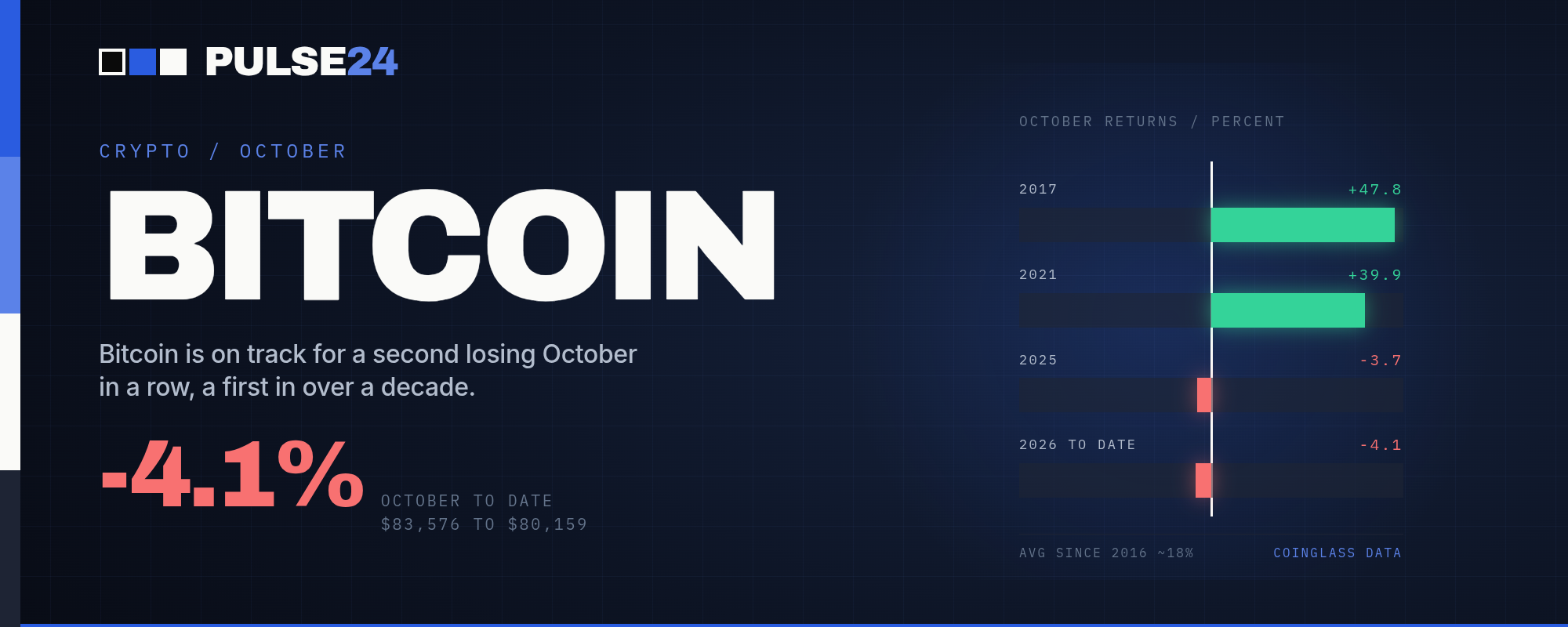
Bitcoin is on track for its second losing October in a row, something that hasn't happened in more than ten years. The real story is how much better it's holding up than everything else in crypto this month.
Bitcoin opened October at $83,576. With two trading days left in the month, it's sitting at $80,159, a loss of $3,417 that puts October down 4.1%. Small by Bitcoin's standards. But it's enough to make this the second losing October in a row, and CoinGlass data shows Bitcoin hasn't managed that unwanted feat in more than ten years.
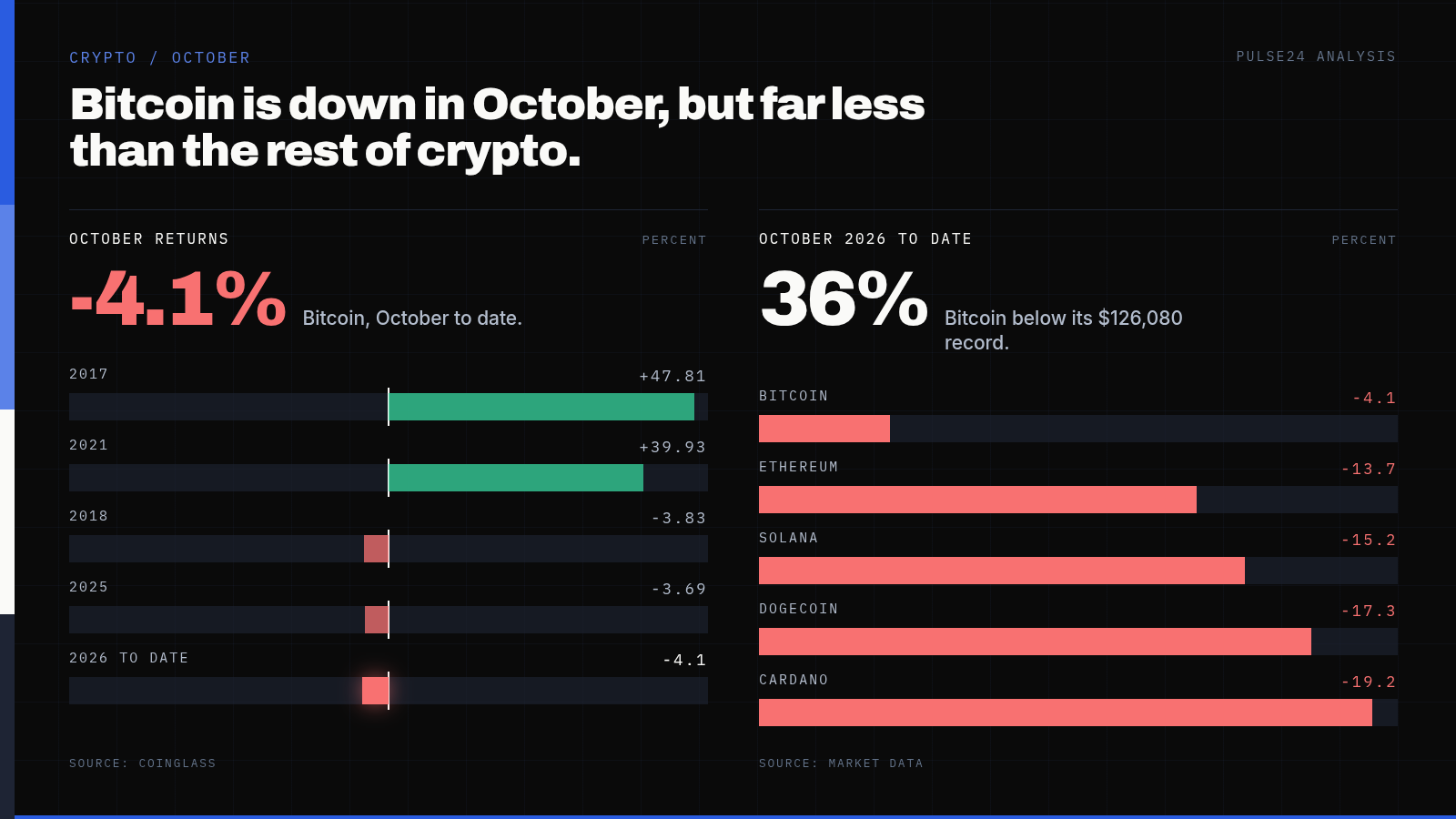
October earned its nickname in crypto circles for a reason. Since 2016, the average October return has run near 18%, with gains of 47.81% in 2017 and 39.93% in 2021 anchoring the pattern traders call Uptober. Red Octobers were rare enough to count on one hand: 2014, then a 3.83% dip in 2018. Last year broke the streak too, closing down 3.69% after an all-time high of $126,080 early in the month gave way to an October 10 crash. This year is on track to make it two losses running.
What Changed
The timing lines up with Wednesday's Fed decision. Policymakers held the fed funds rate at 3.75% to 4% in a 10-2 vote, with two officials pushing for an immediate hike instead of a hold. Bitcoin had dipped below $80,000 on Monday for the first time in more than a week as traders priced in tighter policy, then climbed back above $81,000 once the decision landed roughly as expected. CME FedWatch data showed traders assigning an 86% probability to a December hike by Wednesday afternoon, up from 78% the day before and 76% a week earlier. Chair Kevin Warsh said more data would shape the next move, which traders read as leaving December genuinely open rather than settled either way.
That combination, a hold that removes immediate shock risk while hike odds keep climbing, explains why Bitcoin's bounce has been shallow rather than explosive. The coin spent the week trading in a tight band between roughly $79,000 support and $81,700 resistance, with its 50-day moving average near $80,800 sitting almost on top of its 20-day average near $81,843. That kind of compression followed one of the quietest stretches in Bitcoin's price chart in two and a half years, and this month's chop looks more like the release of that pressure than a fresh breakdown.
The more revealing number this month comes from everyone else. Ethereum is down 13.7%, Solana and Shiba Inu are each off 15.2%, XRP has lost 13.1%, Dogecoin is down 17.3%, and Cardano leads the group at 19.2%. Average those six coins together and they're down nearly 15.6% in October, close to four times Bitcoin's drop. Spot Bitcoin ETFs still pulled in more than $1 billion of inflows even as the price fell below $81,000 earlier this month, a sign institutional buyers kept showing up through the chop while retail-heavy altcoins took the brunt of the selling.
Why It Matters
A second red October matters less as a superstition and more as a signal about what's driving price right now. Bitcoin's seasonal pattern was never really about the calendar. It tracked a market that spent most years rallying into year-end on fresh inflows and improving liquidity. This year the liquidity backdrop is the opposite: the Fed just reinforced a hawkish lean, the dollar firmed slightly on the decision, and gold itself slipped toward $4,035 to $4,068 an ounce as rate-hike expectations built. When the asset that's supposed to benefit most from falling rates instead has to fight rising hike odds, a flat-to-down month is the realistic outcome, not a crash and not a rally.
The gap between Bitcoin and altcoins also reinforces a theme that's been building since the summer: capital rotating toward Bitcoin as the comparatively steadier crypto asset while speculative tokens absorb the bulk of any drawdown. Bitcoin breaking below its 50-day average for the first time since August, while its ETFs logged their worst single-day outflow since June, looked alarming at the time. Two months later, it's produced a milder loss than almost anything else in the asset class.
What to Watch Next
Two trading days remain before October closes, enough for a swing in either direction given Bitcoin's history of late-month moves. Galaxy Digital's head of research, Alex Thorn, told clients this week that the firm views the current chop as an accumulation phase that has preceded every prior advance, dating the bear market's actual bottom to June, when Bitcoin traded near $58,000. Bitwise puts that drawdown from last October's peak at 53%, far shallower than prior bear markets that wiped out 77% or more, and raised its 2036 Bitcoin price forecast to $1.6 million from $1.3 million on the back of that read.
None of that guarantees a particular outcome for the next 48 hours. Watch the $79,000 to $80,000 support band: a clean break below it would argue against the accumulation thesis, while a reclaim of $81,700 resistance would support it. Worth tracking too is whether December's Fed hike odds keep climbing from here, since that single number has done more to explain Bitcoin's month than any crypto-specific headline.
The Pulse24 Take
Calling this a crash would be wrong, and calling it healthy consolidation would be generous. The honest read sits in between: Bitcoin is absorbing tighter policy expectations better than every other major crypto asset, which is itself useful information about where institutional money wants to be positioned heading into year-end. On its own, a 4% monthly loss wouldn't make much of a headline. What makes it worth one is the gap: Bitcoin's decline sits at roughly a quarter the size of the rest of the market's, in the same week the Fed kept hike odds climbing. Whether that makes Bitcoin the safe harbor in this market or just the last domino left to fall is the question investors will answer with their December positioning, not their October one.
How we read the data
Curious how we get from raw data to a take like this? Our Trader's Toolkit walks through the tools we lean on.
Explore the Toolkit