Pulse24 Original
Spot Bitcoin ETFs Took In Over $1 Billion This Week. The Price Fell Below $81,000 Anyway.
October 23, 2026
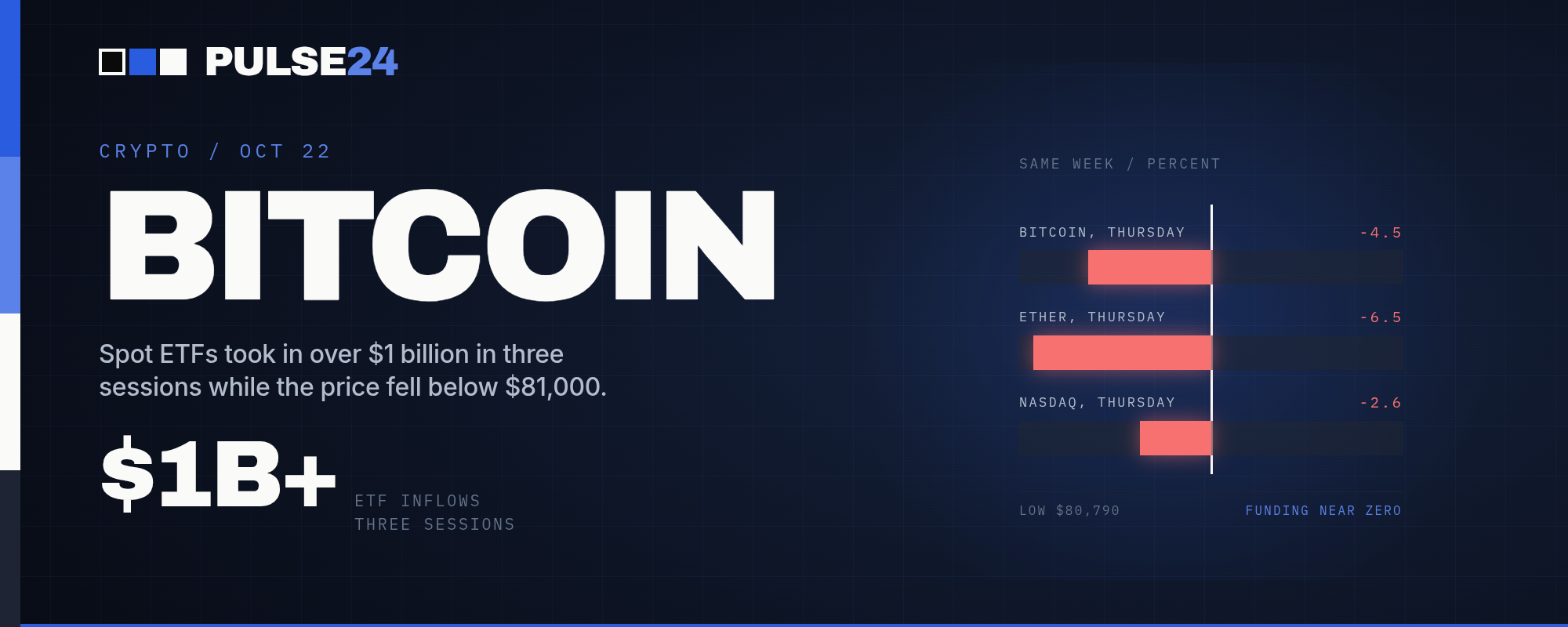
Spot bitcoin ETFs pulled in just over a billion dollars this week even as the price dropped more than 4% in a single session. The split between who's buying and who's being forced to sell says more about market structure than about where bitcoin goes next.
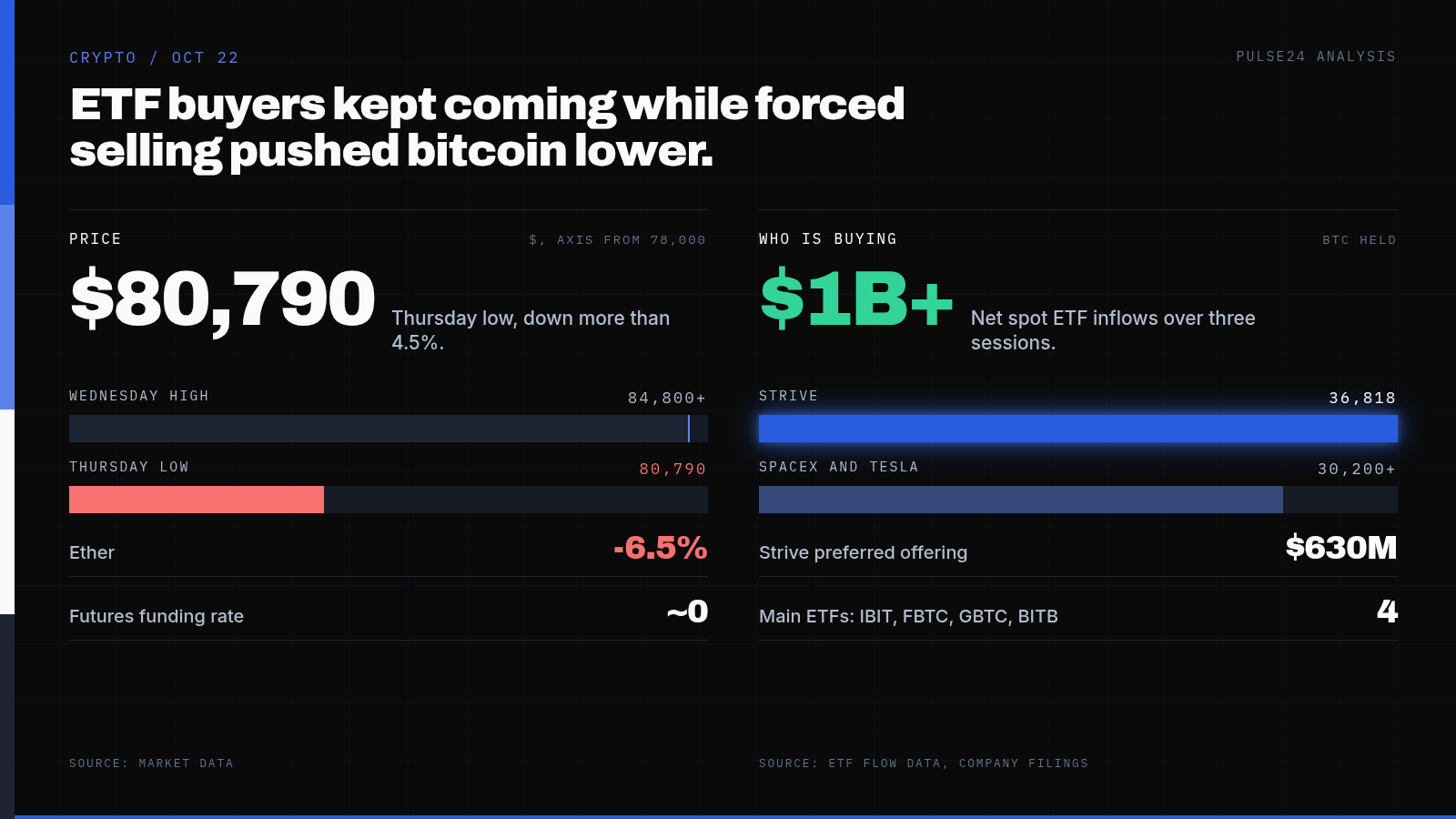
Bitcoin fell more than 4.5% on Thursday, dropping as low as $80,789.61 after trading above $84,800 just a day earlier. Over the same stretch, spot bitcoin ETFs pulled in just over $1 billion across three sessions, with BlackRock's IBIT, Fidelity's FBTC, Grayscale's GBTC and Bitwise's BITB absorbing most of it. Price and fund flows moved in opposite directions that week, and the gap between them says more about who's trading bitcoin right now than about where it's headed next.
What Changed
Thursday's drop arrived inside a broader selloff that had little to do with crypto on its own terms. The S&P 500 closed down 1.2% and the Nasdaq Composite fell 2.6% after Meta's earnings reignited doubts about AI spending, with Tesla's results adding to the unease even though Tesla itself trimmed its 2026 spending plans. Ether fell harder than bitcoin, down roughly 6.5% to about $2,357, which fits a pattern that's held for most of 2026: bitcoin increasingly trades like a high-beta tech stock rather than the uncorrelated asset its earliest backers promised.
Rising oil prices added a second layer of pressure, feeding worries that inflation could stay stickier than markets hoped. Neither of those forces was new information by Thursday afternoon. What turned an ordinary risk-off day into a sharper move was positioning. Bitcoin's push above $84,800 a day earlier had drawn in leveraged long bets, and when that rally gave way, exchanges liquidated those positions automatically. A Nexo analyst pointed out that total options open interest, measured in dollars, barely moved even as trading volume spiked, meaning the number of open contracts held roughly steady. The selling clustered hard and fast rather than spreading evenly across the market.
Why It Matters
The ETF inflows complicate the simple version of this story. If Thursday's drop reflected investors souring on bitcoin broadly, fund flows should have turned negative too. They didn't. Monday brought in about $526 million, Wednesday added roughly $528 million, and the only quiet day was Tuesday at $23 million. ETF buyers, most of them institutions working through brokerage accounts, kept adding on a pace that doesn't bend to one rough afternoon. The sellers pushing the price down were short-term and leveraged, forced out mechanically rather than walking away by choice. Both groups were active in the same market during the same week, and only one of them showed up in Thursday's candle.
There's a liquidity signal tucked inside the derivatives data too. Implied volatility stayed near its 2026 lows through the drop, and funding rates sat close to zero rather than spiking negative. Panic-driven selloffs usually push volatility up fast; this one didn't, which fits a market clearing out one side of a crowded trade rather than losing conviction broadly. Puts still cost more than calls at short maturities on Deribit, which traders read as hedging demand rather than a fresh bet that prices keep falling from here.
What to Watch Next
A few things will decide whether Thursday was a blip or the start of something worse. Oil prices are one, since further gains there would keep inflation fears alive and pressure every rate-sensitive asset, bitcoin included. The Federal Reserve's meeting on October 28 is another; futures markets are leaning toward a hold there, with a December hike back in the conversation among forecasters. The simplest signal, though, is whether ETF buyers keep showing up next week. JPMorgan Asset Management has argued bitcoin can outperform stocks, bonds and gold over the long run, projecting roughly 10% annualized growth, while cautioning that volatility like Thursday's is exactly what scares off investors who can't sit through it.
Corporate treasuries are adding their own signal to watch. Strive raised more than $600 million this week through a stock sale earmarked for buying more bitcoin, pushing its total holdings to 36,818 BTC. SpaceX and Tesla together hold more than 30,200 BTC on their balance sheets. None of these buyers are reacting to a single afternoon of trading, and that's part of why the gap between price and flows is worth tracking rather than dismissing.
The Pulse24 Take
A falling price paired with rising inflows looks like a contradiction until you remember they're running on different clocks. Leveraged traders react within hours, and exchanges don't wait for them to reconsider before liquidating. ETF allocators tend to work in weeks and months, and a billion dollars moving into spot funds over three sessions doesn't reverse because of one bad Thursday. What matters more than bitcoin's next direction is whether the demand showing up in ETF flows can keep absorbing the next round of forced selling, whenever that comes. Oil prices and next week's Fed meeting will likely say more about that than anything in bitcoin's own chart.
How we read the data
Curious how we get from raw data to a take like this? Our Trader's Toolkit walks through the tools we lean on.
Explore the Toolkit