Pulse24 Original
October Fed Hike Odds Fell From 30% to 15% Overnight. Bitcoin Barely Moved, But Celestia Jumped 16%.
October 17, 2026
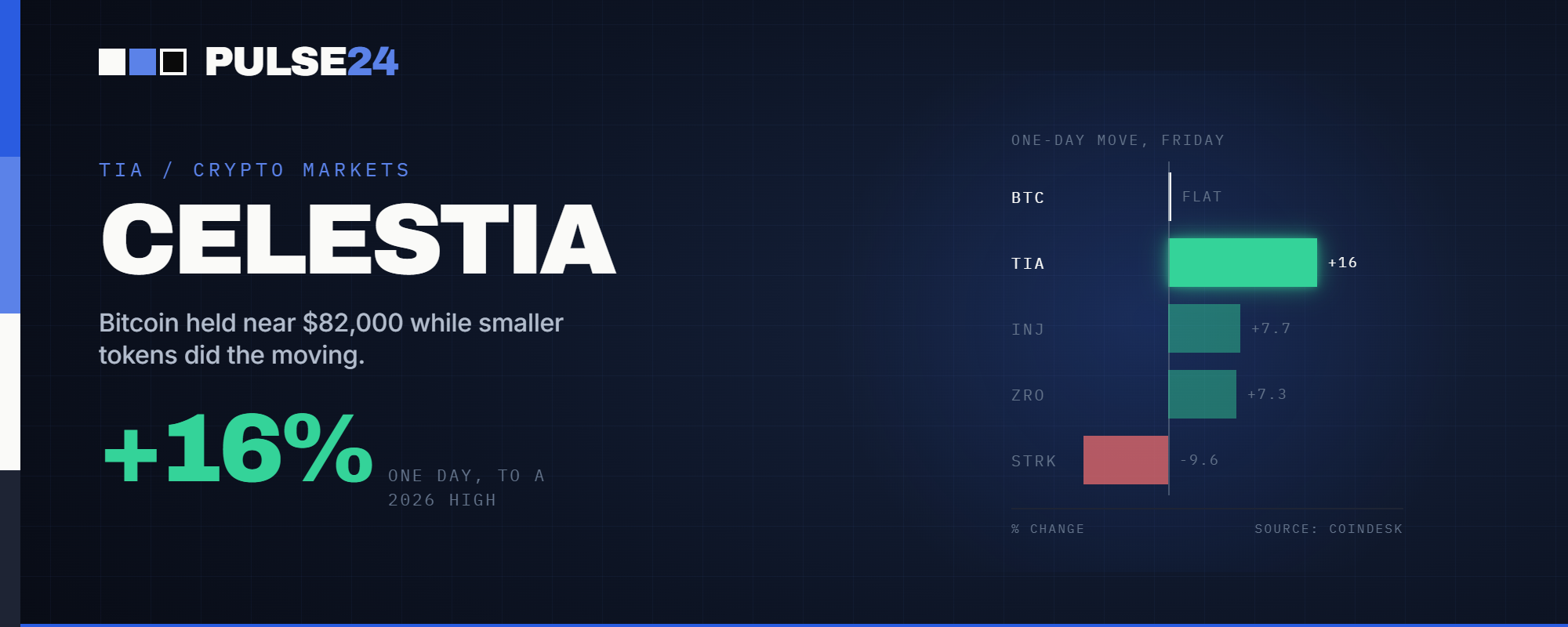
Bitcoin is sitting near $82,000, roughly flat even as two inflation reports beat forecasts and the odds of an October rate hike got cut in half. The real volatility showed up somewhere else this week, in smaller tokens like Celestia and Injective that far outpaced bitcoin.
Bitcoin opened Friday at $82,132 and spent the session drifting between roughly $81,600 and $82,700. That is a strange kind of calm. Two inflation reports landed this week, the Consumer Price Index and the Producer Price Index, and both came in hotter than economists expected. An asset marketed for years as an inflation hedge should have reacted to that combination. Bitcoin barely moved.
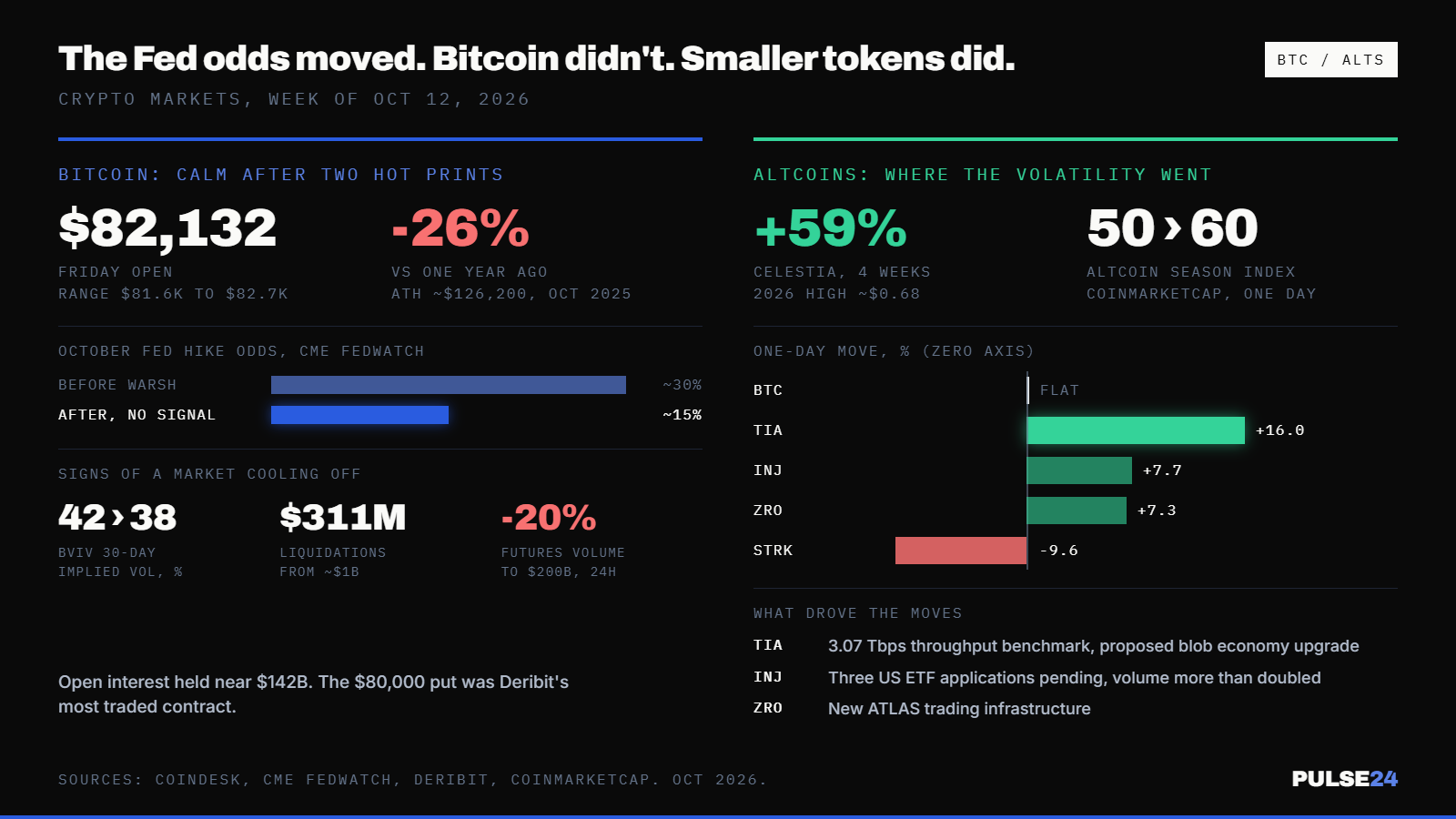
The bigger wobble came a day earlier. Bitcoin briefly broke below $80,000 on Thursday, its first dip under that level in a month, before buyers stepped back in. Bitcoin is also down about 26% from where it traded a year ago, and it sits well below the roughly $126,200 all-time high it touched on October 6, 2025. Even so, 30-day implied volatility, tracked by the BVIV index, has cooled to 38% from a recent high of 42%, an unusual reading just three days after a four-figure round trip.
What Changed
The number that actually moved this week was not bitcoin's price. It was the Fed's odds. CME FedWatch pricing for an October interest rate increase fell to about 15% from roughly 30% within days. The catalyst was almost anticlimactic: Fed Chair Kevin Warsh, speaking at the IMF and World Bank meetings in Bangkok, declined to signal what the central bank will do at its meeting later this month. Those same odds had doubled within the hour after September's inflation report beat every forecast. A chair saying nothing was enough to send them tumbling back down.
Warsh's silence rippled well beyond crypto. Treasury yields held steady, and S&P 500 futures were little changed after three straight losing sessions. Asian markets, which had absorbed the brunt of Thursday's selloff, rebounded hard: South Korea's Kospi rose 2.05% and Japan's Nikkei climbed 1.39%.
Why It Matters
That reaction is worth sitting with. A muted response to two hot inflation prints, paired with falling Fed-hike odds and cooling volatility, points to a market pricing in rate expectations more than inflation risk. Crypto futures volume fell 20% over 24 hours to $200 billion, even as open interest held roughly flat near $142 billion. Liquidations, which had run close to $1 billion earlier in the week, dropped to $311 million. Fewer forced sellers and fewer forced buyers usually mean a market cooling off, not one bracing for its next big move.
Options traders are still hedging for more downside, just with less urgency. The $80,000 bitcoin put was the most actively traded contract on Deribit, and derivatives platform Derive flagged a large put spread wagering on a slide to $78,000. On the call side, the $2,600 ether contract drew the heaviest volume, a sign some traders expect ether to hold its ground near $2,450. That kind of floor has given way before: short sellers lost nearly $40 million defending bitcoin's $83,000 floor earlier this month, and new buyers never fully showed up to reinforce it. Thursday's dip below $80,000 suggests the floor has eroded further since.
The Real Story Is in Smaller Tokens
While bitcoin idled, a handful of smaller tokens did the moving. Celestia jumped 16% to roughly $0.68, a 2026 high and a 59% gain over four weeks, a rally tied to a modular-blockchain throughput benchmark of 3.07 terabits per second and a proposed upgrade its developers call the Sustainable Blob Economy. Injective rose 7.7% to about $9.19 on trading volume that more than doubled, with three separate US ETF applications tied to the token still pending before regulators. LayerZero added 7.3%, linked to new trading infrastructure the project calls ATLAS.
Not every smaller token joined the move. Starknet fell 9.6%, the weakest performer among the major tokens tracked by CoinDesk's CD100 index. The broader rotation was still unmistakable: CoinMarketCap's Altcoin Season Index rose to 60 from 50 in a single day, the kind of jump that typically signals money leaving bitcoin's shadow, at least temporarily, for higher-beta bets elsewhere.
What to Watch Next
The Fed's October meeting is now the event to watch, not because a hike looks likely (Warsh's comments argue against it), but because any shift in his tone could reprice these odds just as fast as they fell. Keep an eye on whether that $80,000 put positioning on Deribit grows or shrinks heading into the decision; a bigger bet on $78,000 would signal traders expect this calm to break. And watch the ETF filings tied to Injective: an approval would be the clearest signal yet that regulators are willing to extend the exchange-traded wrapper beyond bitcoin and ether into the next tier of tokens.
The Pulse24 Take
Markets rarely move in a straight line from cause to effect, and this week is a clean example. Two inflation reports that should have rattled a supposed inflation hedge barely dented it, while a single Fed chair's refusal to commit to anything moved the odds further than the data did. Bitcoin's calm fits a pattern: the asset increasingly trades like other rate-sensitive instruments, pricing the next word from central bankers more than the next economic print. The money chasing Celestia and Injective this week is a reminder that when the biggest token goes quiet, capital does not sit still. It finds a smaller, louder home instead.
How we read the data
Curious how we get from raw data to a take like this? Our Trader's Toolkit walks through the tools we lean on.
Explore the Toolkit