Pulse24 Original
What Is HBM (High Bandwidth Memory)? The Memory Technology Powering the AI Chip Boom, Explained.
September 28, 2026
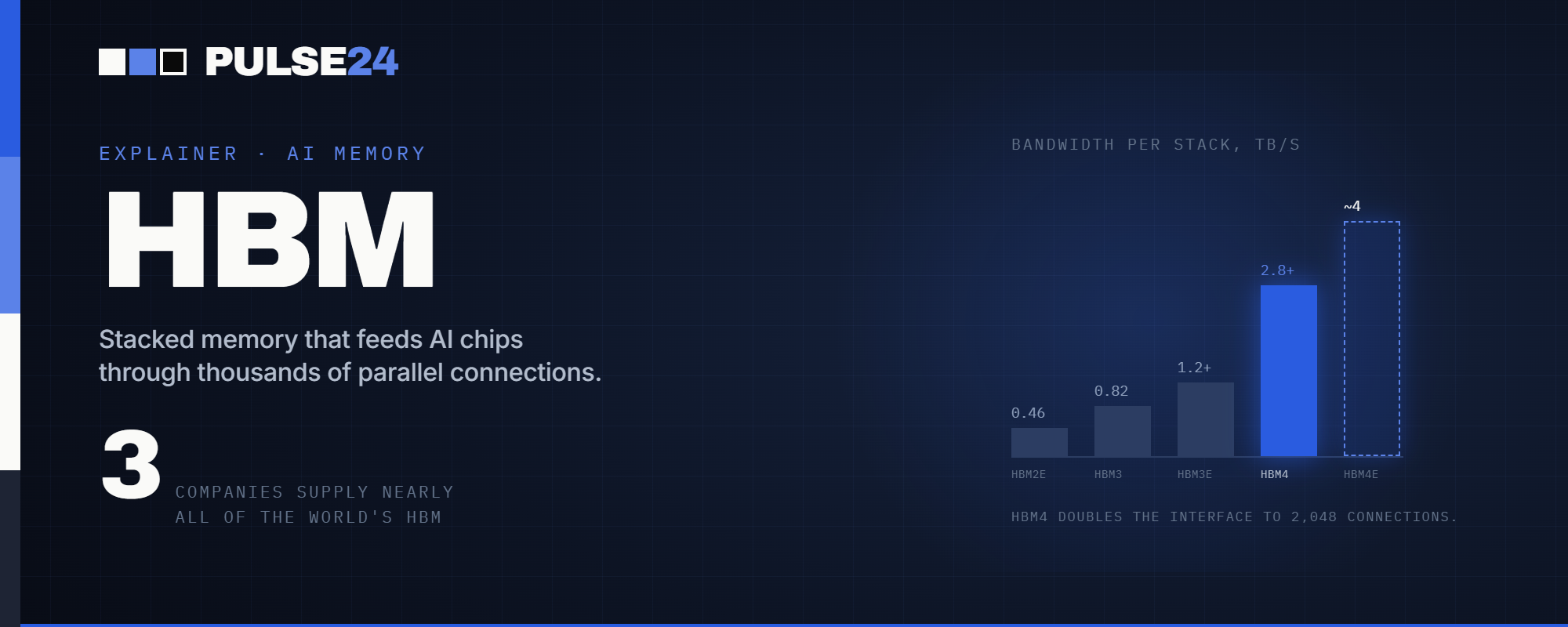
High bandwidth memory, or HBM, solves one of the hardest problems in AI hardware: feeding data to a powerful processor fast enough to use it. Only three companies supply nearly all of it, and the underlying architectural trade behind HBM has stayed remarkably durable even as costs and market shares keep shifting.
High bandwidth memory, or HBM, is one of the most important, and constrained, components inside modern AI accelerators. The reason is straightforward: increasingly powerful processors are only useful if memory can feed them data fast enough to keep up. HBM solves that bottleneck by stacking DRAM dies vertically and placing an unusually wide set of data connections close to the processor itself, and it has become one of the more visible pressure points in the AI buildout because of how hard it is to produce at scale.
How It Works
Ordinary DRAM, the kind used as system memory in most PCs and servers, typically sits apart from the processor and communicates through a comparatively narrow interface running as fast as the physics allow. HBM stacks DRAM dies vertically using through-silicon vias, tiny vertical electrical pathways connecting one die to the next, and links the resulting stack to the processor through a much wider interface than conventional memory uses. Instead of relying on a narrower bus running every connection extremely fast, HBM moves data across many more connections in parallel, at a more modest speed per connection. The stack sits on a silicon interposer immediately next to the processor, and that combination of width and proximity is the core architectural bet HBM makes.
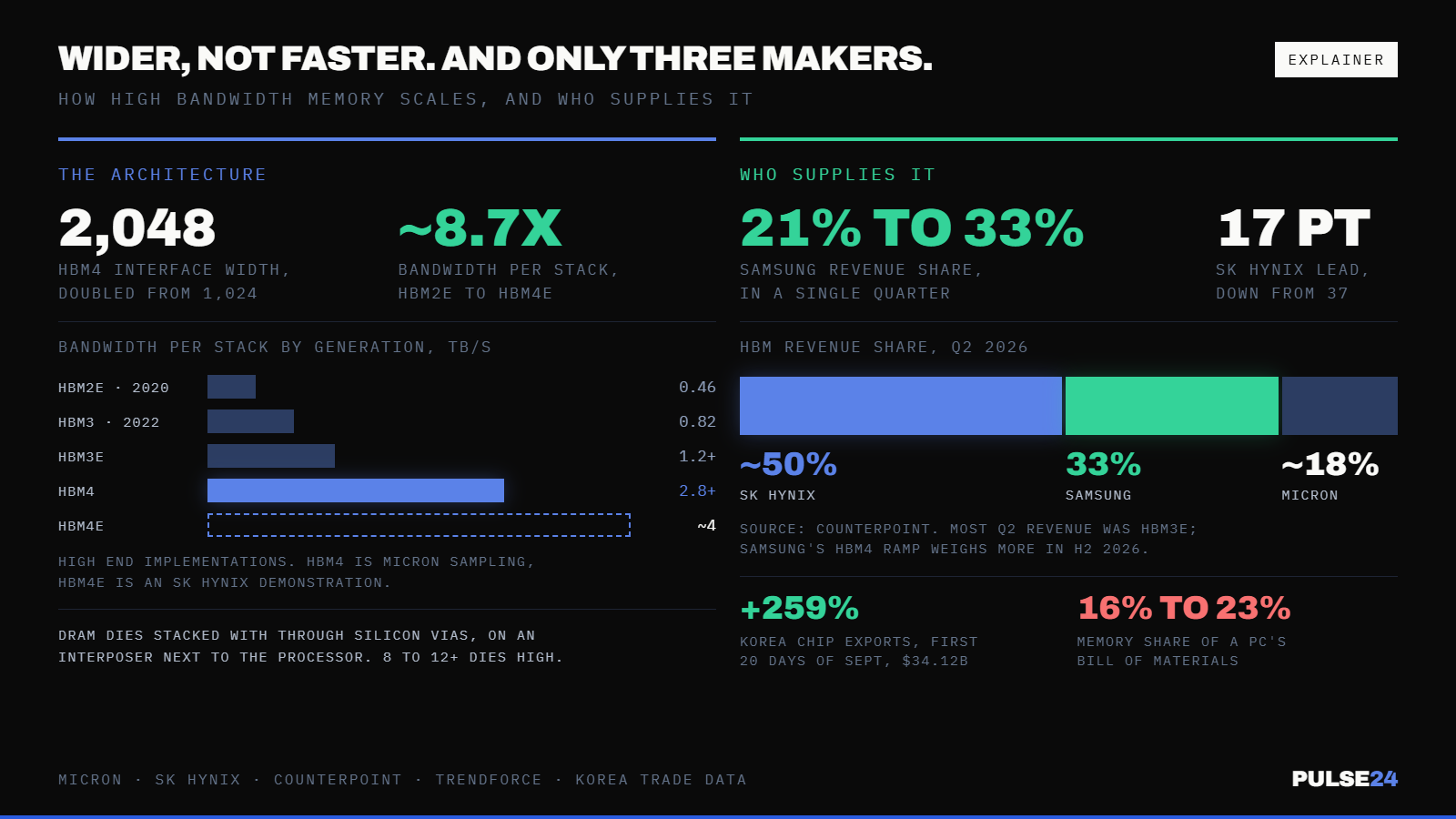
Representative high-end implementations show how quickly bandwidth has scaled across generations. In 2020, HBM2E moved about 461 gigabytes per second per stack. Two years later, HBM3 roughly doubled that to around 819 gigabytes per second. Most of today's AI accelerators run on HBM3E, which Micron specifies at more than 1.2 terabytes per second per stack. The newest generation, HBM4, doubles the interface itself from 1,024 to 2,048 connections, and Micron's implementation is now sampling above 2.8 terabytes per second. The generation after that, HBM4E, has already been demonstrated by SK hynix at close to 4 terabytes per second. Put several of those stacks around a single accelerator package, and aggregate memory bandwidth can reach many terabytes per second.
Why It's So Hard to Make
None of this is simple to manufacture. Each DRAM die has to be thinned dramatically before it can be stacked and bonded to the one below it, and thousands of microscopic vertical connections have to be formed and precisely aligned across every layer of the package. As stack heights increase, from eight dies to twelve and beyond, manufacturers have more opportunities for a bonding or alignment defect to show up somewhere in the stack, which makes final package yield harder to hold steady. That's part of why HBM includes built-in redundancy and repair circuitry, including error correction and dedicated repair paths for individual connections, precisely because defects at this scale are a known risk rather than a rare accident. Testing, known-good-die selection and bonding quality are critical to keeping final package yields high, and that complexity is a large part of why HBM costs substantially more per gigabyte than conventional DRAM. It's also why production has stayed concentrated among a small number of suppliers even as demand for AI chips has exploded. Building the equipment and process expertise to stack and bond dies reliably at volume takes years, not quarters.
Who Controls the Supply
Three companies supply nearly all of the world's HBM, and their revenue shares have been moving fast. SK hynix has led the category since AI-driven demand first took off and still held about 50% of the market by revenue in the second quarter of 2026. Samsung has closed ground quickly. Its HBM revenue share climbed from 21% to 33% in a single quarter, cutting SK hynix's lead over Samsung from 37 percentage points to 17. Counterpoint, the research firm that tracks the split, attributes most of that quarter's revenue to HBM3E rather than HBM4, and expects Samsung's HBM4 shipments to become a larger part of the mix in the second half of 2026, which could shift the shares again. Micron holds the remainder, around 18%, and has been ramping its own HBM4 production alongside the other two.
That concentration is a large part of why memory has become one of the more visible pressure points in the broader AI buildout. South Korea's semiconductor exports jumped 259% year over year in the first 20 days of September 2026, reaching $34.12 billion, a broad chip-export figure covering far more than HBM alone, but one that shows the scale of the semiconductor upcycle unfolding alongside the AI memory boom. Micron's own quarterly results and guidance have become a barometer for the memory market partly because HBM supply is so tight. The shortage isn't confined to AI data centers, either. Standard memory used in laptops and PCs now makes up 23% of a device's bill of materials, up from 16% a year earlier, and HBM is part of the reason why: it consumes a large and growing share of manufacturers' DRAM wafer capacity, a crowding-out dynamic industry analysts at TrendForce have documented as more capacity and capital spending shift toward HBM production.
The Pulse24 Take
HBM is a good reminder that the AI boom runs on physical manufacturing constraints as much as on software or chip design. For the past two years, HBM has been one of the tightest links in that chain, a component capable of limiting how quickly high-end AI accelerators can ship even when demand for the processors themselves is already there. The technology itself won't stay static. HBM4 is already shipping, HBM4E is already being demonstrated, and the gap between SK hynix, Samsung and Micron will keep shifting as each company's yields, qualification progress and production ramps evolve. The generations will change, but the architectural idea is durable: move far more data in parallel across a very wide interface positioned close to the processor, rather than trying to extract everything from a narrower memory bus running ever faster. That trade is what made HBM valuable before generative AI arrived. AI simply turned it into one of the more strategically important components in the data center.
How we read the data
Curious how we get from raw data to a take like this? Our Trader's Toolkit walks through the tools we lean on.
Explore the Toolkit