Pulse24 Original
SOFR Is Pinned at the Fed's 3.90% Ceiling as Rate Decision Day Arrives. Treasury Dealers Are Holding the Most Bills in Two Years.
October 28, 2026
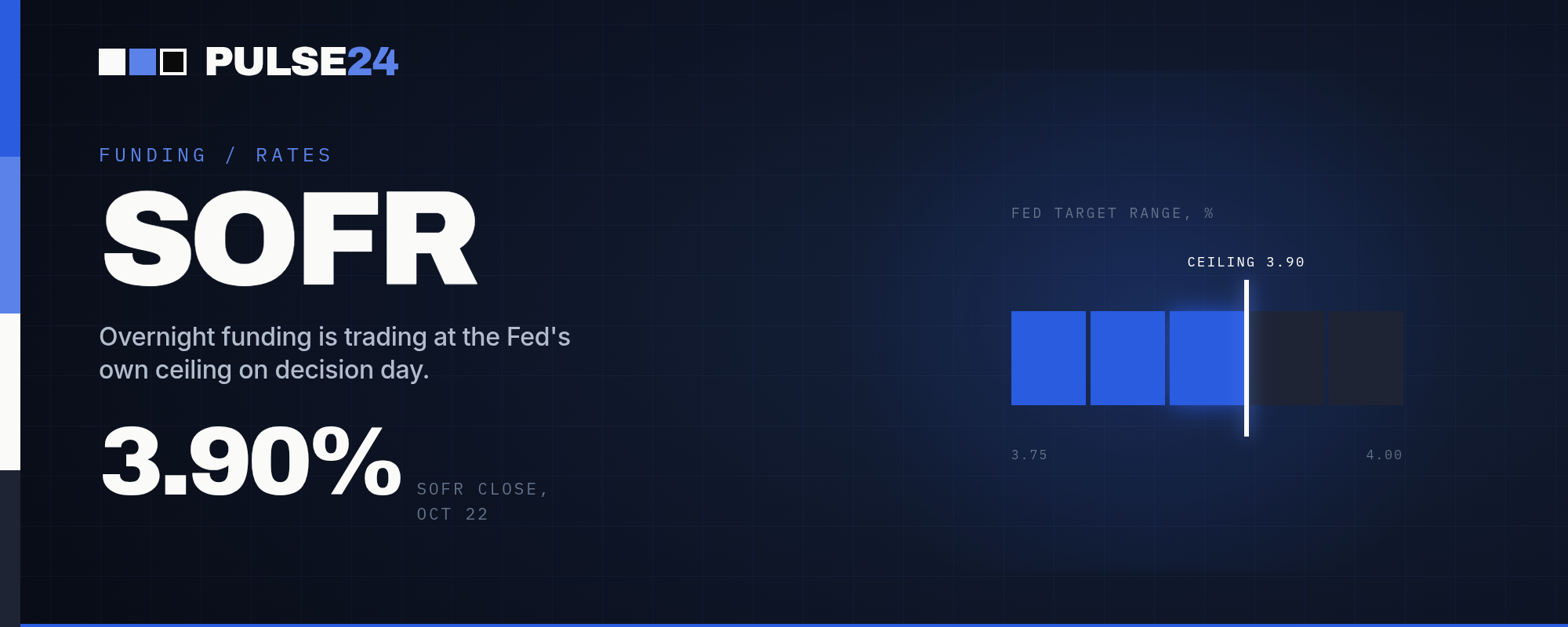
Short-term funding rates are creeping up toward the Fed's own ceiling right as the central bank decides today whether to hold or signal more tightening. Dealers are already absorbing more Treasury bills than they have in two years, and October 30 could test how much slack is left in the system.
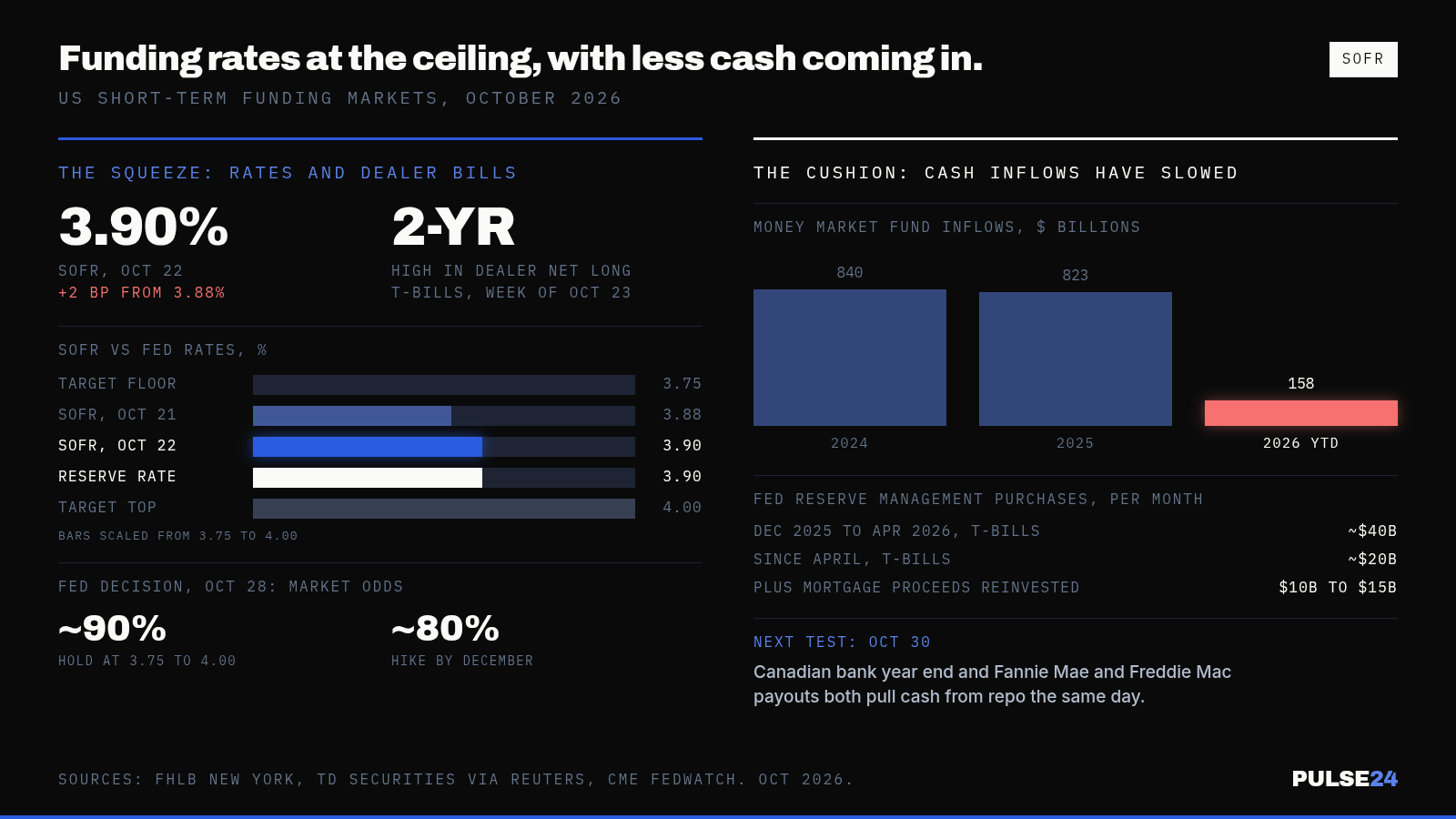
SOFR closed at 3.90% on October 22, after sitting at 3.88% the previous session. Three basis points might look trivial on a stock screen, but in the overnight funding market this is the rate banks and dealers pay each other for cash secured by Treasuries, and 3.90% happens to be the exact rate the Federal Reserve pays on reserves parked at the central bank overnight. When the market price for cash and the Fed's own ceiling sit on top of each other, the people who watch the plumbing for a living start paying attention.
What Changed
Two numbers moved in the same direction last week. SOFR drifted up toward the ceiling, and primary dealers, the banks authorized to trade directly with the Fed, pushed their net long position in Treasury bills to the highest level in two years. The Federal Home Loan Bank of New York flagged both moves in its October 23 weekly update, describing SOFR as staying at or below the Fed's 3.90% rate on reserve balances even as it kept drifting toward that line.
Underneath both of these is a liquidity story that started well before this week. The Fed ended its multi-year balance sheet runoff, quantitative tightening, on December 1 last year, then started buying again within days under what's called reserve management purchases: roughly $40 billion a month in Treasury bills through this past April, stepping down to about $20 billion a month since, plus another $10 billion to $15 billion a month in maturing mortgage-bond proceeds redirected into Treasuries. The goal was to stop reserves from shrinking further after QT had pulled the Fed's balance sheet down from a $9 trillion peak. Ten months later, short-term funding rates are still creeping toward the ceiling anyway, which is the part worth sitting with.
Cash is also behaving differently than it did a year ago. Money market funds have pulled in only about $158 billion so far in 2026, according to TD Securities data cited by Reuters, against $823 billion for all of 2025 and $840 billion in 2024. Slower inflows there mean less cash chasing short-term paper, which can show up later as thinner demand at Treasury bill auctions or as dealers warehousing more supply themselves, exactly what the two-year-high bill position suggests is already happening.
Why It Matters
None of this is a crisis yet, and nobody serious is calling it one. But it lands on a day that already carries plenty of weight. The Fed decides today on where to set its benchmark rate, and futures markets are pricing roughly a 90% chance it holds at 3.75% to 4.00%. The more interesting number sits further out: odds of a hike by December have climbed to around 80%, a sharp reversal from where things stood at the start of the year, when traders were still pricing in cuts.
Warsh's own words have moved those odds sharply in recent weeks. A single speech on artificial intelligence was enough to swing October hike odds, and a Reuters poll found every one of 100 economists surveyed now expects a hike by December, versus fewer than four in ten a month earlier. A central bank leaning toward tightening again, at the same moment short-term funding markets are already running hot, is a combination that deserves more attention than it's getting.
What to Watch Next
The next real test lands October 30. That date marks Canadian bank year end, a recurring source of temporary cash withdrawals from US repo markets, and it coincides with expected cash outflows as government-sponsored enterprises like Fannie Mae and Freddie Mac pay out to mortgage-bond holders. The New York Fed's own framing treats this as a checkpoint to watch, not confirmation that a squeeze is underway. Net Treasury bill issuance is projected to stay positive through November before turning negative in December, which should ease some of the pressure dealers are absorbing right now.
Real stress would look like SOFR pushing sustainably above the 3.90% ceiling rather than just kissing it, weaker demand at upcoming bill auctions, or dealers demanding higher compensation to keep financing their inventory. None of those have shown up yet. What has shown up is a market where the cushion between normal and tight has gotten noticeably thinner than it was even a few months ago.
The Pulse24 Take
Plumbing stories rarely make headlines until the plumbing actually breaks, and this one has not broken. Each piece makes sense by itself: dealers are absorbing more bills because fewer buyers are stepping in, and SOFR drifting toward its ceiling reflects a system running with less spare cash than it had a year ago. Stacked together on the same week the Fed is deciding how much further to tighten, they form something closer to an early warning than noise. Investors who lived through September 2019, when a similar repo squeeze caught the Fed off guard and forced an emergency intervention, know this pattern does not always resolve itself quietly. The more useful question this week has less to do with whether the Fed holds or hikes, and more to do with whether the plumbing underneath that decision can handle either outcome without a repeat of 2019.
How we read the data
Curious how we get from raw data to a take like this? Our Trader's Toolkit walks through the tools we lean on.
Explore the Toolkit