Pulse24 Original
Palantir's Commercial Revenue Topped the US Government's for the First Time. The Stock Fell 3% Anyway.
November 3, 2026
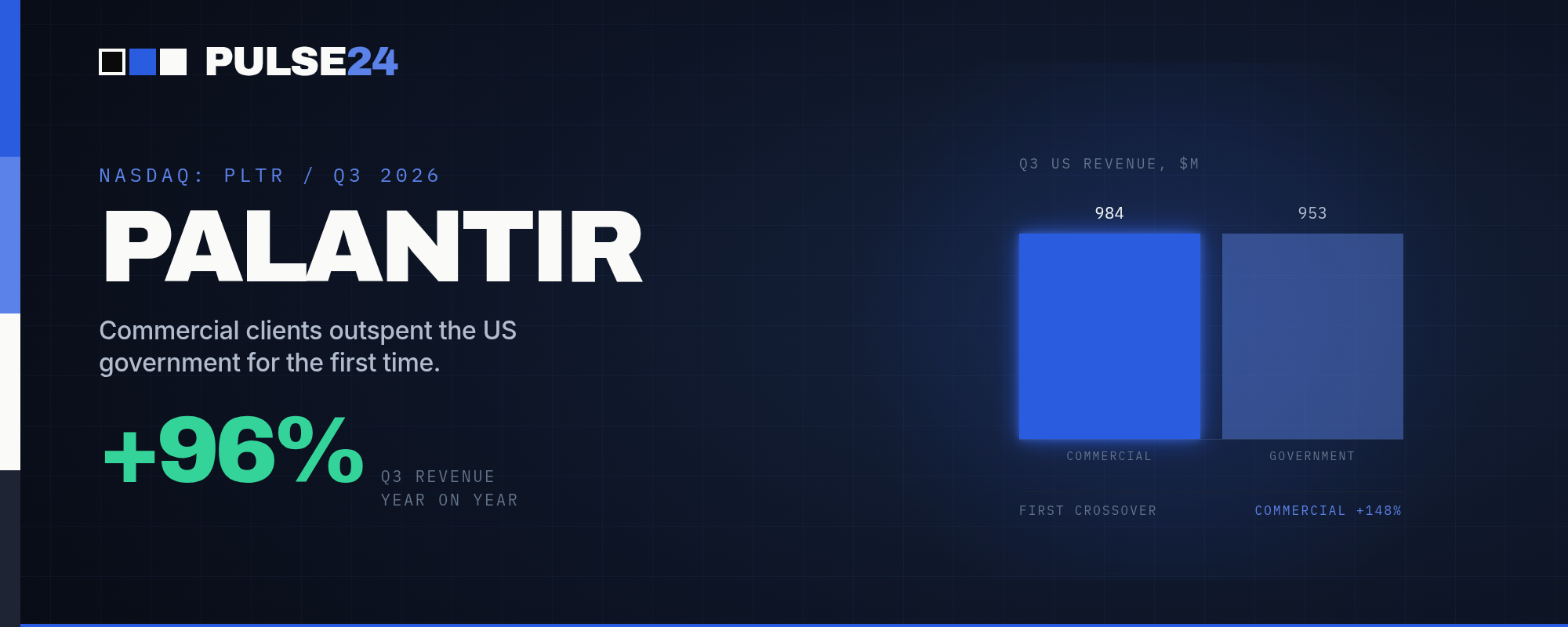
Palantir's revenue nearly doubled last quarter, and commercial clients outspent the federal government for the first time in the company's history. Wall Street still sold the stock, pointing to a valuation near 62 times trailing revenue and contract bookings that grew only a fraction as fast as revenue did.
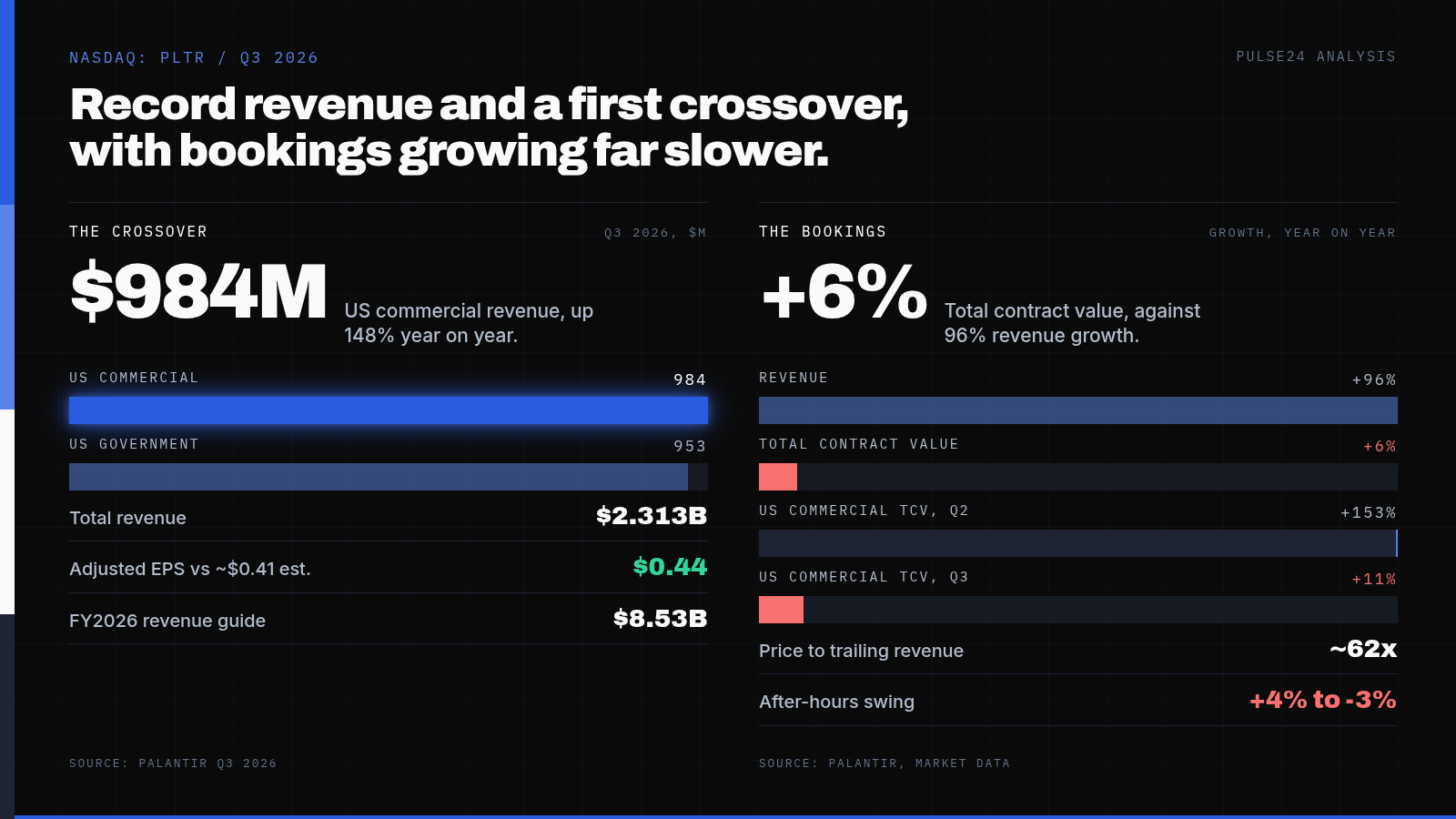
Palantir's commercial customers spent more money with the company last quarter than the United States government did. That has never happened before in the company's history, not during its early years as a government contractor built on Army and intelligence work, and not even earlier this year as its commercial business expanded quarter after quarter. In the third quarter of 2026, US commercial revenue reached $984 million against $953 million from the US government, a crossover years ahead of what most analysts had modeled when Palantir first started breaking the two segments out separately.
The headline numbers were just as striking on their own. Revenue for the quarter totaled $2.313 billion, up 96% from $1.181 billion a year earlier and 20% from the prior quarter. Adjusted earnings came in at $0.44 a share, ahead of the roughly $0.41 to $0.42 analysts had modeled, while adjusted free cash flow more than doubled to $1.216 billion from $539.9 million a year ago. By almost every measure Palantir is usually judged on, the quarter was a record.
What Changed
Palantir's shift from a government-heavy contractor into something closer to an enterprise software company has been underway for several years, but the third quarter marks the point where the numbers finally crossed. US commercial revenue grew 148% year over year to $984 million, continuing a run that's now stretched across multiple quarters. US government revenue still grew a healthy 96% to $953 million, so this isn't a story about government work slowing down. Commercial growth simply outran it.
Executives described a pattern that's become familiar on Palantir's recent calls: artificial intelligence pilots that once took quarters to convert into contracts are now closing faster, in some cases growing from six-figure trial deployments into eight-figure annual commitments within a couple of quarters. One example cited on the earnings call involved a global athletic-apparel company whose $1.6 million pilot, started in the first quarter of 2026, grew into a roughly $21 million annual contract by the following quarter. Management tied the acceleration to what it calls sovereign AI adoption, where enterprises run AI on their own data and keep control of the underlying models rather than handing that value to outside AI providers.
That speed came with a tradeoff. Several of the new eight-figure deals signed this quarter carried shorter contract terms than Palantir's historical norm, executives said, a pattern they expect to reverse as customers renew. Shorter contracts mean customers commit to less total dollar value upfront even while paying more per year in the near term, and that distinction helps explain a gap that shows up clearly in the quarter's booking figures.
Why It Matters
That gap is the detail Wall Street focused on more than the beat itself. Total contract value booked in the quarter, the forward-looking measure of new business signed, grew just 6% year over year to $2.918 billion, a fraction of the 96% growth in recognized revenue. US commercial bookings told a sharper version of the same story: they grew 153% year over year as recently as the second quarter and slowed to just 11% in the third. Remaining performance obligations, a rough measure of contracted revenue not yet recognized, grew 88% year over year to $4.9 billion but were flat compared with the prior quarter, and fell to 67% of trailing revenue from 80% in the second quarter.
None of that means the business is shrinking. It means the mix of what Palantir sold this quarter shifted toward faster-recognized, shorter-duration deals, which flatters current revenue growth while saying less than usual about what's already locked in for future quarters. For a stock priced the way Palantir's is, that distinction carries more weight than it would for a cheaper one. At roughly $180 a share, Palantir carries an enterprise value near $450 billion, about 62 times trailing revenue and more than 100 times trailing free cash flow, among the richest multiples of any large-cap stock in the market.
Palantir's selloff landed in the same week semiconductor stocks fell 3.8% on fresh anxiety about how the AI buildout gets financed, and days after Microsoft's AI spending came in below forecast while Alphabet's capex jumped and its stock still fell 10%. Palantir's challenge is different from those infrastructure names. The company isn't struggling to pay for AI capacity; it already generates far more cash than it spends. Its challenge is convincing investors that bookings will keep compounding at a rate that justifies today's price. Anthropic's own IPO filing showed an $80.7 billion loss priced at up to a $2 trillion valuation, and Palantir, by contrast, is solidly profitable, which is part of why investors were willing to pay up for it in the first place.
What to Watch Next
The next data point that matters is simple: does bookings growth reaccelerate in the fourth quarter, or does the gap between revenue growth and contract value growth widen further. Management guided fourth-quarter revenue to $2.649 billion to $2.653 billion, implying growth continues near the same triple-digit commercial pace. If total contract value growth stays stuck in the single digits while revenue keeps climbing, that would suggest this quarter's gap wasn't a one-time mix shift but a structural change in how Palantir's largest customers are buying.
Watch remaining performance obligations too. A second straight flat quarter there, even with revenue climbing, would tell a more specific story: that customers are renewing faster and smaller rather than locking in multi-year commitments, which could eventually show up in slower revenue growth once the easiest renewal math runs out. Palantir's full-year guide already assumes 91% revenue growth and more than 143% US commercial growth, a bar that gets harder to clear if bookings don't catch up to it.
The Pulse24 Take
A stock falling after a beat has become a familiar pattern across AI-adjacent names this earnings season. What's different about Palantir's case is that the reason behind the drop is specific and measurable: a 6% bookings growth rate sitting next to a 96% revenue growth rate. That gives skeptics something concrete to point to, rather than just sentiment about an expensive stock.
Commercial revenue passing government revenue is a genuine milestone, one that validates years of Palantir's pitch that its AI platform could work as enterprise software and not just classified government tooling. But a milestone in revenue mix doesn't automatically answer the valuation question. At 62 times trailing revenue, Palantir needs bookings to show the same acceleration revenue did, not just this quarter but across the next several, before a 6% contract value print stops being a footnote and starts being the headline.
How we read the data
Curious how we get from raw data to a take like this? Our Trader's Toolkit walks through the tools we lean on.
Explore the Toolkit