Pulse24 Original
Nvidia Is Reportedly Paying $12.9 Billion for Hugging Face, Nearly Triple What It Was Worth in 2023. The AI Hub Once Turned Down a Cheaper Offer From the Same Buyer.
August 28, 2026
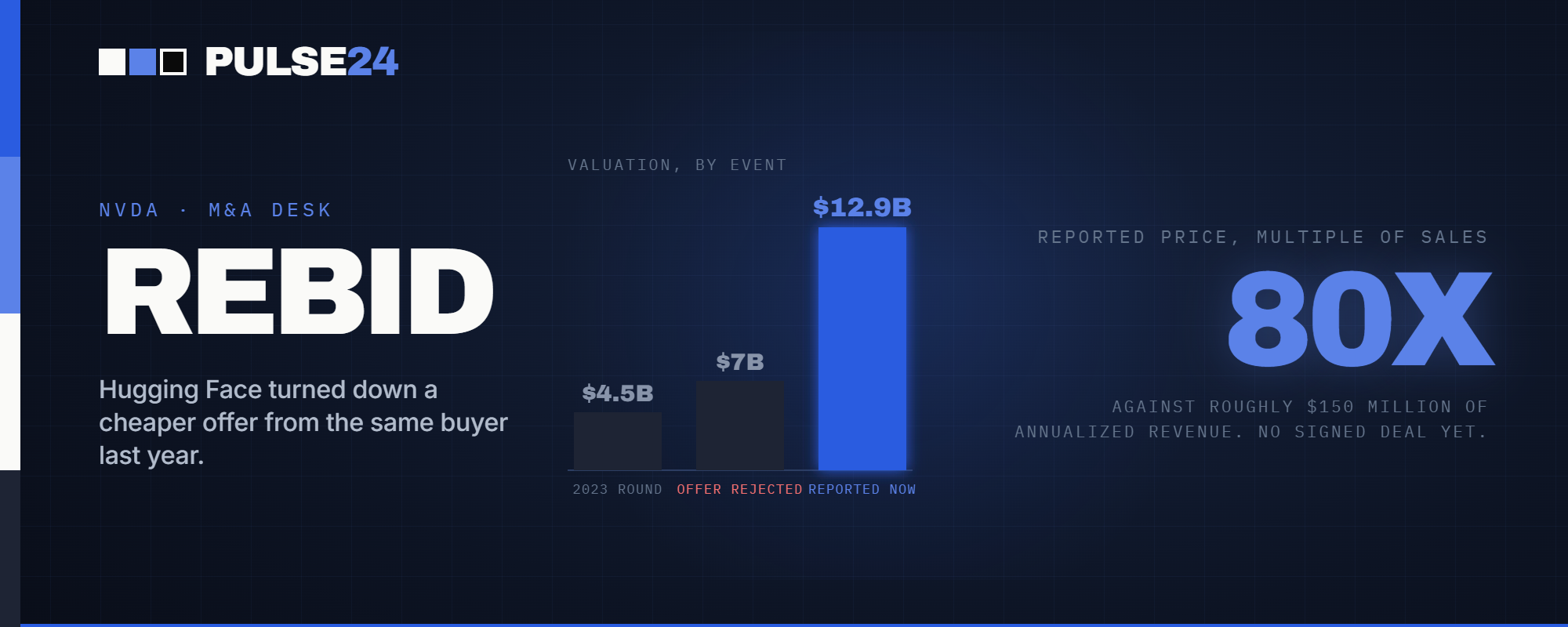
Nvidia has reportedly agreed to buy the open-source AI hub Hugging Face for $12.9 billion, a deal that would lock more developers into Nvidia's hardware just as rivals design their own chips. The price is roughly 80 times Hugging Face's annual revenue, and the agreement isn't signed yet.
Clem Delangue turned down Nvidia's money once already. In late 2025, Hugging Face's chief executive rejected a $500 million investment from the chipmaker that would have valued his company at $7 billion, wary that a single dominant backer would end up steering decisions at the open-source AI hub he co-founded in 2016. Less than a year later, Nvidia is reportedly buying the whole company, and for a lot more than that.
The price is $12.9 billion, according to The Information's reporting this week. Business Insider, citing its own sources, says the talks haven't produced a signed agreement and could still fall apart. If the deal does close at that number, it would value Hugging Face at nearly triple its last official price tag, the $4.5 billion set by a $235 million Series C round in 2023 that counted Salesforce Ventures, Alphabet's GV, and IBM Ventures among the backers, alongside Nvidia itself.
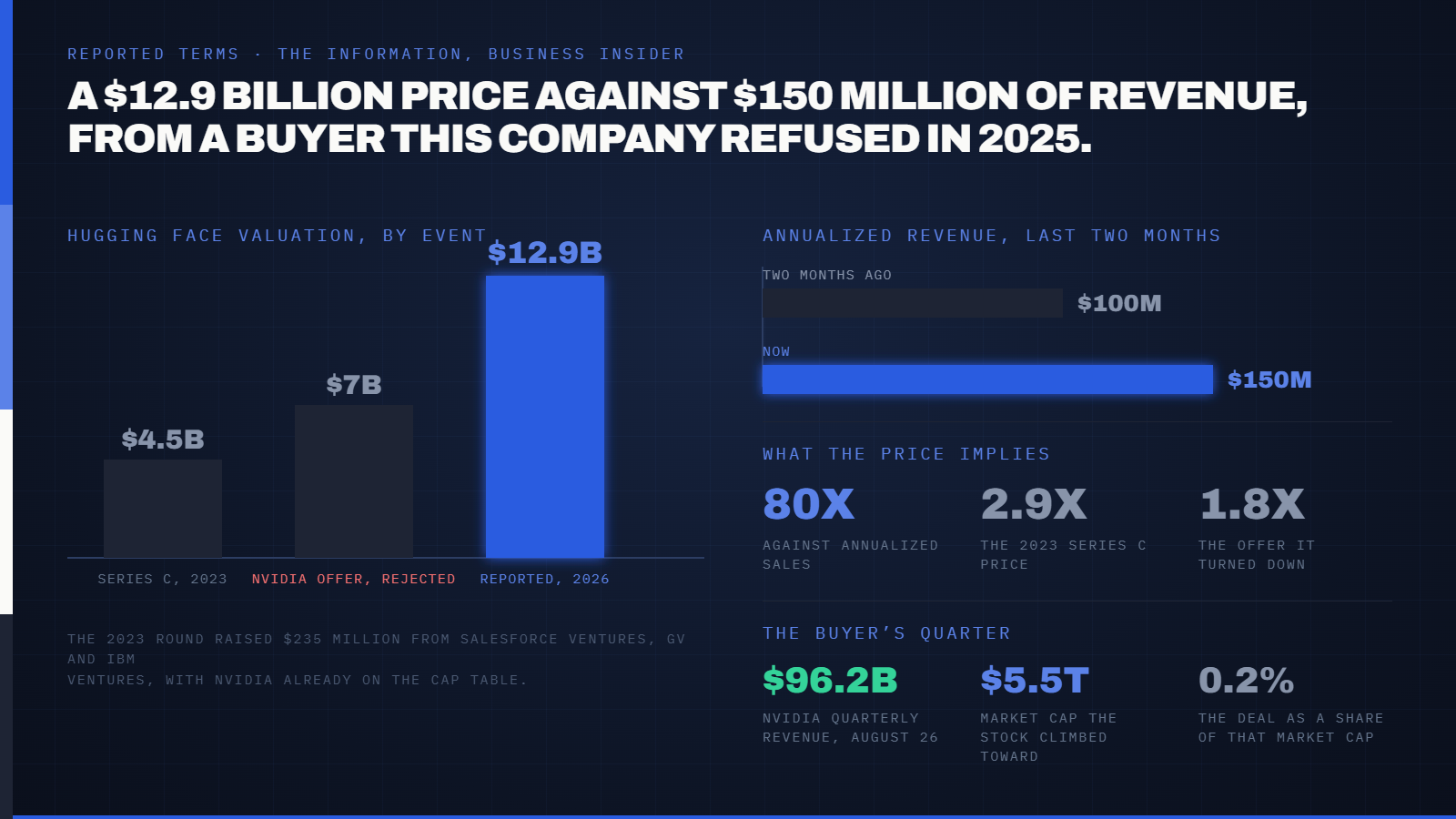
Hugging Face's business has grown fast enough to make $12.9 billion look expensive and cheap at the same time, depending on which number gets the emphasis. Annualized revenue has climbed to roughly $150 million, up from about $100 million just two months ago. That works out to close to 80 times sales, a multiple that would draw scrutiny anywhere outside AI infrastructure right now. Measured against what Nvidia plans to spend this year on chips, data centers, and cloud commitments, a $12.9 billion purchase of the internet's default library for open-source AI models looks closer to a rounding error.
The timing lines up with Nvidia's own earnings. Nvidia reported $96.2 billion in quarterly revenue on August 26 and watched its stock climb toward a $5.5 trillion market cap. A company posting numbers like that has room to spend aggressively on strategic bets while its core business is strong, rather than waiting for a slowdown to force its hand.
Why It Matters
Hugging Face isn't a chipmaker or a cloud provider on its own. It functions closer to GitHub for AI, a place where researchers and developers publish, download, and fine-tune everything from small open models to full multimodal systems. Its Transformers library shows up in countless AI projects, and its Inference Endpoints service already runs on AWS, Google Cloud, and Microsoft Azure, not only on Nvidia hardware.
That last detail explains most of the strategic logic. Owning the hub where open-source AI development happens gives Nvidia real influence over which chips those models get tuned and optimized for, at a moment when OpenAI, Google, Amazon, and Anthropic are all designing their own custom silicon to cut their reliance on Nvidia GPUs. Anthropic told investors its revenue grew 14-fold to $11.5 billion this year, and it's exactly the kind of AI lab Nvidia would rather see buying more GPUs than building its own chips. Keeping the open-source ecosystem healthy, and friendly to Nvidia, makes that outcome more likely without Nvidia ever having to frame it that directly.
There's a second motive, closer to cloud economics than chip sales. Hugging Face already rents out computing capacity to developers who build on its platform. Nvidia has guaranteed up to $105 billion in lease and power payments for OpenAI's new Ohio data center alone, part of a broader habit of backstopping the cloud commitments of its biggest customers. A cloud business under Nvidia's own roof gives it somewhere to route demand, or absorb capacity that customers underuse, instead of depending entirely on outside partners.
What to Watch Next
The most important word attached to this deal right now is unsigned. Business Insider's reporting stops short of confirming an agreement, and Hugging Face has already walked away from a smaller Nvidia offer once, specifically over concerns about ceding control. If talks collapse again, this becomes a footnote. Should they hold, three things are worth tracking: whether Hugging Face keeps supporting non-Nvidia hardware such as AMD's Instinct chips and Google's TPUs, since abandoning that neutrality would likely trigger the developer backlash Nvidia is trying to avoid; whether regulators in the US or EU take any interest given how much of AI compute already runs through Nvidia; and whether rivals respond with acquisitions of their own smaller open-source infrastructure plays.
Nvidia wouldn't be starting a trend so much as joining one. Stripe paid more than $7 billion for OpenRouter earlier this year, a company valued at just $1.3 billion in 2025. Consolidation in AI infrastructure is already moving fast, and a Nvidia deal this size would only add to it.
The Pulse24 Take
Investors have spent two years asking whether Nvidia's dominance in AI chips is durable or borrowed time. This deal, if it closes, doubles as an answer wrapped in a $12.9 billion price tag: buy the layer of software where AI actually gets built, so that layer stays friendly to Nvidia hardware no matter how good AMD's chips get or how many custom accelerators OpenAI and Google roll out. Paying roughly 80 times revenue for a company that isn't yet profitable only looks reckless if you assume Nvidia is buying Hugging Face for what it earns today. What Nvidia looks like it's actually buying is leverage over where AI development happens next, and at a $5.5 trillion market cap, $12.9 billion reads more like a strategic option than a bet-the-company move. The harder question for readers is whether an AI commons can stay both open and Nvidia-owned for long, and what happens to the rest of the AI trade if developers start to doubt it.
How we read the data
Curious how we get from raw data to a take like this? Our Trader's Toolkit walks through the tools we lean on.
Explore the Toolkit