Pulse24 Original
The 10 Best MCU Movies, Ranked From a Franchise That Just Crossed $30 Billion
August 2, 2026
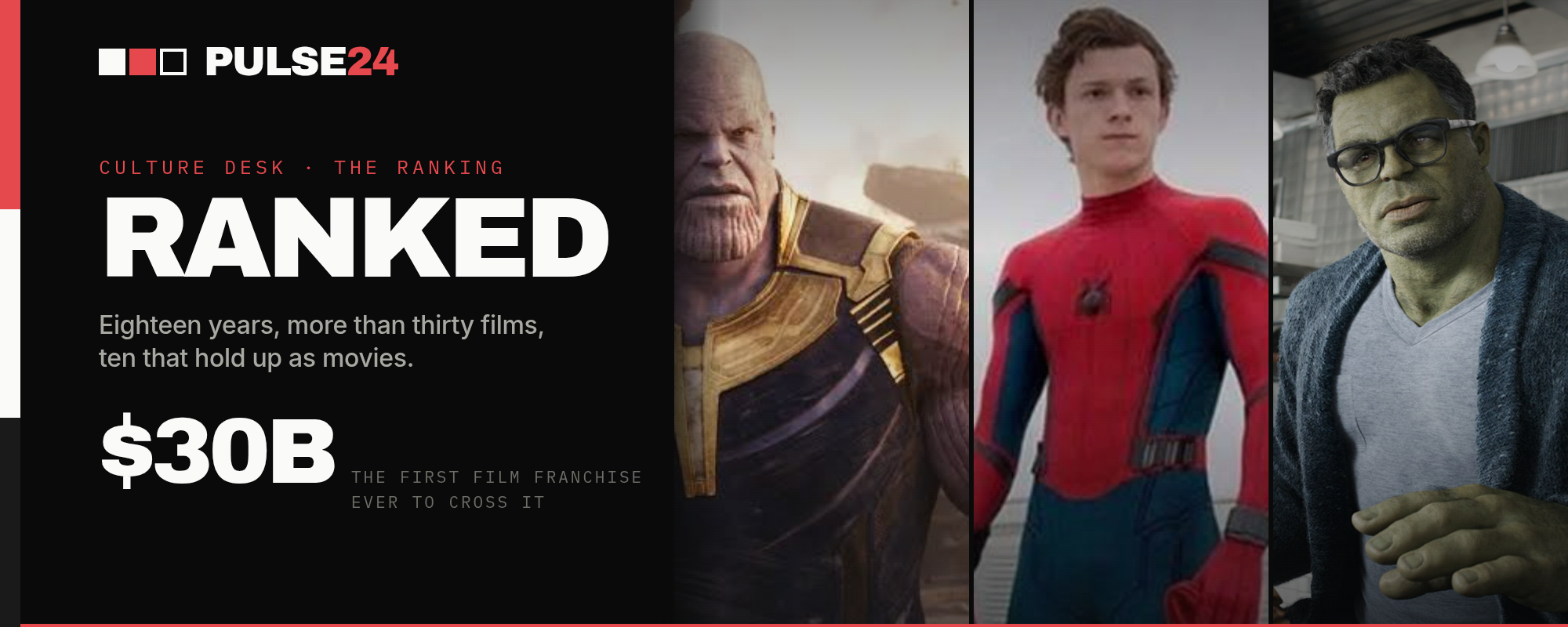
The MCU became the first film franchise ever to cross $30 billion at the worldwide box office, and these are the ten movies that got it there, ranked with a harder standard at the very top: does the film hold together as filmmaking, not just as a chapter in something bigger. That's why Infinity War outranks the higher-grossing Endgame, whose own time-travel logic doesn't fully hold up under scrutiny, and why Spider-Man: Brand New Day gets an honorary mention instead of a number, it's simply too new to judge fairly yet.
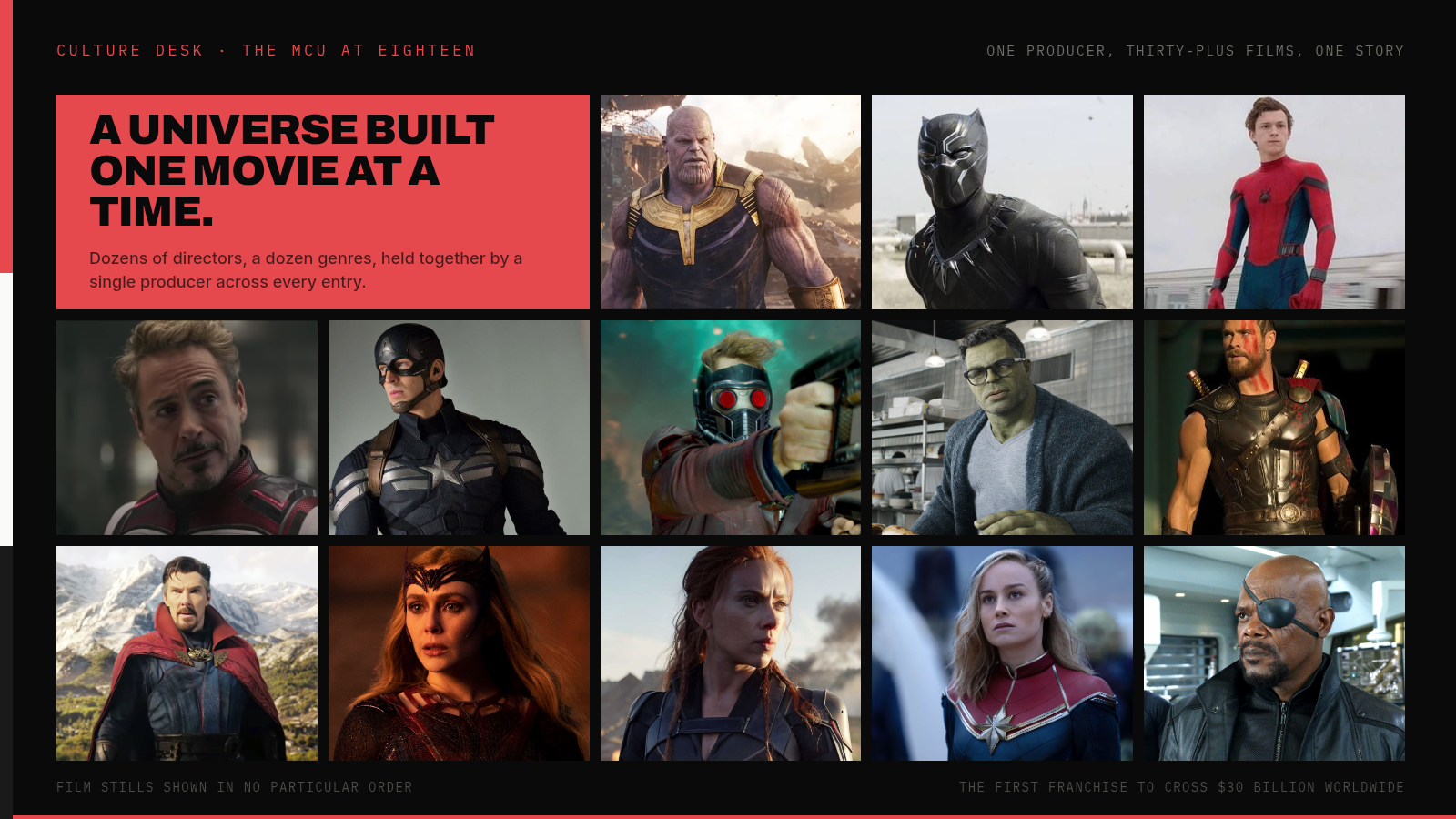
Eighteen years and more than thirty interconnected films after Robert Downey Jr. first put on the suit, the Marvel Cinematic Universe became, in 2024, the first film franchise in history to cross $30 billion at the worldwide box office. No studio had tried anything like it before Marvel did: dozens of separate films, different directors, different genres, all quietly building toward the same shared story, held together by one producer, Kevin Feige, across every single entry.
Ranking ten of them isn't really a box office exercise, or it shouldn't be. The films below are judged on the same combination of factors: commercial scale, critical reception, the cultural footprint they left outside the MCU's own math, how far that footprint traveled globally, and the specific actors or directors whose work actually carried the material. Scale broke almost every tie except one. At the very top, between the two Avengers films built to end an era, the tighter, more disciplined piece of filmmaking won out over the bigger number. Endgame outgrossed Infinity War by nearly $750 million and remains the more massive cultural event of the two, and it still isn't ranked first here, because it asks its own time-travel rules to hold weight they can't quite carry in ways its predecessor never has to. That case gets made properly further down. A few of the biggest earners on the all-time list didn't make the cut for the same reason. A few smaller ones did, because a movie that changed what the studio was willing to try next, or simply held together better as a piece of storytelling, matters more here than one that opened big and faded.
10. Deadpool & Wolverine (2024)
Ryan Reynolds spent years angling for an R rating before Disney finally let the character have one inside the MCU proper. Deadpool & Wolverine paid that patience back with interest: $1.338 billion worldwide, the highest-grossing R-rated film ever made, and more than 100 uses of a word Marvel had spent sixteen years avoiding entirely.
Director Shawn Levy built the film as part joke, part eulogy, folding two decades of 20th Century Fox's X-Men universe into the MCU the moment Disney's acquisition of Fox made it legally possible. Hugh Jackman came out of a retirement from the role he'd called permanent after 2017's Logan to do it, a reversal that made the film an event before a single trailer aired.
What the movie actually changed is the multiverse's emotional register. Every earlier crossover cameo had been treated as sacred. This one turned them into punchlines first, then let several land as genuinely moving anyway, especially for a generation of X-Men fans who'd watched Fox's version of that universe get quietly wound down over the previous decade. The result felt less like corporate synergy and more like closure, and audiences worldwide responded to it the same way.
9. The Avengers (2012)
No studio had successfully stitched five separate franchises into one shared blockbuster before Joss Whedon did it here, and Hollywood spent the following decade trying to copy the formula without ever quite matching it. The film opened to $207.4 million domestically, a record at the time, and finished at $1.52 billion worldwide, becoming just the 13th film in history to cross a billion dollars, and the first Marvel movie to do it.
Whedon's real trick wasn't the spectacle. It was making six lead characters, several of whom had never shared a scene before, feel like they'd known each other for years by the time the credits rolled. Robert Downey Jr.'s Tony Stark supplied the wit, Chris Evans's Steve Rogers supplied the moral center, and an elevator pitch that sounded absurd on paper, a team-up movie built entirely on setup from other movies, became the format every studio in town wanted next.
That imitation is its own kind of legacy. The shared-universe model now used across genres well beyond superhero films traces back to a movie most of the industry expected to underperform before it opened.
8. Iron Man (2008)
Robert Downey Jr. was, in Jon Favreau's own account, considered an extreme risk by much of the studio system before this film. His well-documented history with substance abuse made the casting a hard sell, and Favreau had to personally vouch for him to Marvel executives more than once before the studio agreed to a decision that would define the next eighteen years of the company's output.
The bet paid off in a way nobody, including Favreau, fully predicted. Iron Man grossed $585.2 million worldwide on a $140 million budget, modest by the standards of what the MCU would later produce, and closed on a single unscripted line, "I am Iron Man," that tore up the genre's decades-old rule about secret identities and told audiences this franchise intended to operate on its own logic from the very first film.
Everything that followed, the interconnected universe, the credits-scene teasers, the idea that a superhero movie could double as a character study about addiction and repair rather than pure spectacle, traces back to one $140 million bet on an actor much of Hollywood had already written off.
7. Spider-Man: Far From Home (2019)
Far From Home had the hardest job of any film released in 2019: following Endgame without getting crushed by it. Peter Parker spends the movie trying to process Tony Stark's death while Europe keeps getting attacked by what look like elemental monsters, and Jake Gyllenhaal's Mysterio, introduced as a hero from another Earth, turns out to be a disgruntled former Stark Industries engineer running an elaborate hologram-and-drone con. It grossed $1.13 billion worldwide, at the time the highest-grossing film Sony had ever distributed.
The Mysterio plot has aged into something sharper than it looked in 2019, a villain whose entire weapon is convincing people that fabricated footage is real, years before deepfakes became a mainstream anxiety. Director Jon Watts and returning writers Chris McKenna and Erik Sommers built a smaller, funnier, more contained film than the multiversal spectacle that followed it, and its final scene, J.K. Simmons's J. Jonah Jameson broadcasting Peter's secret identity to the entire world, isn't a stinger for its own sake. It's the premise that makes No Way Home possible, planted a full film in advance.
6. Guardians of the Galaxy (2014)
James Gunn was hired to build a movie around characters almost nobody outside comic shops had heard of: a talking raccoon, a tree with a three-word vocabulary, a green assassin. Guardians of the Galaxy grossed $770.9 million worldwide anyway, and did something none of Marvel's earlier films had managed. It made the cosmic, Earth-optional corner of the MCU feel just as essential as the Avengers themselves.
The soundtrack did as much cultural work as the film did. Awesome Mix Vol. 1, built entirely from songs recorded decades before the movie existed, became the first soundtrack of previously released music ever to top the Billboard 200, and went on to sell more than a million copies at a moment when film soundtracks rarely sold at all.
Chris Pratt went from Parks and Recreation's amiable slacker to a legitimate leading man almost overnight, and Gunn's particular mix of irreverence and unexpected sincerity became the tone Marvel leaned on for much of the next decade. Every wisecracking ensemble that followed owes something to a raccoon voiced by Bradley Cooper.
5. Captain America: The Winter Soldier (2014)
Anthony and Joe Russo had never directed an action film before Marvel hired them. Their résumé was comedy television, Arrested Development and Community, and they beat out nine other directors for the job by storyboarding an entire sequence on spec and pitching a movie that looked nothing like a superhero film: a 1970s-style political thriller about surveillance and institutional betrayal.
It grossed $714 million worldwide and set the record, at the time, for the biggest April box office opening in history with a $96.2 million debut weekend, and critics who'd been lukewarm on the Captain America character before this entry came away treating the MCU as a franchise capable of genuine genre range rather than just spectacle. The elevator fight scene alone is still cited by stunt coordinators and action directors as one of the best fight sequences the genre has produced.
The Russos' reward was directing the two biggest Avengers films ever made. Without Winter Soldier proving Marvel could hand unproven directors a real swing, it's a fair question whether Infinity War or Endgame get made by the same team at all.
4. Spider-Man: No Way Home (2021)
Marvel and Sony spent more than a year protecting the film's biggest secret: that Tobey Maguire and Andrew Garfield's Spider-Men were returning alongside Tom Holland's. Garfield denied his own involvement in interview after interview for roughly two years, later calling it some of the hardest acting he'd ever done, and the deception held until the film itself confirmed it. Early screenings reportedly saw audiences erupt into extended cheers at the reveal.
The film went on to gross $1.9 billion worldwide, the third-highest total any MCU film has ever posted and the biggest global opening of the pandemic recovery era by a wide margin. The nostalgia play could have felt cheap. Instead, No Way Home used three generations of Spider-Man actors to close an emotional loop neither earlier trilogy had fully resolved on its own, giving Maguire's Peter Parker in particular a redemption scene twenty years in the making.
3. Avengers: Endgame (2019)
Endgame is still, more than six years and a global box office rebound later, the second-highest-grossing film ever made, and for eight months in 2019 it was the highest-grossing film, period, dethroning Avatar in a record that had stood for a decade. It made $2.8 billion worldwide as the 22nd film in the shared universe, a single three-hour movie built to close out everything the previous twenty-one had set up, giving meaningful send-offs to a dozen characters at once without any of them feeling shortchanged.
None of that is in dispute. What keeps it out of the top two here is the machinery it needed to pull it off. The film establishes its own time-travel rule early, through Bruce Banner explaining that altering the past doesn't rewrite your present, it only splits off a new one. That's the rule that shuts down War Machine's suggestion, later in the same scene, that they just go back and kill Thanos as a child. Hulk's answer is a flat "that's not how it works." The Russo brothers added that exchange in post-production specifically because test audiences kept getting stuck on the mechanics. Editor Jeff Ford has said the goal of the line was simply to tell the audience, "you don't have to do math, you don't have to write this down, go with it."
The trouble is the film doesn't really go with it either. Minutes later, the Ancient One tells Hulk that removing the Time Stone from 2012 risks unraveling that timeline into multiversal chaos, unless it's returned, which implies the damage is conditional and reversible rather than instant and permanent the way Banner's own rule described it to the Avengers moments earlier. By the finale, a 2014 version of Thanos follows the team's own time corridor forward into 2023 and dies there, raising a question the film never answers: if that Thanos never returns to 2014, he never lives out the future the movie already showed us, the one where he finishes the snap, retires to a farm, and gets killed by Thor in Endgame's own opening scene. And Steve Rogers' ending, quietly living out a full life with Peggy Carter before reappearing as an old man on a bench, has two competing official explanations from the people who made the film. Director Joe Russo has said Steve created a branched timeline and found his way back into the main one. Screenwriters Christopher Markus and Stephen McFeely have said he never left the main timeline to begin with. Those two answers contradict each other, and nobody involved has reconciled them since.
None of that erases what Endgame accomplished, and it's still the bigger cultural event of the two Avengers films by any measure. But Infinity War never has to explain any of this, because it never promises an ending it has to engineer its way out of. That's the gap between a 3 and a 1.
2. Black Panther (2018)
Black Panther crossed $1.35 billion worldwide and became the first superhero movie ever nominated for the Academy Award for Best Picture, the first Marvel film to win an Oscar of any kind, taking home three: Best Original Score, Best Costume Design, and Best Production Design. Ryan Coogler, the director behind it, has since built one of the more complete résumés in the business, carrying the biggest franchise in the world in one decade and an original horror film with no built-in audience the next.
The film's impact never lived inside Marvel's own math. Wakanda became a real cultural touchstone rather than a fictional location, cited in commencement speeches and classrooms and treated by audiences worldwide, particularly across Africa and the African diaspora, as a mainstream blockbuster that built an entire civilization on Black excellence rather than Black struggle.
Chadwick Boseman died in August 2020, and the world learned only then that he had spent four years secretly filming this movie, Avengers: Infinity War, Avengers: Endgame, and Da 5 Bloods while battling colon cancer that progressed from Stage III to Stage IV, never disclosing the diagnosis publicly. He never got to make the sequel he had been planning to return for. When Wakanda Forever arrived in 2022, Ryan Coogler rebuilt the film around his absence rather than recasting the role, and Boseman's death is now inseparable from how the original film is remembered, not just as a hit, but as a performance made under circumstances almost nobody watching it in 2018 could have known.
1. Avengers: Infinity War (2018)
No blockbuster in modern memory had ended on a note this bleak, and few have aged into the stronger film for it. Thanos wins. Half of all life in the universe turns to dust mid-sentence, mid-hug, mid-joke, and the credits roll before anyone tells the audience how it gets fixed. Studios don't typically let a two-billion-dollar tentpole end in defeat. The Russo brothers, directing their third MCU film after Winter Soldier and Civil War, talked Marvel into it anyway, and the result is a rarer thing than its own sequel turned out to be: a franchise film that doesn't owe anyone a resolution.
That freedom is what separates it from Endgame, and why it sits at the top of this list instead. Told largely from Thanos's own point of view, Infinity War never has to bend its plot to service a happy ending, a dozen character sendoffs, or a time-travel mechanic invented after the fact to make the math work. It grossed $2.05 billion worldwide, coordinating close to eighty characters across a single film without the whole thing collapsing into noise, a directing feat few films before or since have attempted at that scale. The ending, quickly nicknamed the Snap, became instant cultural shorthand, spawning a year of internet debate and one of the longest collective waits in blockbuster history for a sequel that had, remarkably, been spoiled by almost nobody by the time it arrived.
It's the tighter script, the harder ending, and, for plenty of people who've watched both films more than once, the one that actually rewards the rewatch. Endgame made more money and closed more doors. Infinity War is simply the better movie.
Honorary Mention: Spider-Man: Brand New Day (2026)
Brand New Day doesn't get a numbered slot on this list, and that's deliberate, not a snub. Days before this piece was published, it opened to $355 million domestically, the second-biggest domestic opening in box office history, and $927 million worldwide in a single weekend, the second-best global debut any film has ever posted. Preview night alone brought in a record $72 million. Those are top-three numbers on this entire list already, before the film has had any chance to prove whether it holds up the way Winter Soldier or Iron Man did, or fades the way some of Marvel's biggest single weekends have.
Director Destin Daniel Cretton, working from a script by returning writers Chris McKenna and Erik Sommers, stripped away nearly everything that made the earlier Tom Holland trilogy comfortable. Peter Parker spends the film erased from the memory of everyone he loves, a premise the character has been building toward in one form or another for sixty-four years, and undergoes a transformation critics have called the darkest turn the role has taken on screen, for a character Tom Holland has spent his entire adult career building a second act around rather than trying to escape. It's too early to know where it settles into that history. The numbers already say it belongs in this conversation. Revisit this list in two years and it may well have earned the number itself.
The Pulse24 Take
Rank these ten by any single metric, box office, critics' scores, cultural staying power, and the list shuffles a little each time. That's not a flaw in the exercise. It's the honest answer to what holds a franchise like this together for eighteen years: no single film had to be the best movie ever made. It had to be good enough, and connected enough, that the next one felt inevitable. The exception is the very top of this list, where a harder standard applied: does the film hold together as filmmaking on its own terms, not just as a chapter in something bigger. That standard is why Infinity War sits above Endgame despite the money, and it's the same standard by which Brand New Day, for all its opening-weekend size, hasn't earned a number yet.
Kevin Feige has now overseen every film here, ranked and honorary both, from a $140 million bet on an actor much of the industry had written off in 2008 to a movie that opened this month to the second-biggest weekend in box office history. That continuity, one producer's hand on every major decision for eighteen years and counting, is the part no competitor has managed to copy, no matter how many shared universes they've tried to build in response. The MCU became the first film franchise in history to cross $30 billion at the worldwide box office. These ten movies, and the one still proving itself outside the list, are the reason it got there.
How we read the data
Curious how we get from raw data to a take like this? Our Trader's Toolkit walks through the tools we lean on.
Explore the Toolkit