Pulse24 Original
The Kid Under the Mask: Why Spider-Man Still Feels Like Ours
July 29, 2026
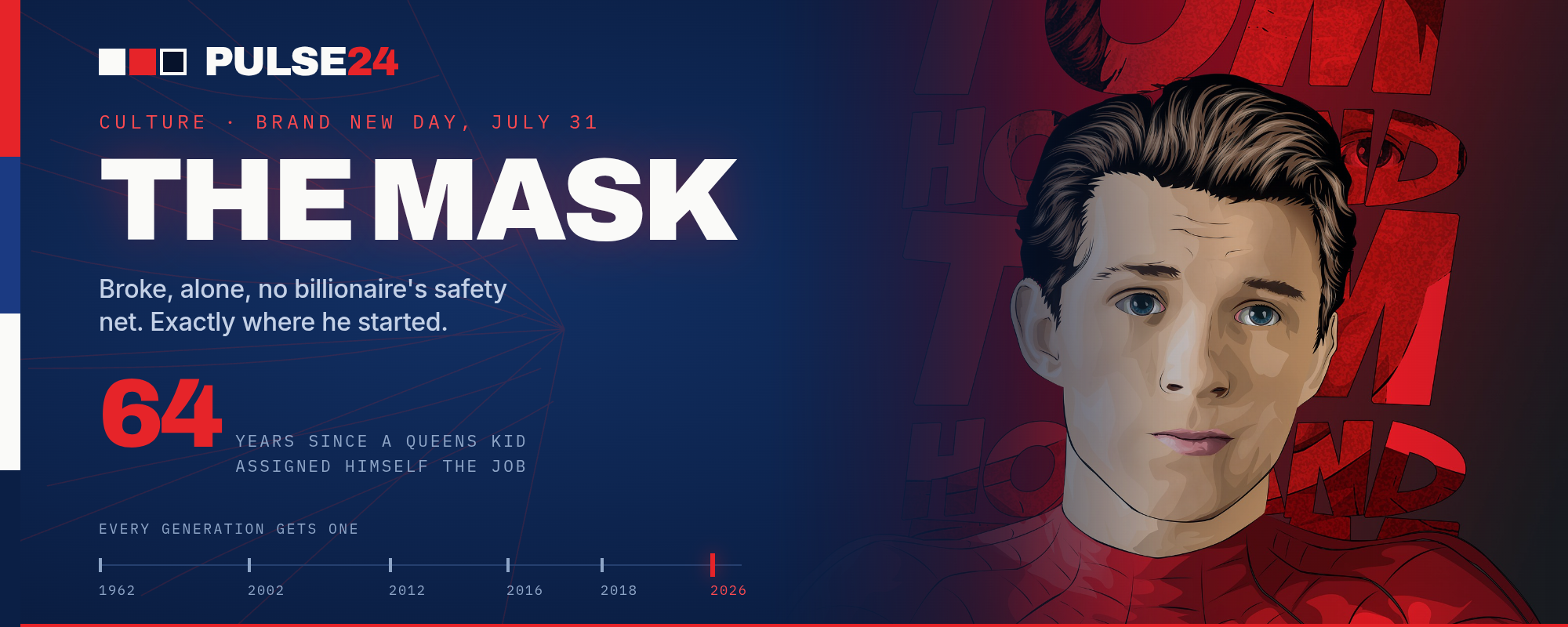
Spider-Man: Brand New Day strips Tom Holland's Peter Parker of Tony Stark's tech and safety net, sending him back to where the character started 64 years ago: broke, alone, and entirely on his own. Here's why that return matters, and why kids still want to be him more than any other hero.
This Friday, July 31, Tom Holland pulls the mask back on for "Spider-Man: Brand New Day," and something about this one feels different before a single ticket gets scanned. Not bigger. Smaller. A guy in a modest apartment, listening to a police scanner, building his own gear because nobody rich is doing it for him anymore. Sixty-four years after a teenager in Queens first climbed a wall in a comic book nobody expected to sell, Spider-Man is going back to where he started: broke, alone, and entirely on his own.
That return is the whole story. To understand why it matters, you have to go back to why any of this ever mattered in the first place.
A hero built out of guilt, not glory
Stan Lee and Steve Ditko introduced Peter Parker in "Amazing Fantasy" #15 in 1962, and the pitch was almost a joke by the standards of the time. Superman was an alien god. Batman was a billionaire with a cave full of gadgets. Peter Parker was a bullied high school kid with bad eyesight and no money, who got bitten by a radioactive spider and used his new strength, at first, to try to make a few bucks in a wrestling ring. He let a thief run past him because stopping him wasn't his problem. That thief killed his uncle a few pages later.
"With great power there must also come great responsibility" wasn't a slogan Marvel bolted onto a lunchbox. It was Peter's punishment, the sentence he gave himself for one selfish choice, and it's the only superhero origin in American pop culture built entirely on guilt instead of grief for someone else or destiny or a cosmic prophecy. Every other hero of that era was given their mission. Peter Parker assigned it to himself, and he's been serving it ever since. Ditko drew him hunched, tired, and doubting himself in nearly every panel where the mask came off, because the point was never that Spider-Man is strong. The point is that he keeps showing up anyway, broke rent and blown dates and all.
Everyone gets to have their own Spider-Man
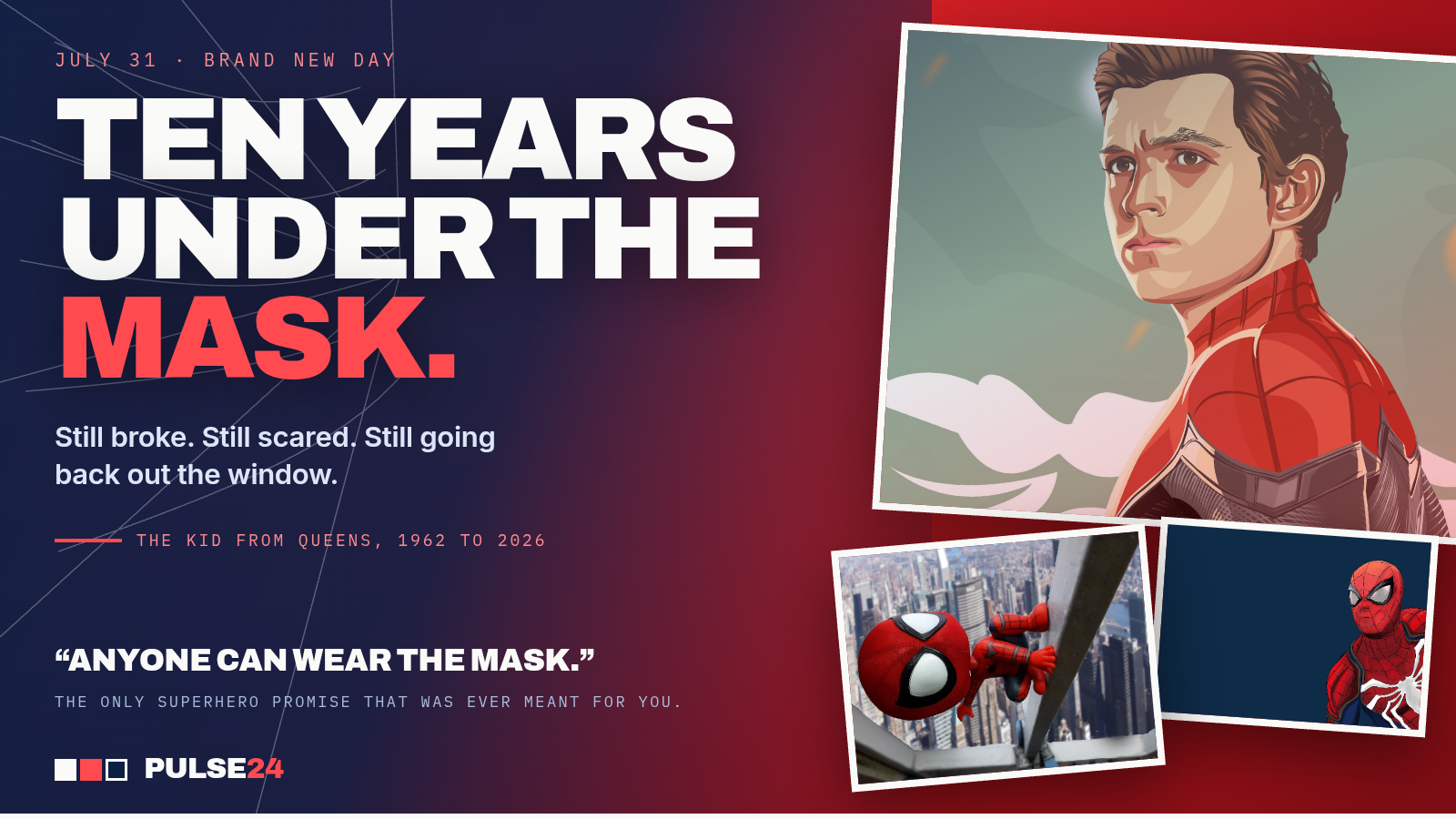
Sixty-four years and counting, and no other superhero has been reintroduced to the culture as many times, by as many different people, as Spider-Man has. Tobey Maguire's trilogy in the 2000s gave a generation of kids an awkward, earnest Peter who cried more than he punched. Andrew Garfield's version, a few years later, was a wounded skater kid falling for Emma Stone's Gwen Stacy in a story that ended in tragedy most PG-13 franchises wouldn't touch. Tom Holland arrived in 2016 as the youngest, most obviously still-a-teenager Spider-Man yet, landing the role after a chemistry test where he surprised the room, Chris Evans included, with an improvised side flip on his way through the door before he'd even said a line. And in 2018, "Into the Spider-Verse" handed the mantle to Miles Morales and, through him, to every kid who'd never quite seen themselves in the role before. Its most quoted line, delivered by Miles himself in the film's closing minutes, isn't a joke or a catchphrase. It's a promise: "Anyone can wear the mask."
That's not a coincidence of casting. It's built into the character on purpose. Bruce Wayne is always Bruce Wayne under the cowl. Peter Parker's mask covers his whole face, on purpose, from the very first drawing, specifically so that the person underneath could be anyone. A kid in 1962 Queens, a kid in 2002 watching Maguire in a theater, a kid in 2018 who looked like Miles for the first time. Every generation gets to project itself onto the same blank, expressive eyes, which is a big part of why the character never ages out of relevance the way plenty of his Silver Age peers have.
What the Iron Man years gave Spider-Man, and what they cost him
Tom Holland's Spider-Man didn't start out broke and alone. He started out as Tony Stark's protege, recruited by a billionaire in a hangar in "Captain America: Civil War," handed a suit with a built-in AI and training wheels he had to be talked out of using. It was a clever way to fold the character into the Marvel Cinematic Universe fast, and it gave "Homecoming" real charm: a kid desperate for his mentor's approval is a relatable feeling even if the mentor happens to fly around in a nuclear-powered exosuit. But it also quietly rewired what Spider-Man's struggle was about. When Tony Stark can drop in and fix your problems, or your suit, or your worldview, the character's oldest engine, a poor kid solving impossible problems with nothing but his own ingenuity, starts idling instead of running.
"Far From Home" spent an entire movie on Peter grieving Tony and inheriting his gadgets and expectations. "No Way Home" ended by stripping all of it away in one spell: no more memory of him in anyone's mind, no more support system, no more safety net. "Brand New Day" picks up from exactly that wreckage, and by every account so far, it doesn't hand any of it back. Producer Kevin Feige has described wanting a "proper Spider-Man" dealing with "street-level crime as opposed to world-ending events." Director Destin Daniel Cretton has talked about a Peter who feels it's "his duty to be alone and to work," a man-child hiding from grief inside his job, which is a very different wound than a teenager missing his cool mentor. Holland himself called it "more mature" and "a darker theme," one he thinks is "incredibly relatable to young people," and it's easy to see why: isolating yourself and telling yourself that's just how it has to be is a much more common teenage and twenty-something experience than inheriting a dead billionaire's satellite network.
This is why grounding him matters more now than it would have mattered in 2017. Peter Parker's sacrifice only lands when he actually has something to lose by making it, when there's no rich friend one phone call away to soften the fall. The Stark years gave the MCU version of the character spectacle and a ready-made emotional hook, but they also borrowed some of his oldest, most durable currency: the fact that his power never came with money, and his responsibility never came with backup. Stripping that away isn't Marvel taking something from Peter Parker. It's Marvel giving him back to himself.
Why kids still want to be him
Ask a kid which superhero they want to be for Halloween and Spider-Man usually tops the list outright, the way he did again in 2025, and it isn't only the red-and-blue suit. It's that he's the one hero on the shelf who's a kid too, or close enough to remember what it felt like. He fails constantly. He gets fired, dumped, grounded, humiliated in front of people he's trying to impress, and he still climbs back out the window that night. He cracks jokes mid-fight because he's scared and doesn't know what else to do with his hands, which is exactly how most children process fear. And because the mask hides everything, the fantasy has no prerequisites. You don't need to be born on Krypton or orphaned into a fortune. You just need to decide, over and over, that you're going to do the responsible thing even when nobody's forcing you to and nobody's going to thank you for it.
That's the trick that's kept Spider-Man swinging for 64 years across comics, cartoons, three separate live-action franchises, and an Oscar-winning animated universe that expanded who gets to wear the mask at all. He was never the strongest hero, or the richest, or the most powerful. He was just the one who kept choosing responsibility over the alternative, tired and broke and scared, one more time than anyone could reasonably ask of him. On Friday, Tom Holland gets to play that character again for the first time in years without a billionaire's safety net underneath him, sharing the screen this time with Jon Bernthal, the same actor who helped him nail the audition that got him the role a decade ago. If the early reactions are any indication, that's exactly what makes it feel like Spider-Man again.
How we read the data
Curious how we get from raw data to a take like this? Our Trader's Toolkit walks through the tools we lean on.
Explore the Toolkit