Pulse24 Original
Eurozone GDP Grew 0.4% Last Quarter. France Shrank Inside the Same Report.
November 2, 2026
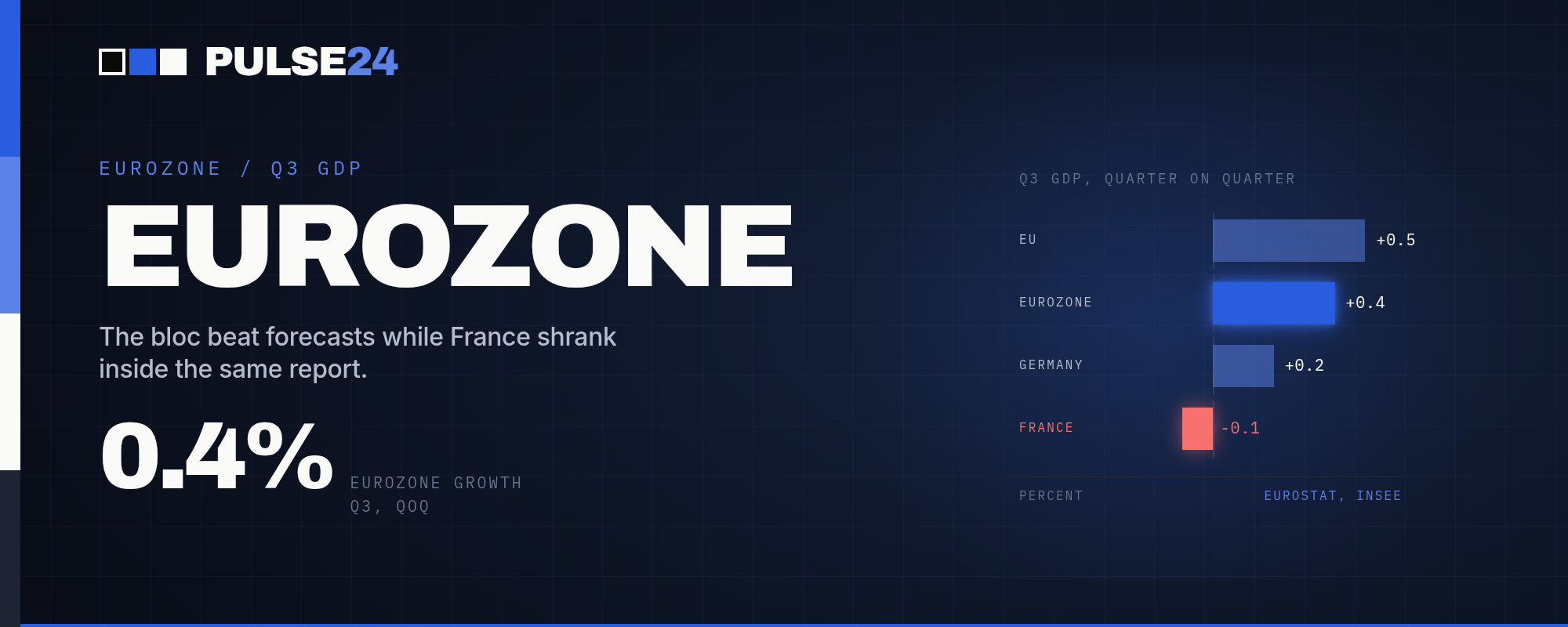
The eurozone grew 0.4% last quarter and beat forecasts, but the number hides a split: France actually contracted, Germany barely grew, and inflation ranges from 2.8% in Germany to 5.4% in Italy. The ECB held rates anyway, and UBS says the euro's slide went too far.
France's economy shrank 0.1% in the third quarter. Three days later, Eurostat said the currency bloc built around it grew 0.4%, beating every forecast economists had filed. Both figures came from the same release. The gap between them is the actual story.
Germany, the eurozone's largest economy and the one investors usually look to for direction, managed only 0.2% growth in the same period. Add France's contraction and Germany's near-stall together, and the bloc's two biggest members combined for something close to zero. The 0.4% headline number came almost entirely from smaller member states picking up the slack.
What Changed
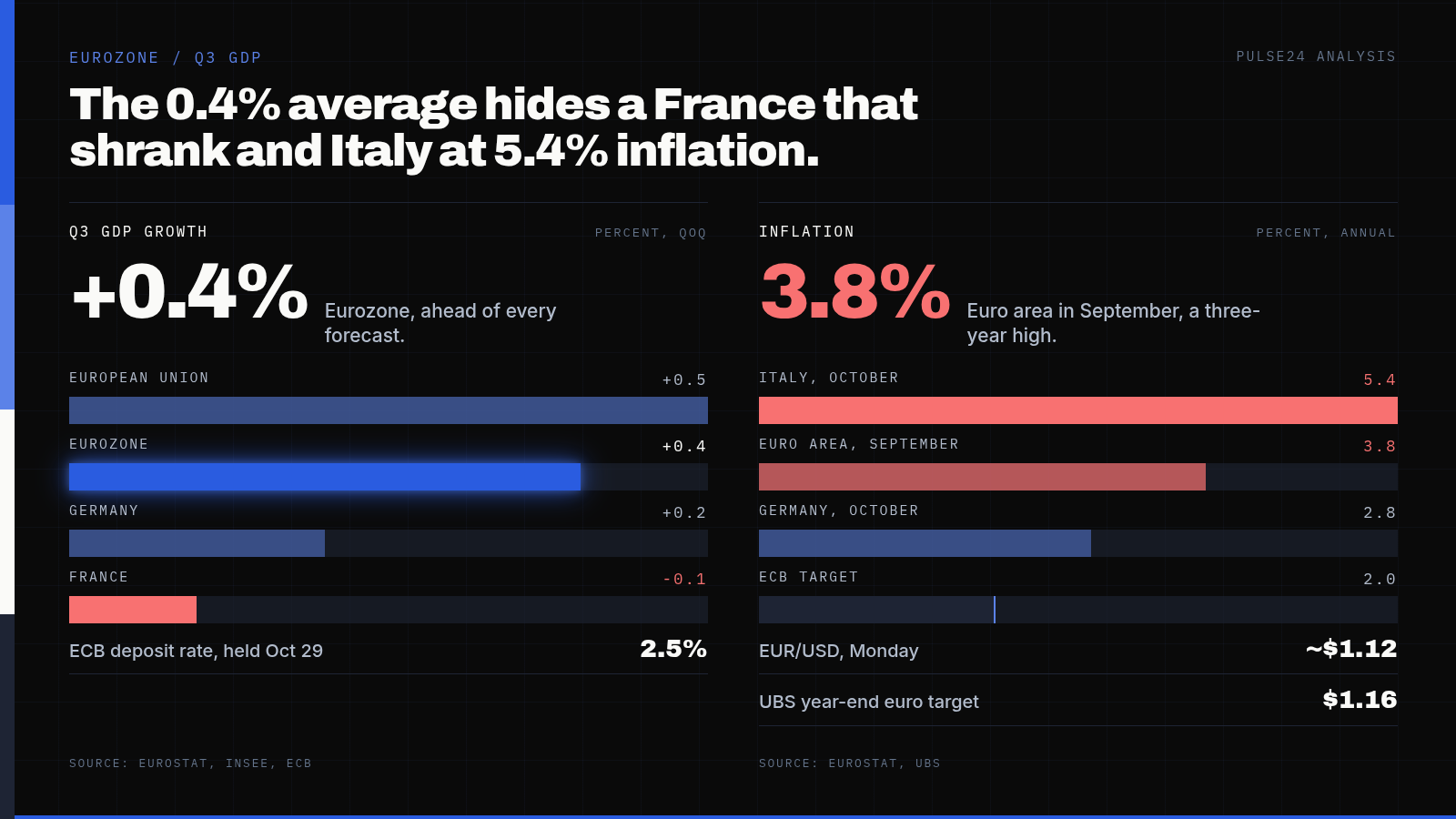
Eurostat's preliminary estimate, published October 30, put eurozone GDP growth at 0.4% quarter-on-quarter for the third quarter, ahead of what forecasters had penciled in. The European Union as a whole grew 0.5%. France's statistics agency INSEE reported a 0.1% contraction for the same period, driven in part by a government that has spent much of the year fighting off no-confidence votes over its budget. Prime Minister Sébastien Lecornu survived those votes, but the political fight has left businesses and consumers reluctant to commit to anything new.
Inflation told a messier story than growth did. Eurostat's September reading put euro area annual inflation at 3.8%, a three-year high and close to double the ECB's 2% target. When the October flash numbers broke out by country, the divergence got sharper rather than narrower: Italy's inflation rate jumped to 5.4%, while Germany's eased to 2.8% after Berlin cut a fuel tax that had been propping up pump prices. A single interest rate is supposed to fit all of that. It increasingly looks like it can't.
The ECB met this split growth-and-inflation backdrop by doing nothing. On October 29, the central bank held its deposit rate at 2.5%, the level it had raised rates to with a quarter-point hike in September, the same day Lagarde confirmed she'll step down on February 7, 2027, about nine months before her term was due to end. That announcement, and the French bond market's reaction to it, already got the market's attention last week. The GDP and inflation data that followed is the part of the story that came after the headlines moved on.
Why It Matters
A currency bloc with nineteen different economies was always going to produce uneven numbers. What's unusual is how wide the split has become. Italy running inflation near 5.4% while Germany sits at 2.8% is not a rounding error, it's two economies facing almost opposite policy problems inside the same interest rate. The ECB can calibrate for the eurozone average, or it can calibrate for France's stagnation, or for Italy's inflation, but not really for all three at once.
That tension is exactly what the three-central-bank hiking story from earlier this week was pointing at: when multiple major central banks are weighing further tightening in the same stretch, markets start pricing in more than any one of them may be able to deliver without breaking something domestically. Some investors have leaned into bets that the ECB tightens further given inflation's distance from target. UBS has pushed back directly on that view, arguing the euro's slide toward $1.11 already overshot what the underlying numbers justify, and forecasting a recovery to $1.16 by the end of the year.
The currency reaction is where this connects to the dollar side of the trade. EUR/USD was still struggling to clear $1.1200 on Monday, capped less by the GDP numbers themselves than by lingering nervousness over French fiscal risk. A eurozone that grows while its second-largest member shrinks is an awkward sell to currency traders, even when the aggregate number beats forecasts. The dollar has had its own credibility problem lately, with Fed hike odds collapsing and the dollar index giving back an 18-month high in the span of two weeks. Whichever side of that trade looks less broken tends to win it by default, not by strength.
What to Watch Next
The next real test is the December ECB meeting, where the bank has to decide whether a 3.8% inflation print outweighs a French economy that's shrinking and a German one that's barely moving. A hike would validate the market's hawkish pricing. A hold would suggest the ECB is more worried about growth than it's letting on.
France's political situation is also worth tracking on its own terms. Lecornu's government has survived confidence votes before, but the budget fight that's weighing on growth hasn't actually been resolved, just postponed. Any fresh flare-up there would test whether UBS's call for euro strength holds up against another round of French bond stress.
And Germany's 2.8% inflation print came with an asterisk: a fuel tax cut that won't be permanent. If that number drifts back up once the tax effect fades, the case for the ECB holding gets weaker, and the gap between what markets are pricing and what the ECB actually does could widen again.
The Pulse24 Take
The eurozone's 0.4% growth number is accurate and also somewhat beside the point. Averages are supposed to describe the thing they're averaging, and this one doesn't, not when France is shrinking, Germany is barely growing, and Italy's inflation rate is nearly double Germany's. A single number can be technically true and still hide the more useful information.
The ECB's bet, intentional or not, is that holding rates steady buys time for the picture to clarify rather than fracture further. UBS is betting the market overcorrected on the euro and will get paid back for being patient. Both bets rely on the same assumption: that France's political drama stays a French problem rather than becoming a eurozone one. The bond market mostly backed that assumption last month. Whether the growth and inflation data now backs it too is the question actually worth watching into December, not whether 0.4% beat the forecast.
How we read the data
Curious how we get from raw data to a take like this? Our Trader's Toolkit walks through the tools we lean on.
Explore the Toolkit