Pulse24 Original
France's 10-Year Bond Yield Hit a 24-Year High This Month. Christine Lagarde Will Leave the ECB Nine Months Before Her Term Ends.
October 29, 2026
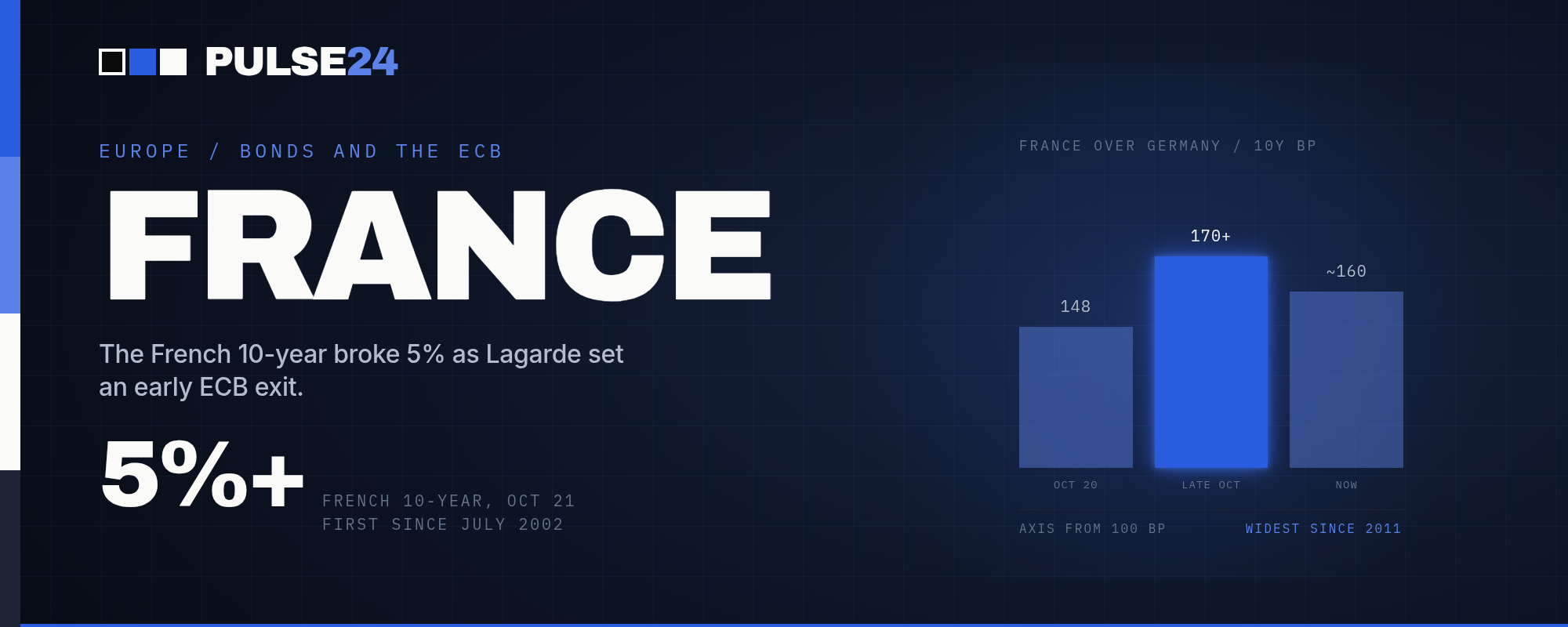
Christine Lagarde announced she's leaving the ECB nine months early, the same week France's bond market did the central bank's tightening job for it. The French 10-year yield hit its highest level since 2002, and Moody's left the country's rating alone, for now.
Christine Lagarde told reporters in July she wasn't going anywhere before 2027. On Thursday, she told them something different.
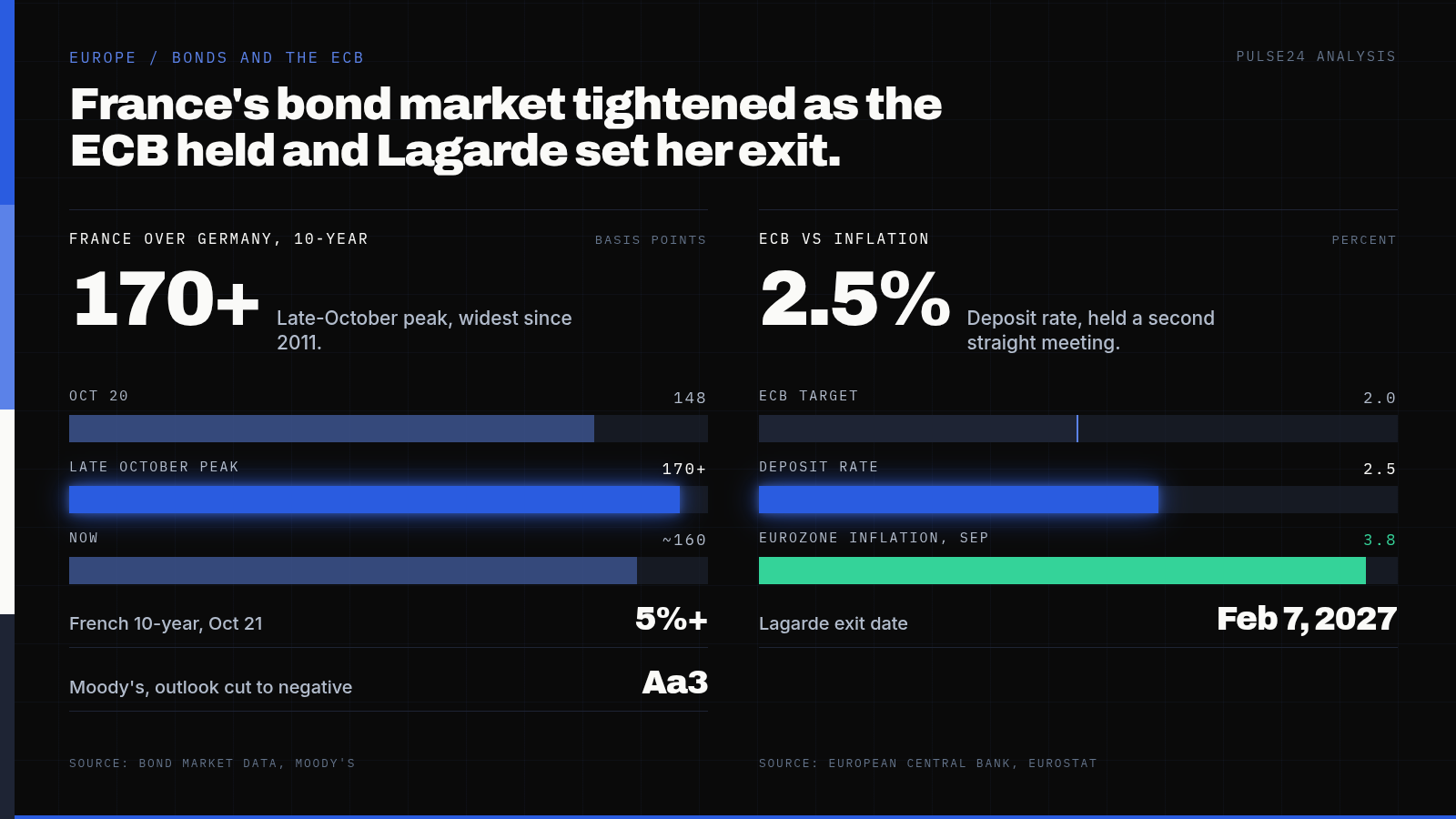
The European Central Bank president announced she will leave her post on February 7, 2027, roughly nine months before her eight-year term was set to expire. The ECB gave no official reason for the timing. It falls just months ahead of France's April 2027 presidential election, and reporting since has connected those two dates without much subtlety.
The announcement landed on the same day the ECB held its deposit rate at 2.5% for a second straight meeting, even with eurozone inflation running at 3.8% in September, nearly double the bank's target. A president with an exit date now attached to her, and inflation still climbing, would ordinarily be the bigger headline. Instead, the more interesting story might be sitting in the French bond market, which has spent the past month doing a version of the ECB's job without being asked to.
What Changed
France's 10-year bond yield crossed 5% on October 21, its first trip past that level since July 2002. It touched roughly 5.12% the next day, held above 5% through that Friday, then eased back to around 4.95% earlier this week. The spread between French and German 10-year debt, a standard gauge of how much extra investors demand to hold French risk over German risk, widened past 170 basis points in the same stretch, a level not seen since the 2011 eurozone debt crisis, before narrowing back toward 160 basis points. Five-year credit default swaps on French government debt, essentially insurance against a default, rose above 100 basis points on October 22, a level last seen in October 2012.
None of this happened because a rating agency finally pulled the trigger. Moody's reviewed France on Friday, October 23, and kept its rating at Aa3, the level it has held for years, while cutting the outlook from stable to negative. The agency pointed to political instability that could slow any real fix to the deficit, along with the risk that Prime Minister Sébastien Lecornu's government lets the 2023 pension reform unwind under pressure, which would weaken the long-term fiscal math rather than improve it. Fitch and S&P already have France a notch lower, at A+, after cutting the country last year. Investors sold the bonds anyway, even with the one agency that still rates France highest choosing not to move.
Carsten Brzeski, ING's head of macro research, put a number on what the bond market has effectively done by itself. In an October 22 note, he estimated that the rise in German yields since September has done roughly the work of a 25 basis point ECB hike, and that the effect in France is closer to 50 basis points. His description: the bond market has taken over the ECB's job. That helps explain why a central bank facing inflation at nearly double its target felt comfortable sitting still this week.
Why It Matters
France's underlying numbers are the ones worth watching past the headlines. The budget deficit sits near 5% of GDP against the European Union's 3% ceiling, and public debt is near 119% of GDP against the bloc's 60% guideline. The European Commission expects both to get worse before they get better, projecting a 5.7% deficit and debt above 120% by 2027. A parliament that has struggled to pass a budget without triggering a confidence vote is not an encouraging backdrop for fixing either number, and French consumer confidence fell to its lowest level in thirteen years this month.
Normally, a transition like this doesn't move markets by itself. This case is different. Lagarde has roughly fifteen months left in the job, heading into a leadership contest, right as the ECB most needs the credibility to hold a steady line between a eurozone still overshooting on inflation and a member state whose bond market is behaving like a quieter echo of 2011. Pablo Hernández de Cos, the former Bank of Spain governor who now runs the Bank for International Settlements, and Klaas Knot, the former Dutch central bank president, are the two names most often floated as her successor, and how that race unfolds says something about whether the next ECB president leans toward Germany's inflation-hawk instincts or the flexibility France is likely to need.
There is a reason none of this is being treated as a financial crisis yet. Analysts covering French banks note their balance sheets carry relatively little mark-to-market exposure to the sovereign debt causing the stress, which is part of why strategists describe the situation as closer to a political problem than a systemic one, at least for now. The ECB's Transmission Protection Instrument, built specifically to stop one country's bond stress from spreading across the currency bloc, is the backstop everyone assumes is there if that assessment turns out to be wrong.
This isn't a new storyline so much as the next chapter of one. The French-German spread first pushed past 148 basis points in late October, with that week's Moody's review flagged as the next catalyst to watch. That review has now come and gone without a downgrade, and the spread has since moved past where it stood back then anyway. One day earlier, the Federal Reserve held its own benchmark rate steady in a divided vote, a reminder that holding rates while inflation runs hot is not a uniquely European problem this week. The difference is that nobody is asking whether Fed Chairman Kevin Warsh will still be in his job fifteen months from now.
What to Watch Next
The next real test is whether France's bond yield keeps drifting back toward 5% or settles meaningfully below it, since that level has become the market's informal line between political noise and an actual funding-cost problem. Markets are increasingly pricing a December ECB hike alongside the French story, not because of it, with HSBC among the banks expecting a quarter-point move at that meeting. Whether Lagarde pushes that through herself or leaves it for whoever takes over in February is worth tracking.
The ECB succession race deserves its own attention too. de Cos and Knot represent genuinely different instincts on when to tighten and when to ease, and a market already nervous about French fiscal credibility will read early front-runner chatter as a signal of how much flexibility the next ECB president is likely to extend to a government under fiscal strain.
The Pulse24 Take
The headline event here was supposed to be a central bank holding rates while inflation sits at nearly double its target. That turns out to be the less interesting part. A central bank with an open credibility gap on inflation can get away with standing still precisely because the bond market has quietly done its tightening for it, which is a strange kind of relief for any policymaker to lean on.
Lagarde leaving nine months early does not change the eurozone's inflation math or France's deficit math. What changes is who has to answer for both over the next year, at a moment when the answers were already getting harder to give. Markets have so far shown they can price French fiscal stress without panicking into a 2011-style spiral. Whether that holds through a leadership transition and a December hike decision is the question the next few months actually need to answer, not whether this week's hold was the right call.
How we read the data
Curious how we get from raw data to a take like this? Our Trader's Toolkit walks through the tools we lean on.
Explore the Toolkit