Pulse24 Original
France's Bond Spread Over Germany Hit 148 Basis Points, Its Widest Since the Eurozone Crisis. Moody's Rules on the Rating Friday.
October 20, 2026
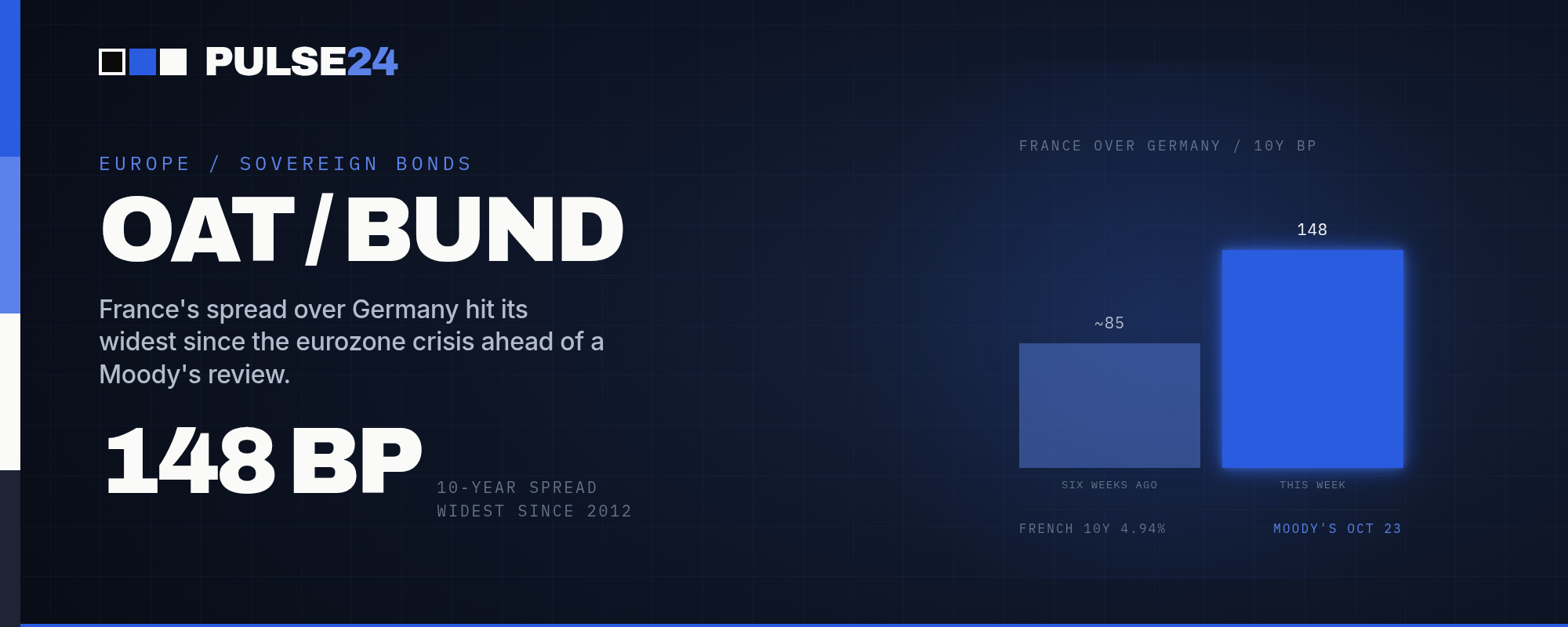
France's borrowing costs over Germany have widened to levels last seen during the eurozone debt crisis, and Moody's delivers its verdict on the country's credit rating this Friday. Nationwide protests over the 2027 budget are still working through the streets of Paris, and the ECB has made clear it isn't stepping in to help.
France's 10-year government bonds are now trading about 148 basis points above Germany's, a gap last this wide during the eurozone's 2011-2012 sovereign debt crisis. Six weeks ago that spread sat closer to 85 basis points. The jump isn't the product of one bad headline. It's a slow bleed that has pushed France's own 10-year yield up to 4.94%, with a Moody's ratings decision landing in three days and a fiscal standoff still playing out in the streets of Paris.
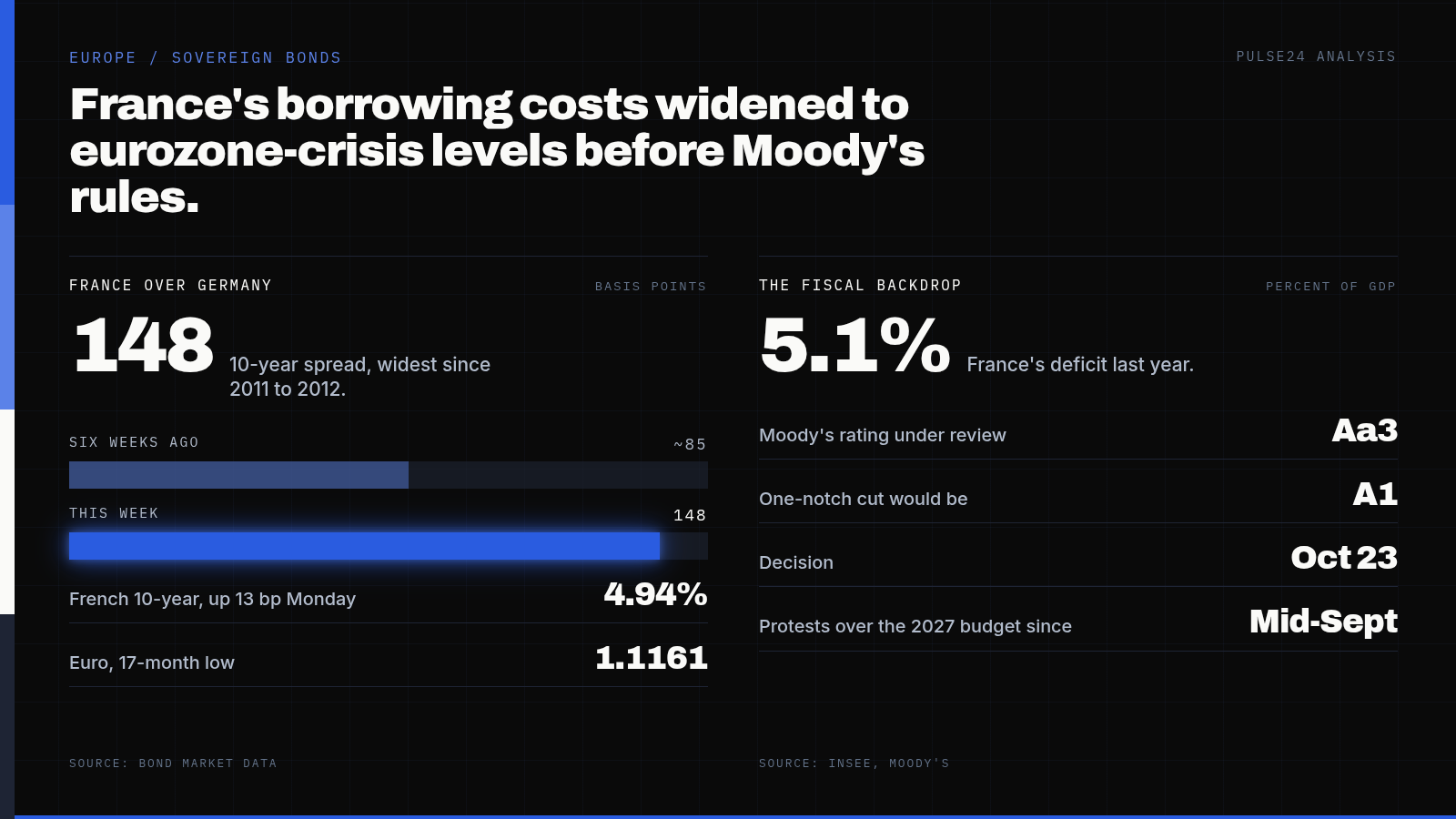
What Changed The French-German spread has been climbing in fits and starts since early September, when it traded around 85 basis points, a level traders already considered elevated. By September 30 it had reached 124 basis points. Two days later it briefly topped 140, a threshold last crossed in 2011, before easing back to the high 120s as investors debated whether the move had gone too far too fast. It didn't stay there. By Monday, France's 10-year yield had climbed 13 basis points in a single session to 4.94%, its biggest one-day jump since September, pulling the spread back up to around 148 basis points.
Behind the number is Prime Minister Sebastien Lecornu's 2027 budget, which tries to narrow a deficit that reached 152.5 billion euros last year, or 5.1% of GDP, against an EU average closer to 3.1%. The plan leans on a public-sector pay freeze and limits on pension increases, and it has run into protests that started in mid-September over school funding and spread into a broader movement echoing the 2018 "yellow vest" demonstrations. Thousands of people have taken part in marches across the country, and the unrest shows little sign of fading before parliament votes on the budget.
Emmanuel Moulin, a Bank of France governor and ECB Governing Council member, said earlier this month that "current conditions do not justify" intervention from the European Central Bank, and that the fix lies "here at home." That's a notable statement on its own. The ECB built a tool specifically for moments like this one.
Why It Matters That tool is the Transmission Protection Instrument, created in 2022 to let the ECB buy a struggling country's bonds when market stress threatens to break monetary policy across the currency bloc. The ECB has said the TPI isn't warranted for France yet, and the math explains why it's reluctant to reach for it. Euro-area inflation rose to 3.8% in September, and the ECB has already pushed its key rate to 2.5% this year. Buying French bonds to cap a single country's yields would sit awkwardly next to a central bank that is still fighting inflation everywhere else, which is part of why [the ECB's own rate path](/article/ecb-december-hike-odds-88-percent-reversal) has stayed on a hawkish track even as France's fiscal picture worsens.
France isn't short on debt to sell, either. Paris has penciled in a record 340 billion euros of bond issuance for 2027, up from 310 billion this year, and public debt already sits at 115.6% of GDP, the third-highest ratio in the EU behind Greece and Italy. The cost of insuring against a French default has moved too: credit-default swaps on French debt climbed to around 81 basis points in early October, their highest level since 2013. None of this means France is near default. It means the market is charging more to hold the risk than it has in a long time, and that cost shows up everywhere from mortgage-linked rates to the euro itself, which touched a 17-month low near 1.1161 against the dollar in early October before drifting lower again.
The spread widening hasn't stayed contained to France. Italy's 10-year spread over Germany has pushed back above 100 basis points for the first time since spring 2025, and strategists have flagged early signs of the same pressure reaching Belgian debt, which trades closely in step with French yields. That's the pattern eurozone watchers worry about most: one country's fiscal stress reshaping how investors price risk across the whole currency bloc, the same feedback loop that turned a Greek debt problem into a continent-wide crisis a decade and a half ago.
What to Watch Next Moody's publishes its review of France's Aa3 rating this Friday, October 23. The agency confirmed that rating with a negative outlook back in April, and a review date doesn't guarantee a change. Analysts see three realistic outcomes: Moody's holds Aa3 with a negative outlook, moves the outlook to stable, or cuts one notch to A1, which would put it in line with Fitch and S&P, both of which already rate France in the single-A category. A cut is arguably half-priced in already given where the other two agencies sit, so the bigger risk to watch is what the budget vote in parliament does to the spread over the following weeks, not the rating action itself.
There's also a longer fuse running underneath all of this. Polling for France's 2027 presidential election currently shows far-right leader Marine Le Pen ahead of her rivals, and RBC BlueBay's Mike Bell has floated a scenario where the spread could push toward 200 basis points if a candidate opposed to raising the retirement age looks likely to win. That's a conditional warning, not a forecast, but it's the kind of tail risk that keeps this story alive well past Friday's rating decision. Worth noting on the other side of the ledger: JPMorgan strategists have pointed to position liquidation and simple caution as drivers of the recent selling, not investors refusing to hold French debt outright.
The Pulse24 Take It's tempting to reach for 2011 every time a European spread widens this much, and the comparison isn't crazy. But France in 2026 isn't Greece in 2011, and the spread today, even at 148 basis points, is still well below the roughly 225 basis points France-Germany spreads touched at the height of that crisis. What's happening now looks more like a market testing whether a government can actually pass an unpopular budget while people are marching against it, and pricing in the odds that it can't.
The more interesting question isn't whether Moody's trims a notch on Friday. Ratings agencies tend to follow the bond market, not lead it. The real signal will come from whether the spread keeps grinding wider after the budget vote, or whether it settles once France actually has a passed budget in hand, however ugly the process to get there. Until then, the safest assumption is that French fiscal risk stays a slow-moving story rather than a sudden one, the kind that rewards patience over panic.
How we read the data
Curious how we get from raw data to a take like this? Our Trader's Toolkit walks through the tools we lean on.
Explore the Toolkit