Pulse24 Original
Disco's Shipments Rose 60% to a Record High. The Stock Fell 7% on the News.
October 23, 2026
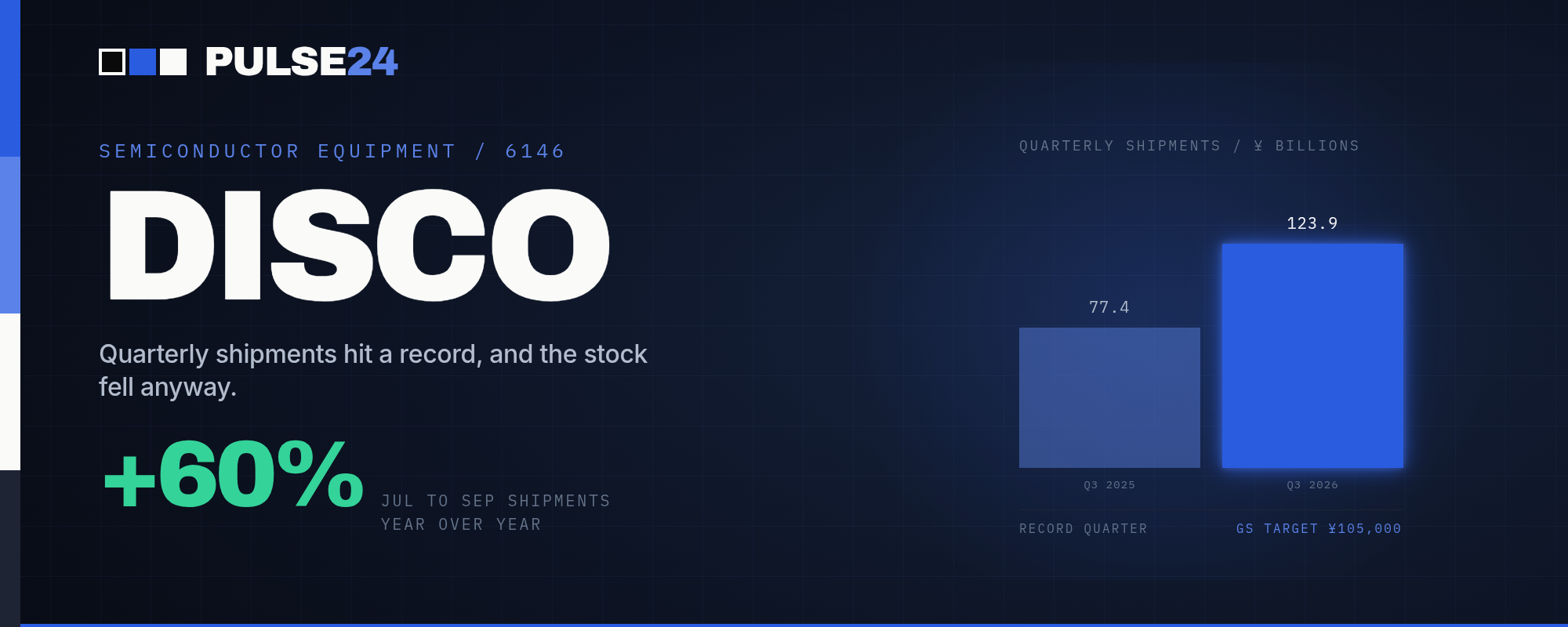
Disco's AI-chip equipment shipments jumped 60% to a record high this quarter, and investors sold the stock anyway. Goldman Sachs says the shares could still nearly double, a reminder that order books and share prices aren't telling the same story in this capex cycle.
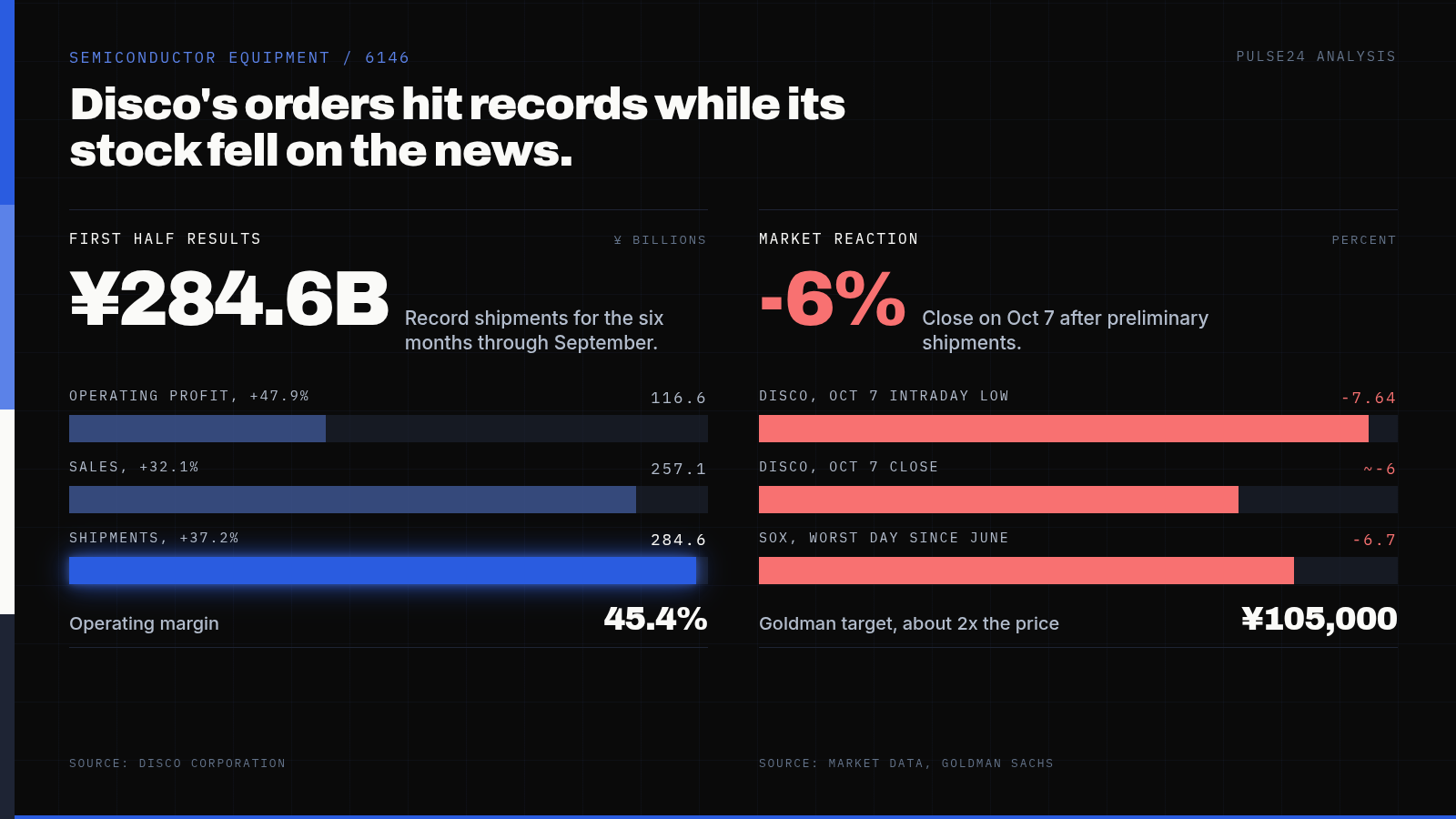
Disco Corporation, the Hiroshima-based maker of the precision saws and grinders used to slice and polish silicon wafers, booked ¥257.1 billion in sales for the six months through September, a 32.1% jump from the same period last year. Shipments for the half rose even faster, up 37.2% to a record ¥284.6 billion. Operating profit climbed 47.9% to ¥116.6 billion, and the operating margin reached 45.4%, a level most industrial companies never touch even once.
The stock did not celebrate. When Disco released preliminary shipment figures on October 7 showing the same underlying strength, shares fell as much as 7.64% intraday before closing down roughly 6%. The numbers were, by most accounts, excellent. They were also, in traders' eyes, already priced in.
That gap between the numbers and the stock price is the real story this week, and it is playing out well beyond one Japanese supplier.
What Changed
On a standalone, parent-only basis, Disco's shipments for July through September alone hit ¥123.9 billion, up 60% from ¥77.4 billion a year earlier and a new quarterly record. Standalone shipments for the full six-month period reached ¥240.5 billion, up 41.1%. Gross margin on that standalone business hit 71.7% in the quarter, also a record, and about 1.5 percentage points above what the company itself had assumed.
Management used the earnings release to disclose guidance through the December quarter for the first time this cycle: nine-month cumulative sales of ¥389.5 billion, up 28.2%, and nine-month net profit of ¥121.9 billion, up 31.6%, with the January-to-March quarter still undisclosed. The interim dividend rose to ¥186 a share from ¥129. None of this reads like a company worried about demand.
Wall Street's own read on the stock tells a more complicated story. Goldman Sachs reiterated its Buy rating on October 18 with a price target of ¥105,000, close to double Disco's ¥52,630 close two days earlier, citing expected expansion in advanced packaging as AI chips lean more heavily on stacked memory. A trailing price-to-earnings ratio above 40 means the market is already paying up for growth; the disagreement is over how much room is left above that.
Why It Matters
Disco's numbers arrived in the same week the market's patience with AI-related spending visibly cracked. The Nasdaq fell 2.6% on October 23, its steepest one-day drop since June, and the Philadelphia Semiconductor Index lost 6.7%, its worst session since June 23 and now more than 26% below its June record, even after a 51.5% year-to-date gain. Intel, AMD, Sandisk and Marvell each fell more than 8%. Meta dropped 7% despite beating earnings estimates, dragged down by a first negative free cash flow quarter in over a decade tied to AI infrastructure spending.
Investors are questioning whether the money hyperscalers are pouring into AI infrastructure will eventually show up as profit. Disco's order book answers a narrower, more mechanical question: whether the physical chips underneath that spending are actually being cut, ground and packaged in greater volume. Right now the answer to that second question is an unambiguous yes, a different signal than a stock chart sliding for weeks.
It is also not an isolated case. ASML, the Dutch equipment maker, posted a 134% profit jump tied to AI chip demand projected out to 2028, and its stock still didn't follow. Two of the world's most important chip equipment suppliers posting blowout, forward-looking results while their shares stall or fall is a pattern worth sitting with, not explaining away in either direction.
There's a memory angle too. Disco management has argued that if Nvidia ends up shipping its next-generation Rubin Ultra chip with fewer memory layers than originally planned, a possibility tied to the ongoing HBM shortage reshaping the AI chip supply chain, that would not necessarily hurt equipment demand. Fewer layers per stack can mean more individual memory packages need to be diced and bonded, which is Disco's business. The same HBM capacity crunch has already reshaped how Samsung, TSMC and Nvidia are splitting up memory production work, and Disco sits downstream of nearly all of it.
What to Watch Next
Disco's next scheduled results cover the October-to-December quarter and will show whether the 28.2% nine-month sales guidance survives contact with reality, and whether management adds a January-to-March forecast on top of it, or whether this week's broader chip selloff eventually bleeds into actual order cancellations rather than just stock-price anxiety. Watch other equipment suppliers, Tokyo Electron and Lasertec among them, for the same split between unit demand and share performance. And watch the Philadelphia Semiconductor Index's drawdown from its June peak: a further slide would suggest the market's doubts are deepening, while stabilization would suggest this week's drop was a valuation reset rather than the start of something bigger.
The Pulse24 Take
When a sector narrative turns as negative as "AI spending" did this week, it's worth separating what investors are afraid of from what is actually happening on factory floors. Those aren't always the same thing, and this week they clearly weren't. Disco's shipments, margins and nine-month guidance all point to a hardware buildout that is still accelerating, not slowing. The stock's reaction points to a market that has decided the easy money in AI infrastructure stocks has already been made and is now demanding proof of returns before paying up further.
Neither side is obviously wrong. Equipment orders placed today can still turn into a glut eighteen months from now if hyperscaler capital spending genuinely rolls over, and Disco's own trailing valuation leaves little room for disappointment. But conflating a stock-price story with a physical-demand story, in either direction, is how investors end up surprised later. The physical demand for the tools that make AI chips is still running at record levels right now. Whether that holds is a different question than whether the stocks that make those tools keep falling.
How we read the data
Curious how we get from raw data to a take like this? Our Trader's Toolkit walks through the tools we lean on.
Explore the Toolkit