Pulse24 Original
CME Group Will List the First Futures Contracts on AI Computing Power This October. The Benchmark Behind Them Already Prices an Hour of Nvidia's Newest Chip at $5.74.
August 30, 2026
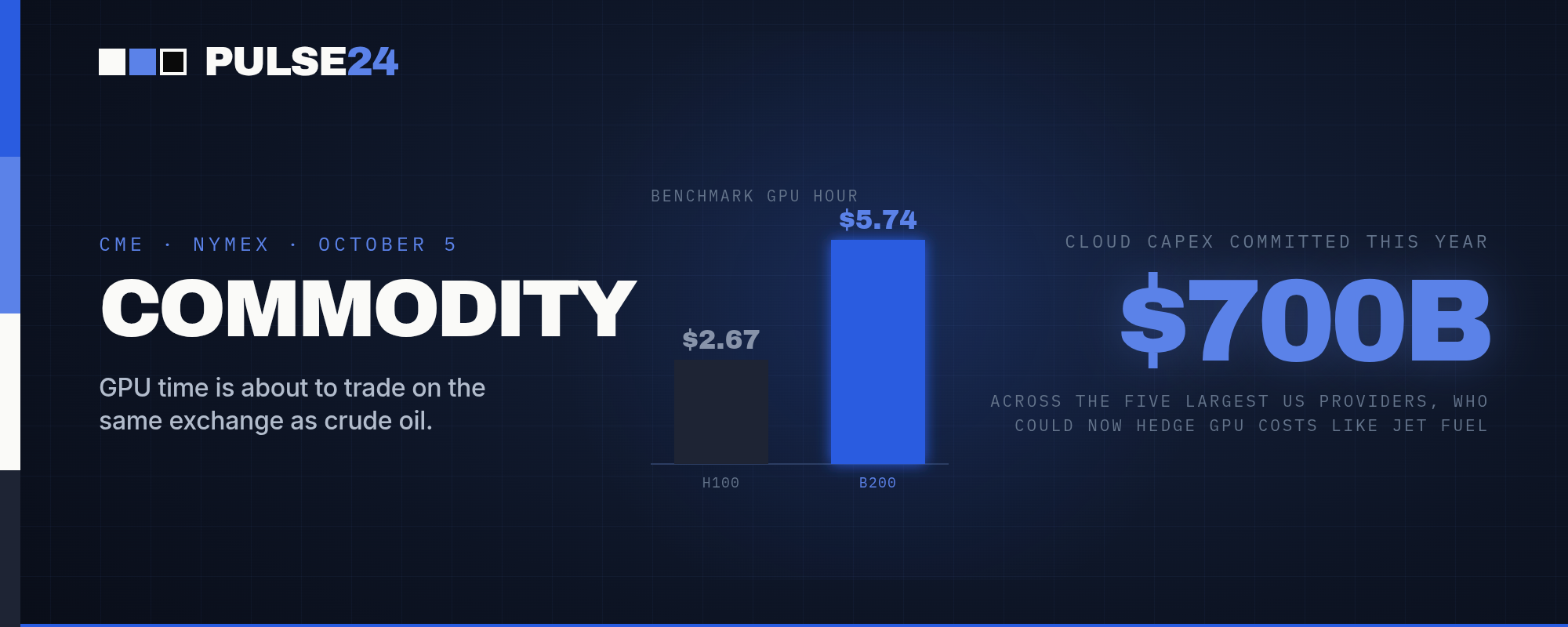
CME Group and Silicon Data are about to give Wall Street its first public futures market for Nvidia GPU rental prices, launching October 5. It is a bet that AI compute has finally become standardized enough to trade like oil or wheat, at a moment when the largest cloud providers have committed more than $700 billion to the buildout those chips power.
Renting an Nvidia H100 chip for an hour costs $2.67 right now. A B200, Nvidia's newer and more powerful chip, costs $5.74. Until this month those numbers lived inside a specialized pricing service most traders had never heard of. Starting October 5, assuming regulators sign off, they will set the reference price for a public futures market.
CME Group announced the plan alongside Silicon Data, the firm that has spent the past year building daily benchmarks for GPU rental prices across neo-cloud providers and hyperscalers. Pete Keavey, CME's global head of energy and environmental products, said "compute has become the currency of the AI age," and that the new contracts will "bring transparency to current and future costs that AI builders and hyperscalers need to hedge as they grow." The contracts will list on NYMEX, the exchange that already handles crude oil and natural gas futures, and each one will track a full month of GPU rental costs at a time.
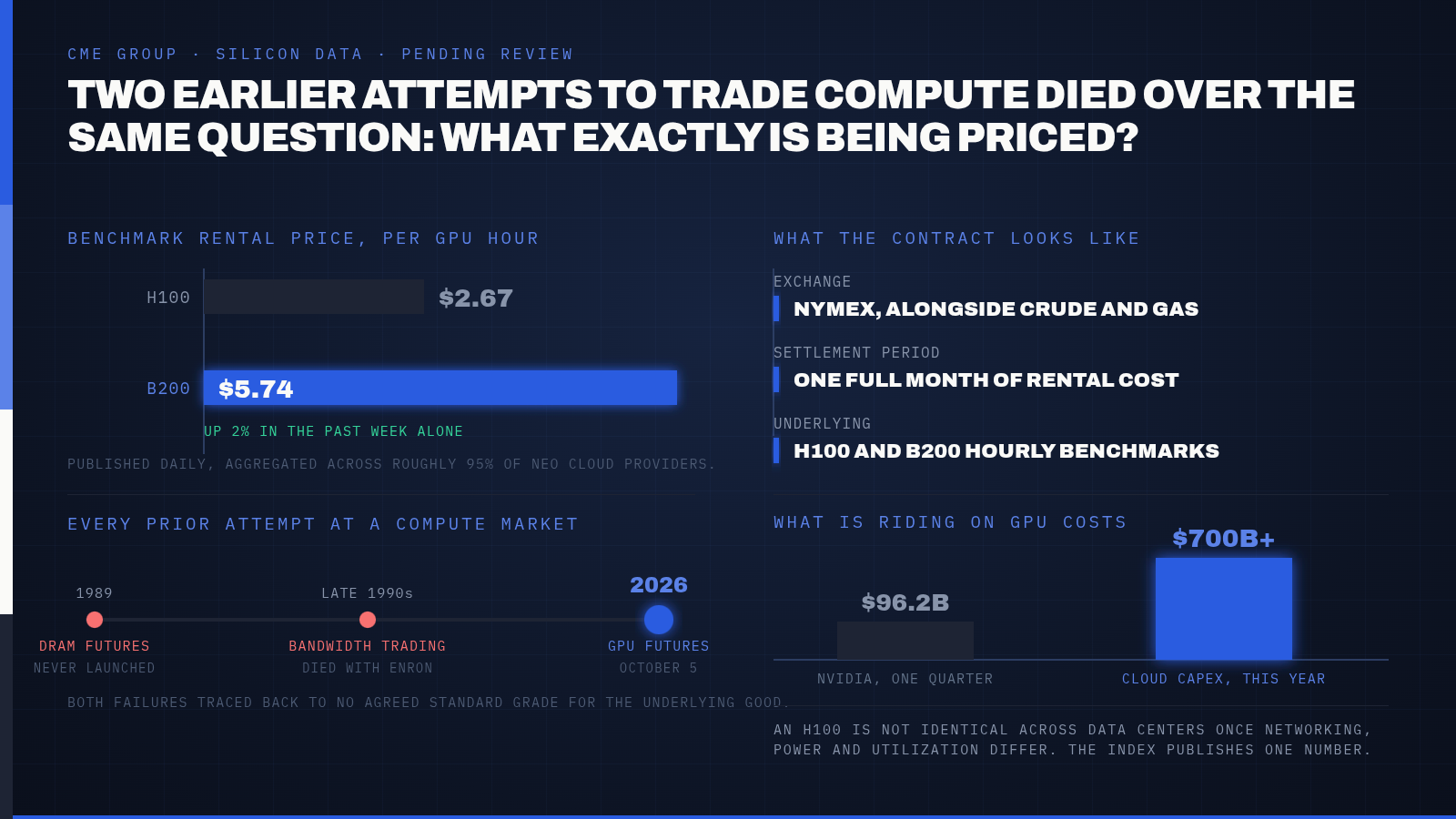
Wall Street has tried this before and failed. An exchange attempted a futures market for DRAM memory chips in 1989, and it never got off the ground because no one could agree on a standard grade for a product that changes generation to generation. A bandwidth-trading market modeled on the same idea took shape in the late 1990s under Enron's sponsorship, then disappeared once Enron did. Both failures traced back to the same problem, a lack of agreement on what, precisely, was being priced. GPUs carry a version of that problem today. An H100 running in one data center is not identical to an H100 running in another once you factor in networking speed, power availability, and how heavily the chip is already being used.
Why It Matters
Silicon Data's answer is to standardize what can be standardized. Its index aggregates pricing across roughly 95% of neo-cloud providers and the major hyperscalers, adjusting for region, rental structure, and chip variant, then publishes a single daily number for each GPU model. That number is what CME plans to settle its contracts against. Carmen Li, Silicon Data's chief executive, described the goal as giving the market something it has never had: a public, tradable reference price for the resource every AI system runs on.
The timing lines up with how much money is riding on GPU costs staying predictable. Nvidia reported $96.2 billion in quarterly revenue in August, and the five largest US cloud and AI infrastructure providers have committed to spending more than $700 billion on capital expenditure this year, a figure analysts already describe as rising as guidance gets revised upward through the year. Locking in the cost of GPU time for a training run months in advance follows the same risk-management logic an airline uses when it hedges jet fuel. Without it, a hyperscaler planning a multi-year training buildout is betting on where compute prices land, on top of everything else that bet already depends on.
There is also a quieter motive at work, one that connects to a debate that has been building around AI infrastructure debt all year. Credit-default swap spreads on Broadcom's and Oracle's own debt hit records this week as investors priced in the risk that the AI buildout does not generate returns fast enough to cover what is being borrowed to build it, and JPMorgan is separately arranging $5 billion in debt for a data center company that did not exist seven months ago. A liquid futures market does not eliminate that risk, but it gives lenders and equity investors an independent, market-derived price to check assumptions against, rather than taking a hyperscaler's internal capex model on faith.
What to Watch Next
The launch itself is not guaranteed. CME's announcement describes the contracts as pending regulatory review, and CFTC Chair Michael Selig has spoken publicly about the need for a robust derivatives market without confirming a specific approval timeline. Assuming the October 5 date holds, the more interesting test comes afterward, whether trading volume actually shows up. A futures contract only works as a hedge if enough participants trade it that the price reflects something real, and Wall Street's history with novel commodity contracts, from onion futures (banned entirely by Congress in 1958) to more recent attempts at weather and freight derivatives, is that most fail to attract enough volume to matter.
Watch too for how Nvidia itself responds. Jensen Huang has been telling investors for months that "compute is revenue," a framing that fits neatly with a public benchmark reinforcing GPU time as a scarce, priced resource, but transparency cuts both ways: the same benchmark makes it easier for customers to spot when they are being charged a premium above the going rate. Rivals building custom silicon, and cloud providers reselling someone else's spare GPU capacity, will be watching the same number just as closely.
The Pulse24 Take
A futures market existing for something is itself information. Oil, wheat, and natural gas all got their own contracts once the world decided those inputs mattered enough, and were standardized enough, to hedge at scale. GPU compute joining that list says as much about how mainstream AI infrastructure has become as anything in a quarterly earnings report. The skepticism is fair too. DRAM tried this in 1989 and bandwidth tried it in the late 1990s, and both attempts failed because the underlying product refused to behave like a commodity. An H100 sitting in a well-cooled data center with cheap power is not the same asset as an H100 running in a facility fighting for electricity, and no benchmark fully erases that gap. What the launch really tests, more than whether traders show up on October 5, is whether the AI buildout has reached the point where its biggest cost input can be priced like one thing instead of a thousand slightly different things. A maturing market says yes. Thin volume and a quiet fade, the same path DRAM futures and bandwidth trading took before it, would say otherwise.
How we read the data
Curious how we get from raw data to a take like this? Our Trader's Toolkit walks through the tools we lean on.
Explore the Toolkit