Pulse24 Original
UK 30-Year Gilt Yields Hit Their Highest Level Since 1998. The Bank of England Still Might Hike in November
October 20, 2026
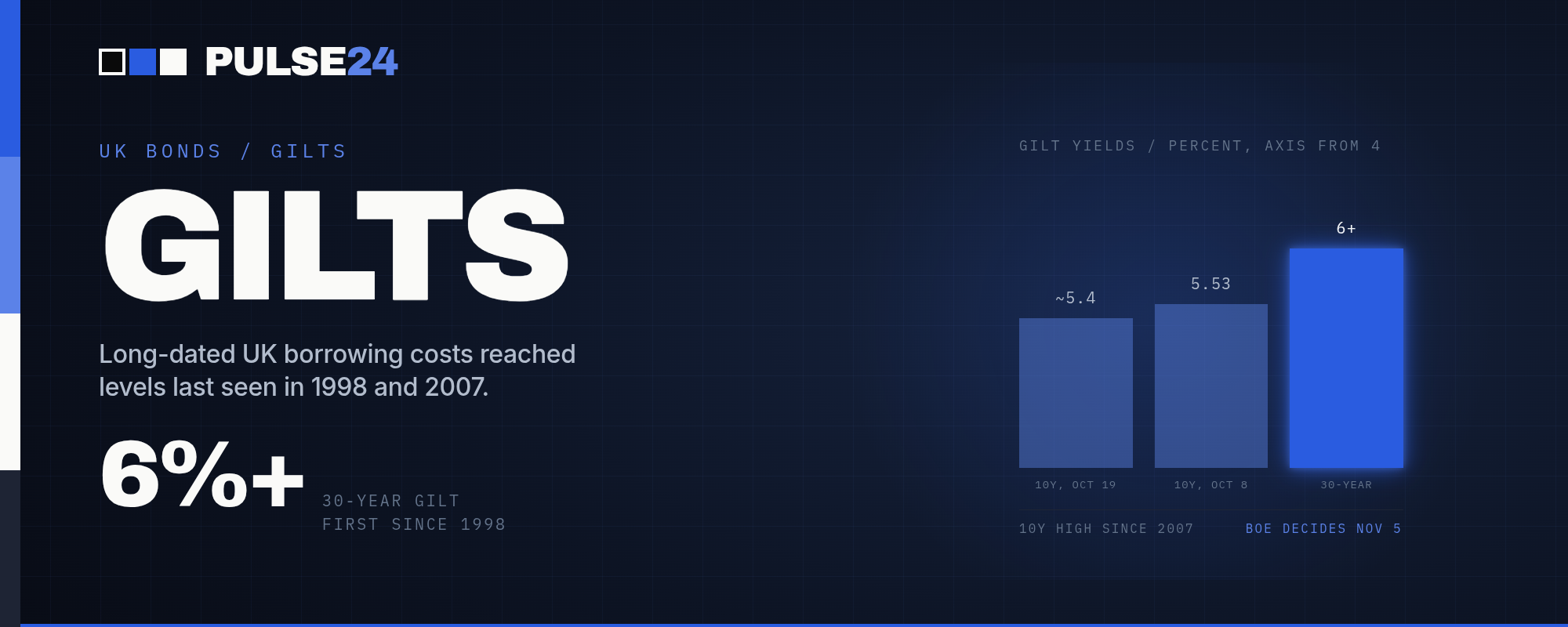
UK government bond yields have climbed to levels last seen in 1998 and 2007, and the Bank of England's November 5 decision now carries real tail risk. The selloff is about energy costs and surprisingly strong growth, not just another fiscal scare.
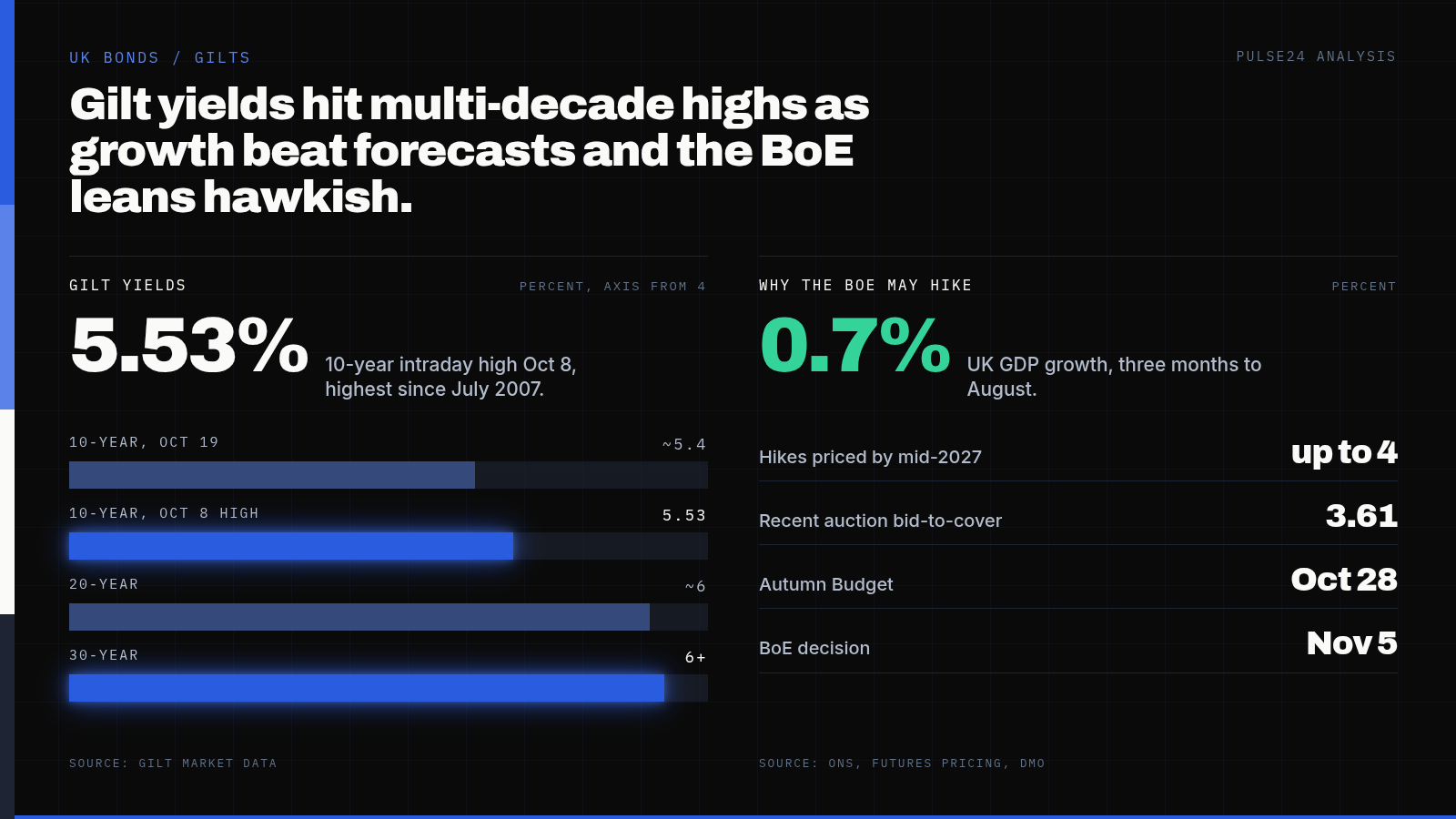
Britain's 10-year borrowing costs hit 5.53% intraday on October 8, a level the gilt market hadn't traded at since July 2007. The 30-year yield did something arguably more dramatic, clearing 6% for the first time since 1998. Neither move happened because of a single headline. Energy costs are climbing again, and UK growth keeps beating forecasts by enough that the Bank of England increasingly sounds unwilling to rule out another hike.
What Changed Gilt yields had already been drifting higher through September, with the 10-year note around 5.3% to start the month. Then came the first week of October. Brent crude jumped roughly 5% to touch $105 a barrel, and that move fed directly into inflation expectations for an economy that still imports a large share of its energy. By October 8, the 10-year yield had climbed past its own high from a week earlier, and 20-year and 30-year paper followed it to levels unseen in nearly three decades.
The move wasn't purely a UK story. US Treasuries sold off over the same stretch, which suggests part of this was a global repricing of how long rates stay restrictive, not something unique to Westminster. Yields did ease briefly around October 16, falling back below 5.35% as a broader equity selloff sent money into government bonds for safety. That relief didn't last. By October 19, the 10-year yield had climbed back to roughly 5.4%, tracking a similar move higher across European bond markets, where France's own spread over Germany has been widening for separate reasons.
Demand at recent auctions cuts against the simplest version of this story. The bid-to-cover ratio, a rough gauge of how many buyers show up relative to the bonds on offer, actually rose to 3.61 even as the 10-year yield pushed through 5.4% this week. Investors haven't stopped buying gilts. They're just demanding a higher yield to do it, which is its own problem for a government that needs to keep selling debt at a pace few of its peers can match.
Why It Matters A 10-year gilt yield near 5.4% matters well beyond bond-desk spreadsheets. The 10-year note is the benchmark much of Britain's new borrowing gets priced against, so every basis point higher raises the government's own interest bill at exactly the moment Chancellor John Healey is trying to find room in the budget for cost-of-living relief. Mortgage rates tied to gilt yields tend to move in the same direction, which is its own drag on the consumer spending the Bank of England is trying to manage.
The inflation side of the story matters just as much as the yield itself. UK GDP grew 0.7% over the three months to August, the fourth consecutive month of growth that beat economists' forecasts, and that kind of resilience gives the Monetary Policy Committee less cover to treat rising energy costs as a one-off. Bailey has said there's limited evidence so far that higher energy prices are feeding into broader wages and prices, but he's also acknowledged it's too early to rule out the risk. Committee members Megan Greene and Huw Pill have gone further, arguing the MPC should act before any second-round effects take hold rather than wait for proof they've already arrived.
That's a notably different posture than the one markets expected even a month ago, when a hold at the November meeting looked like the consensus call. Now LSEG pricing data shows investors betting on as many as four rate hikes by July 2027, a sharp turn for a central bank that spent much of the past two years more worried about growth than inflation. Japan's central bank has been running a parallel experiment, hiking at its fastest pace since 1990 without managing to stop the yen's slide, a reminder that raising rates doesn't automatically solve the problem a central bank is hiking to fix.
What to Watch Next The Bank of England's next scheduled decision lands November 5, alongside its quarterly Monetary Policy Report. A 25-basis-point hike isn't the only outcome on the table, and the betting around it has eased slightly in the past few days, but the fact that a hike is even the base case for some desks shows how far sentiment has shifted since September.
Before that, Healey's October 28 budget is arguably the bigger near-term catalyst for yields. Some fund managers, including M&G and Ninety One, have reportedly been buying gilts ahead of the announcement on the bet that visible fiscal discipline could pull yields back down regardless of what the Bank of England does two weeks later. If the budget disappoints that crowd, the 10-year note could retest its October highs quickly. If it reassures them, gilts have room to rally even with a hike still on the table.
Wage growth data and the next UK inflation print are worth watching too. Bailey's own comments suggest the MPC's hawkish wing is waiting for confirmation that energy costs are leaking into paychecks and services prices, not just headline inflation. That's the data that would turn a one-meeting hike into the start of a longer tightening cycle rather than a single defensive move.
The Pulse24 Take The instinct when gilt yields touch 2007 and 1998 levels in the same week is to reach for the word crisis. That's probably the wrong frame here. The 2022 gilt crisis was about a market that stopped trusting the government's math overnight. This looks closer to a central bank catching up to an economy that refuses to slow down, with an inconvenient energy shock layered on top. Growth that beats forecasts four months running isn't typically what a bond crisis looks like.
The more useful question for markets outside the UK is whether this is an early preview of a broader problem: central banks that spent 2024 and 2025 planning for rate cuts now facing economies and energy prices that haven't cooperated. The Bank of England just happens to be the one furthest along in admitting it out loud. Whether the Federal Reserve and the ECB end up having the same conversation in the coming months is the thing worth tracking long after November 5 has passed.
How we read the data
Curious how we get from raw data to a take like this? Our Trader's Toolkit walks through the tools we lean on.
Explore the Toolkit