Pulse24 Original
PTC Stock Jumped 33% on Schneider Electric's $22.6 Billion Buyout. Schneider's Own Shares Fell 10%.
October 6, 2026
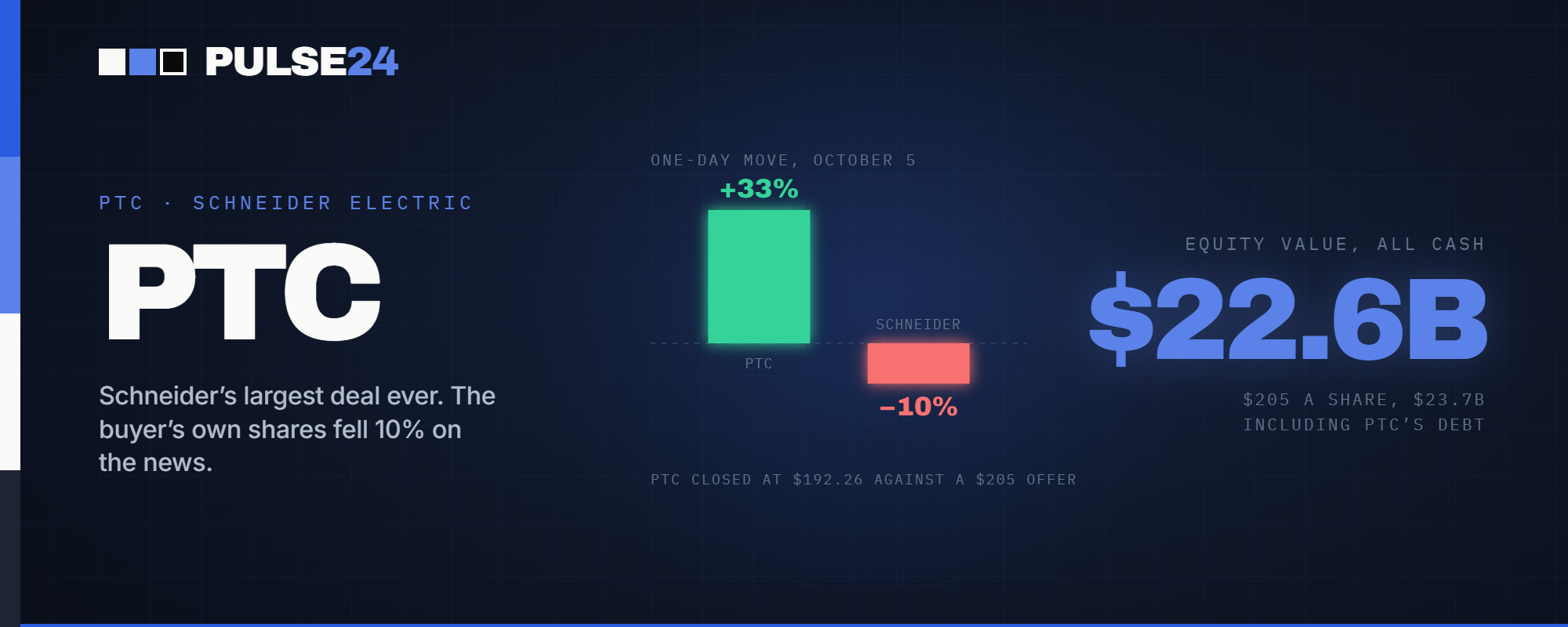
Schneider Electric agreed to pay $22.6 billion for PTC, its largest acquisition ever and a bet that industrial software is the next frontier for AI capital spending. PTC's stock jumped 33% on the news while Schneider's own shares fell 10%.
Schneider Electric agreed to pay $205 a share, all cash, for PTC on Monday. That works out to $22.6 billion in equity value, $23.7 billion including PTC's debt, and it is the largest acquisition the French industrial giant has ever made. PTC's stock jumped 33% to close at $192.26. Schneider's own shares fell 10%, a reaction investors don't usually give the company making an offer that rich.
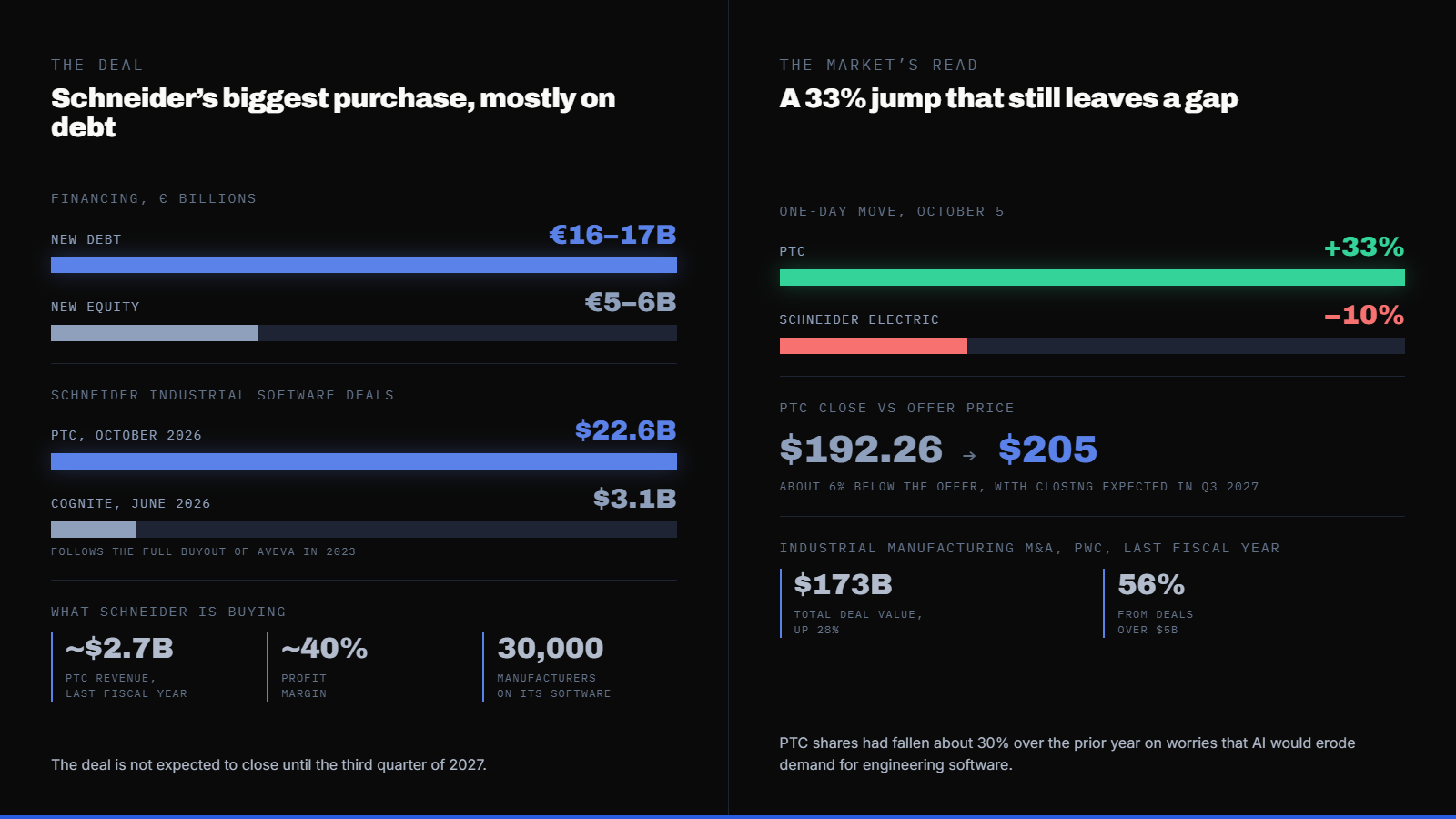
The gap between PTC's new closing price and the $205 Schneider is actually paying tells its own story. Deals this large take time to clear antitrust review, and Schneider isn't expecting to close this one until the third quarter of 2027, nearly two years out. A spread that size is the market pricing in both the wait and the chance, however small, that regulators or shareholders complicate things along the way.
What Changed
PTC makes the software that roughly 30,000 manufacturers use to design products, manage their lifecycle from blueprint to retirement, and track how they perform once they're built. It's a specialized, sticky business: switching CAD or PLM systems mid-project is expensive and slow, which is part of why PTC carries profit margins near 40% on revenue of roughly $2.7 billion last fiscal year. Schneider wants to bolt that onto its own industrial software stack and connect it with the physical equipment, sensors, and energy systems it already sells.
This is the third time Schneider has gone shopping for industrial software in three years. It bought UK-based Aveva outright in early 2023, folding in plant-operations and engineering software it already held a majority stake in. In June, it agreed to pay $3.1 billion for Cognite, a Norwegian industrial AI firm. PTC is by far the biggest of the three, and Schneider is framing it the same way each time: physical infrastructure plus the software layer on top equals something competitors can't easily copy. CEO Olivier Blum described the logic on Monday, saying the deal will let Schneider "create a unique digital thread for the next generation of industrial AI" by connecting data across a product's entire lifecycle.
None of this is cheap, and Schneider isn't paying for it out of cash on hand. The roughly €22 billion purchase price is being funded with €5 billion to €6 billion in new equity and €16 billion to €17 billion in fresh debt, on top of what the company already carries. That financing mix, more than the price tag itself, is likely why Schneider's shares fell as hard as they did.
The price itself has a case behind it, even with the premium. MIT Sloan professor Michael Cusumano noted that PTC shares had already fallen about 30% over the prior year as investors worried artificial intelligence would eventually erode demand for traditional engineering software, the same fear that's weighed on several enterprise software names this year. Buying into that pessimism, rather than paying up at a high, is arguably the more disciplined version of an AI-era acquisition. Robert W. Baird analyst Joe Vruwink framed the strategic logic more simply: the deal will, in his words, "significantly enhance Schneider's own line of industrial software products."
Why It Matters
Pulse24 has tracked how AI capital spending keeps finding its way into industries that have nothing to do with building chips or renting cloud servers. Every sector in the S&P 500 is projected to grow earnings this quarter for the first time since 2021, and strategists have pointed to hyperscaler spending showing up as revenue for everyone from catering companies to industrial parts suppliers. Schneider's bet on PTC is the M&A version of the same idea: if manufacturers are going to spend more connecting physical assets to AI systems, the company that already owns the data layer in between stands to benefit, whether or not it ever builds a chatbot itself.
The debt side of the deal lands at an awkward moment for borrowing. High-yield spreads widened to 294 basis points just last week, and September was already the busiest month of the year for junk bond issuance. Schneider's own debt is investment-grade, not junk, so it isn't borrowing in that exact corner of the market. But the broader signal is similar: credit investors are pricing risk more carefully than they were earlier this year, right as a wave of AI-linked companies ask them for money. PwC counted $173 billion in industrial manufacturing M&A in its last fiscal year, up 28%, with mega-deals of $5 billion or more now making up 56% of that total, well above where that share stood a year earlier. Schneider just added one of the largest entries yet to that list.
What to Watch Next
The deal isn't expected to close until the third quarter of 2027, an unusually long runway that reflects the antitrust review a transaction this size will draw across multiple jurisdictions. That gap is exactly why PTC's stock, even after jumping 33%, closed at $192.26 rather than near the $205 Schneider is actually paying. Expect that spread to narrow gradually as regulatory milestones clear, and to widen again if any jurisdiction raises objections.
Watch how Siemens and Rockwell Automation respond. Both compete directly with pieces of Schneider's expanded software portfolio, and a deal this size raises the competitive stakes for the entire industrial software category. Credit rating agencies are worth watching too, given how much new debt is funding this purchase; a rating action in either direction would say a lot about how Wall Street views serial, debt-funded acquisitions in the current rate environment.
Longer term, the number that matters is the €800 million in annual revenue synergies and €250 million in cost synergies Schneider says it can extract by the deal's third year. Those targets are easy to put in a press release and much harder to deliver while stitching together three separate software acquisitions in three years.
The Pulse24 Take
Buying the thing everyone's afraid AI will replace, at a discount created by that very fear, is a strategy with some logic to it. PTC's stock had already priced in a worst case that assumed AI would hollow out demand for CAD and PLM software. Schneider is betting the opposite: that AI makes the data these tools generate more valuable, not less, because someone has to feed clean product data into whatever industrial AI systems come next.
Execution is the bigger question than the thesis. Schneider now has to integrate Aveva, Cognite, and PTC into one coherent platform while carrying tens of billions in new debt, all while convincing 30,000 PTC customers not to bolt for a competitor during a messy, two-year ownership transition. The market's initial verdict, a 10% drop in Schneider's own stock, suggests investors aren't yet convinced that math works out. They've been right to be skeptical of ambitious AI-adjacent spending before. Whether this is different probably won't be clear until those synergy numbers come due, years from now.
How we read the data
Curious how we get from raw data to a take like this? Our Trader's Toolkit walks through the tools we lean on.
Explore the Toolkit