Pulse24 Original
PJM's Capacity Auction Price Rose 11-Fold in Two Years. The Utility Stocks Built for This Moment Are Down 5% on the Year.
October 21, 2026
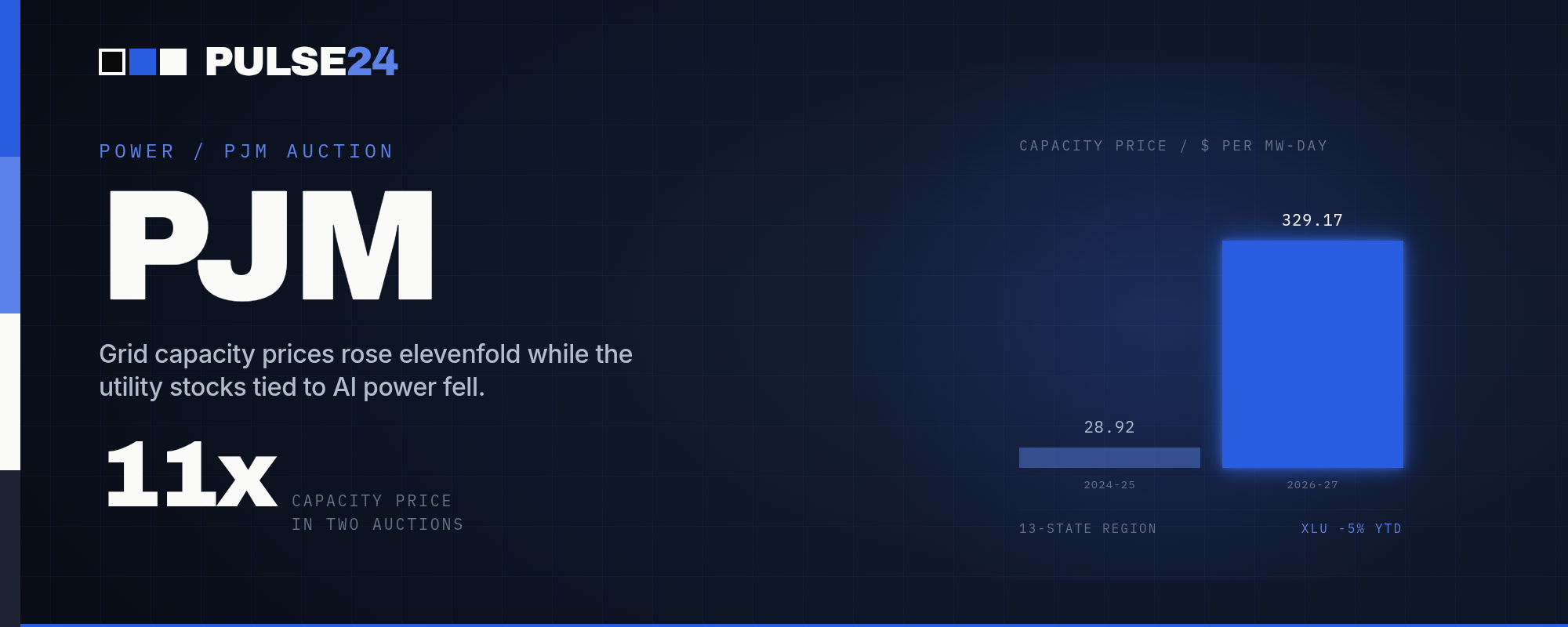
PJM's power auction price has rocketed more than 11-fold in two years as AI data centers strain the grid, yet the utility stocks closest to that demand are down for the year. Rising rates and a regulatory setback explain the gap between the AI power trade and the AI power bill.
Twenty-eight dollars and ninety-two cents. That was the price PJM Interconnection, the grid operator serving roughly 65 million people from Chicago to Washington, paid generators per megawatt-day of guaranteed capacity for the 2024-2025 delivery year. Two auctions later, the price for 2026-2027 settled at $329.17, more than eleven times higher, even after PJM capped the auction to keep it from climbing further still. Numbers don't move that far by accident, and the mover here has a name: artificial intelligence.
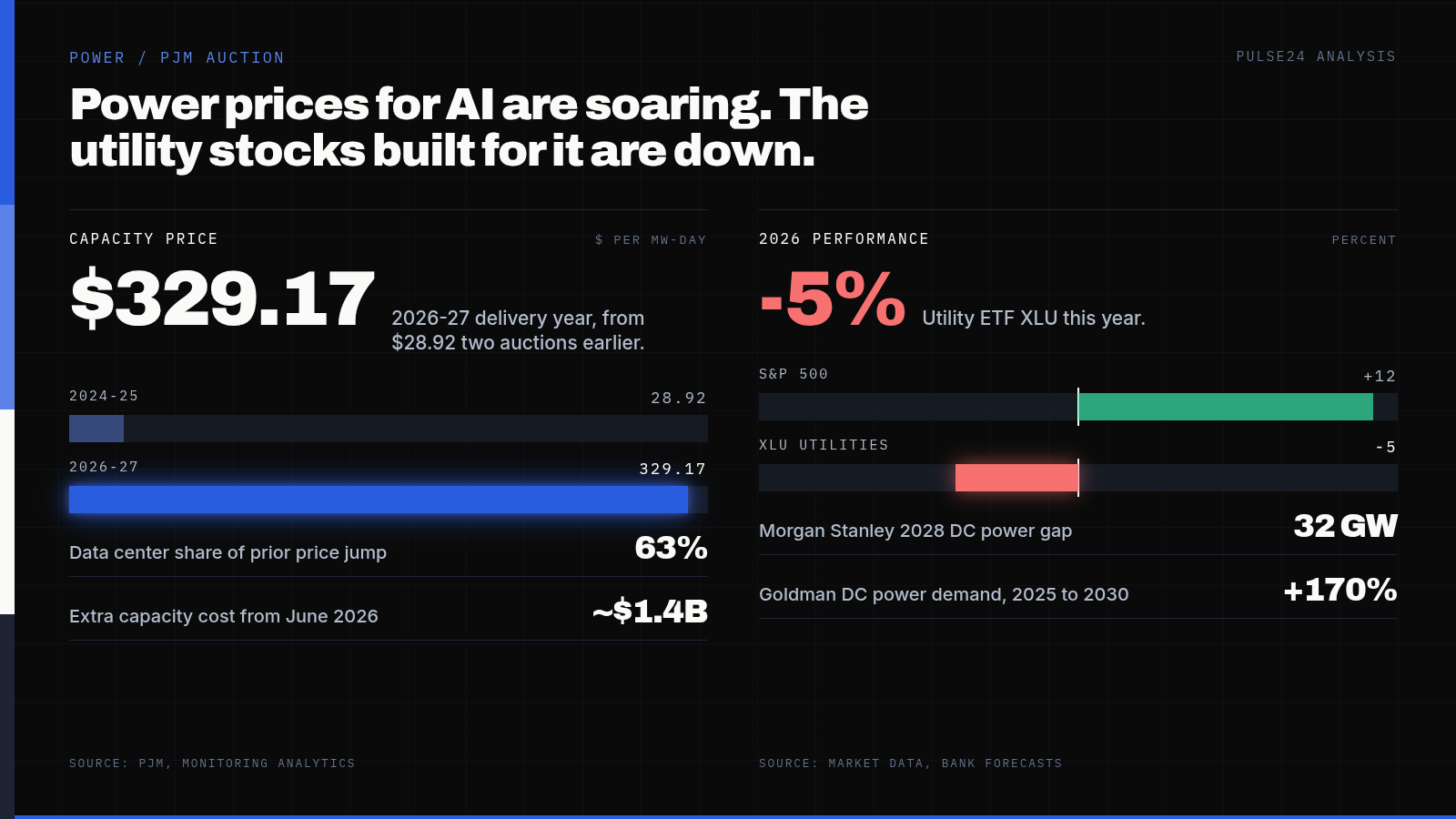
What Changed PJM's capacity auction works like an insurance policy for the grid. Power plants bid to guarantee they'll be available three years out, and the market-clearing price reflects how tight supply looks against projected demand. For the 2024-2025 delivery year, that price was $28.92 per megawatt-day. A year later, for 2025-2026, it jumped to $269.92, a nine-fold increase that market monitor Monitoring Analytics attributed 63% to data center growth, adding roughly $9.3 billion in costs across the region. The 2026-2027 auction, held in July 2025, pushed the price to $329.17, another 22% higher, and PJM says it would have gone higher still without a price cap imposed after the prior auction's shock.
Forecasts behind those prices tell the same story from a different angle. Dominion's slice of the PJM footprint, which includes Northern Virginia's dense cluster of data centers, projected in 2022 that load would grow by about 5,700 megawatts through 2037. By 2025, the forecast for data centers alone in that same zone had grown past 20,000 megawatts. Whether that specific figure ever materializes is an open question, PJM's own long-range forecasts have run hot before, but the market is pricing contracts today as if it will.
Federal data backs up the regional story as well. The Energy Information Administration's September outlook puts 2026 US electricity generation at a record 4,368 billion kilowatt-hours, up 2.2% from 2025, with another 1.7% increase expected in 2027. Electricity sales are projected to rise almost 2% in both years, and the agency points to data center development, alongside industrial and commercial growth, as a driver. For a grid that spent most of the last two decades growing demand by less than 1% a year, that's a meaningfully different trajectory.
Why It Matters The strange part of this story is where the stock market has landed. If AI data centers are driving historic capacity prices and record demand, the companies that generate and deliver that power should be among 2026's best-performing stocks. Instead, the Utilities Select Sector SPDR Fund, ticker XLU, is down about 5% this year while the S&P 500 is up roughly 12%, and the fund has fallen about 6% in the past month alone, its sharpest stretch of selling since October 2023.
Part of that comes from interest rates. Utilities carry heavy debt loads to fund power plants and transmission lines, and Treasury yields near 5% make bond-like utility dividends look less attractive by comparison. The Fed's rate path has become a swing factor for nearly every corner of this market, and utilities, long considered a defensive, bond-proxy sector, are increasingly reacting to AI headlines the way chip stocks do. Regulation is weighing on the group too: federal energy regulators placed a five-month hold in late September on PJM's Reliability Backstop Procurement, a plan to secure emergency backup power capacity, a decision that hit merchant generators Constellation Energy and Vistra, both sizable holdings in the sector fund, harder than traditional regulated names like NextEra.
There's a financing angle as well. GE Vernova, which makes the gas turbines utilities need to meet this demand, is sitting on a backlog of about $176 billion against a projected 2026 revenue of roughly $46 billion, a gap that shows how far orders have outrun the industry's ability to actually deliver equipment. That bottleneck helps explain why Morgan Stanley forecasts a 32-gigawatt US data center power shortfall by 2028. Capital markets are already showing strain around AI infrastructure spending more broadly, and the power buildout is one more piece of that financing picture investors are scrutinizing rather than taking on faith.
None of this erases the demand story. Goldman Sachs now projects global data center power demand will grow 170% between 2025 and 2030, up from its earlier estimate of 117%, and the EIA still expects record US generation for a second straight year. What's changed is that the stocks tied to meeting that demand are being priced for the difficulty of the buildout, not just its scale.
What to Watch Next PJM has already moved past that figure twice: the 2027-2028 delivery year auction, held in December 2025, and the 2028-2029 auction, held in July 2026, both cleared at PJM's price cap, $333.44 and $325 per megawatt-day, with PJM's own report on the latter citing a 6.8-gigawatt reliability shortfall. That both auctions settled at the cap rather than below it is itself telling: the cap, not supply catching up with demand, is now the binding constraint. The real test is PJM's next auction, for the 2029-2030 delivery year, and whether new generation reaching the grid by then offers any relief or the price simply hits the ceiling again. A resolution to the federal hold on PJM's backup-capacity plan is also due within its five-month window, and how regulators rule will matter more to Constellation and Vistra specifically than almost any single earnings report this quarter.
Watch electricity's share of the inflation data too. Rising power costs feed directly into the services component of CPI, and a grid straining to keep up with AI demand is one more reason the Fed may be reluctant to declare victory on inflation even as its hiking cycle continues. On the corporate side, GE Vernova's order backlog, along with any sign that utilities are accelerating capital spending plans, will show whether the supply side of this bottleneck is catching up to demand or falling further behind.
The Pulse24 Take The AI power story usually gets told as a simple demand problem: there isn't enough electricity, so prices rise and utilities win. The data backs the first half of that framing. PJM's capacity price rising more than eleven-fold in two years and the EIA's record generation forecasts are measurable evidence that AI infrastructure is reshaping the grid faster than the grid can comfortably absorb it.
Zoom out, though, and the second half gets more complicated. Rising rates, a specific regulatory setback, and growing scrutiny of how AI capital spending gets financed are all weighing on the utility stocks that were supposed to be the clean way to play this trade. That doesn't mean the long-term demand thesis is wrong. It means the market is pricing in how hard and expensive the buildout will actually be, not just how large it might eventually get, and that's worth remembering the next time a utility stock drops on a day when the AI headlines sound bullish.
How we read the data
Curious how we get from raw data to a take like this? Our Trader's Toolkit walks through the tools we lean on.
Explore the Toolkit