Pulse24 Original
Oil Erases a Week of War Premium in a Day. The Fed's Hike Case Went With It.
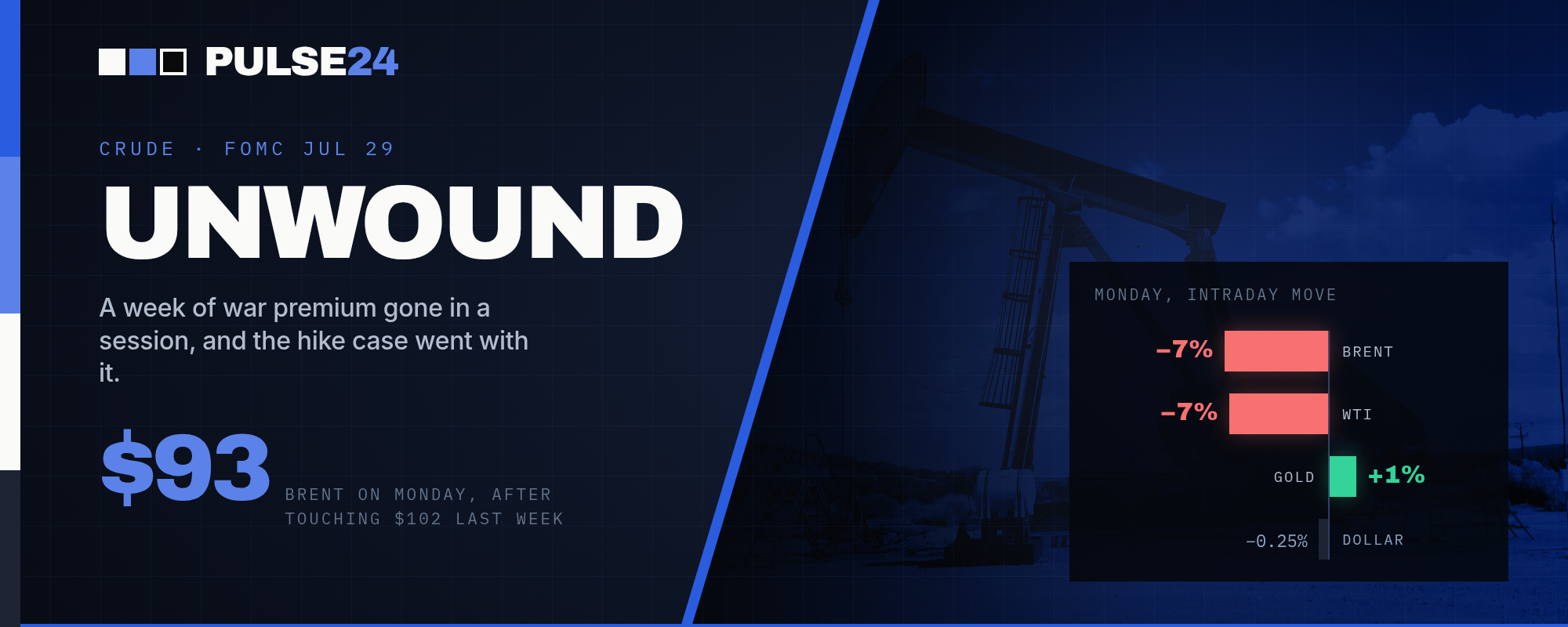
Brent crude fell as much as 7% Monday after the US and Iran went several days without exchanging strikes, unwinding much of the war premium that had tripled the market's odds of a Fed rate hike just three days earlier. Gold rose, the dollar eased, and CME FedWatch now points to a hold at Wednesday's meeting instead of the coin-flip odds oil's spike had priced in.
What Changed
Brent crude opened Monday trading near $93 a barrel, down as much as 7% intraday from Friday's close, after the United States and Iran went several days without exchanging strikes. WTI slid a comparable percentage to around $84, a smaller dollar move than Brent's because WTI's run-up carried less direct exposure to the Strait of Hormuz to begin with. Both benchmarks had touched fresh highs the week before, with Brent breaching $102 and WTI near $85, so Monday's reversal wiped out a meaningful chunk of the premium the market had built into oil since the conflict widened in early July.
The de-escalation followed 13 consecutive nights of US strikes on Iranian military installations, a campaign that ended abruptly on Friday without an official explanation from the Trump administration. Iran suspended its own retaliatory strikes around the same time, and reports point to Oman quietly mediating talks between the two sides. Capital.com analyst Kyle Rodda put it plainly: strikes "have been put on hold in recent days, reportedly as US strategists rethink their effectiveness," and any real resolution "requires a major compromise from either the US or Iran."
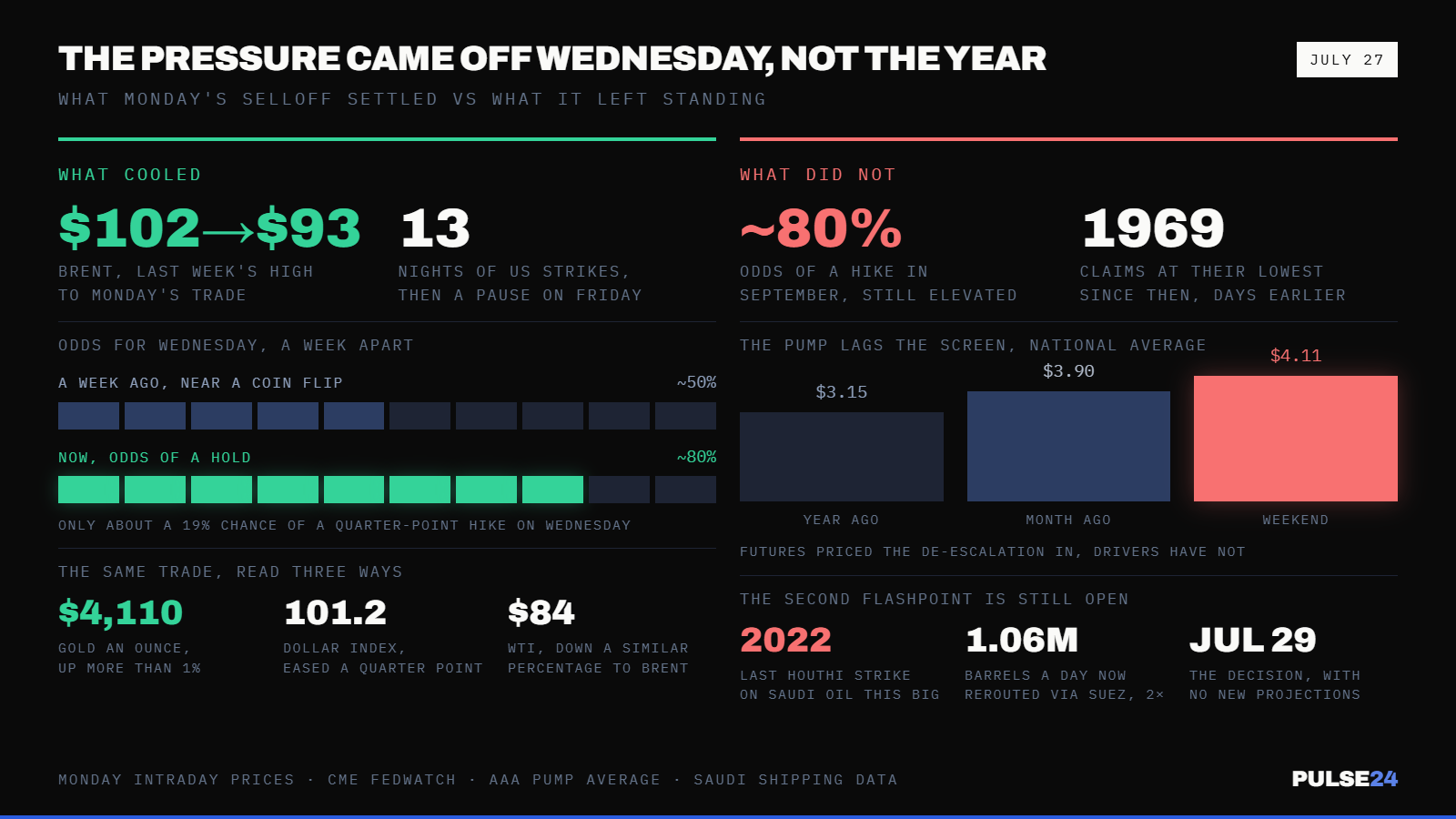
The rally isn't over just because it's paused. Yemen's Houthi movement, backed by Iran, claimed responsibility for strikes on Saudi Aramco facilities at Jizan and Yanbu over the weekend, the most direct Houthi assault on Saudi oil infrastructure since 2022. The group also declared a maritime embargo on Saudi ports and has been targeting tankers in the Red Sea, forcing Saudi crude shipments through the Suez Canal to more than double to roughly 1.06 million barrels a day as vessels avoid the Bab el-Mandeb strait. The main flashpoint has cooled. The secondary one hasn't.
Gasoline prices tell the same lagging story oil always tells at the pump. The national average sat at $4.11 a gallon over the weekend, up from $3.90 a month earlier and $3.15 a year ago, even as futures markets were already pricing in the de-escalation. That gap between what drivers pay today and what traders expect tomorrow is normal, but it's also a reminder that the inflation data the Fed watches doesn't turn on a dime the way an oil chart does.
Why It Matters
Three days ago, this same publication covered a very different setup: Brent crossing $100 for the first time since May, with Fed rate-hike odds for Wednesday's meeting more than tripling in a week. That thesis hasn't gone away, but it has lost real ground in three trading days. Oil at $100 was doing genuine work on the Fed's inflation calculus, and oil back in the low $90s does the opposite kind of work, loosening the pressure that had traders pricing in something close to a one-in-three chance of a hike.
CME FedWatch and prediction-market data now put the odds of a hold at Wednesday's meeting near 80%, with only about a 19% chance of a quarter-point hike, a sharp retreat from the near coin-flip odds oil's spike had priced in a week earlier. The bigger story has simply moved a meeting later rather than disappeared: traders still see something close to an 80% chance of a hike in September. Oil cooled off just in time to take the pressure off Wednesday, not off the year.
Gold and the dollar are telling a version of the same story from a different angle. Gold gained more than 1%, touching above $4,110 an ounce, the kind of move that shows up when traders dial back expectations for aggressive tightening. Higher rates make non-yielding assets like gold less attractive, so a rally in gold alongside falling oil reads as the market betting the inflation scare is cooling faster than last week's labor data suggested. The dollar index eased about a quarter of a percent to roughly 101.2, consistent with the same shift in rate expectations.
There's a genuine tension sitting under Wednesday's decision now. Jobless claims fell to their lowest level since 1969 just days before oil started sliding this weekend, a labor-market signal that argued for a hawkish Fed on its own terms. Now the energy side of the inflation equation is pulling the opposite direction. Fed Chair Warsh doesn't get to pick one data set and ignore the other, and a meeting that looked like it might turn into a genuine hike debate now looks more likely to end in a hold with hawkish language attached, an outcome that keeps optionality open without forcing the committee's hand this week.
What to Watch Next
The most immediate question is whether the US-Iran pause holds through Wednesday's FOMC decision or gets tested again before then; oil markets have round-tripped on this conflict more than once already this month. Also worth tracking is whether the Houthi campaign against Saudi infrastructure escalates enough to reopen the risk premium even without a fresh US-Iran exchange, since Red Sea shipping disruptions carry their own independent effect on global crude flows. Regardless of which way oil moves next, Wednesday's Fed language will matter more than the vote itself. A hold delivered with hawkish framing would tell markets the door to a hike in September or later is still very much open, ceasefire or not.
The Pulse24 Take
This is what a connected macro system actually looks like in practice, not a chart moving in a straight line but a chain reacting to itself in real time. Oil spikes, rate-hike odds triple, then a diplomatic pause knocks the legs out from under both within a week. None of that means the underlying risk has disappeared. The Strait of Hormuz didn't get any safer because the US and Iran paused strikes for a few days, and the Houthi attacks on Saudi infrastructure are a reminder the conflict still has more than one front that can flare.
What matters for positioning is that the Fed now walks into Wednesday with a genuinely mixed data set instead of a one-way inflation signal. That's arguably healthier than the alternative. A committee reacting to a single oil spike with a snap hike would have been trading a temporary geopolitical shock for a permanent rate decision, exactly the kind of move that tends to get revisited a year later. The odds swinging back toward a hold reflects the data actually doing its job, not the Fed going soft on inflation.
How we read the data
Curious how we get from raw data to a take like this? Our Trader's Toolkit walks through the tools we lean on.
Explore the Toolkit