Pulse24 Original
Six Pillars, Twelve Years, $13.5 Billion: India Relaunched Its Chip Mission This Week. Applied Materials and Lam Research Committed More Than $6 Billion Combined the Same Day.
September 17, 2026
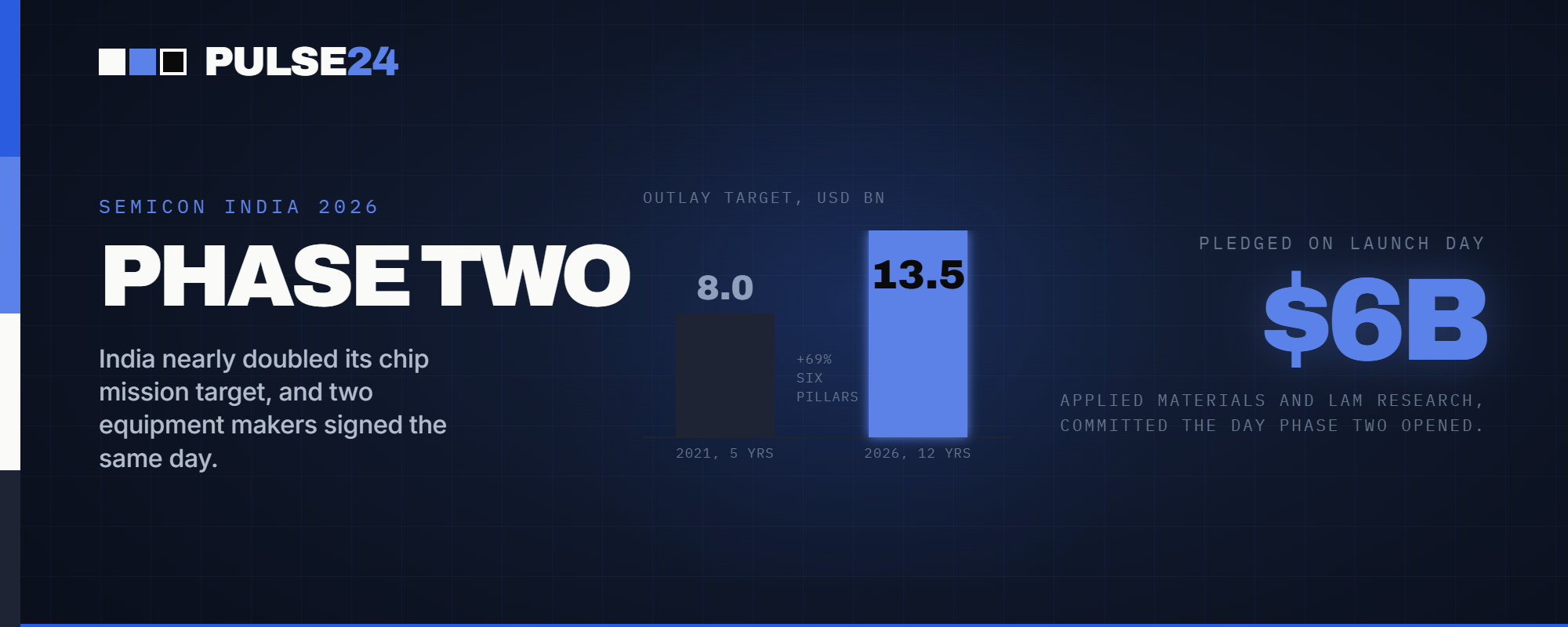
India kicked off a $13.5 billion second phase of its chip mission this week, and Applied Materials and Lam Research answered with more than $6 billion in new India investment on the spot. The pledges say a lot about how seriously chip equipment makers are hedging their exposure to a chip market Taiwan still dominates.
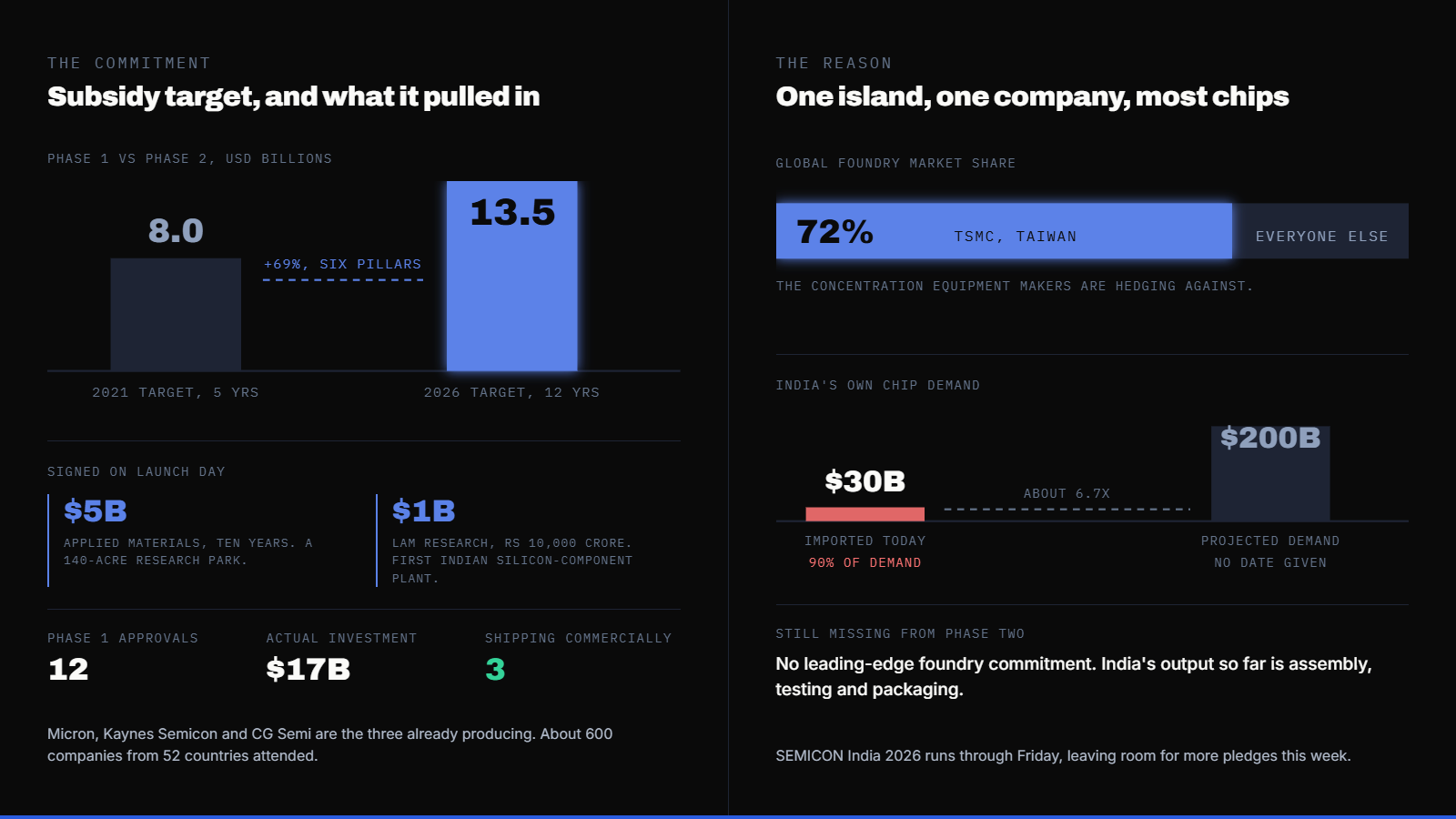
Prime Minister Narendra Modi took the stage in New Delhi on Wednesday with a specific number: $13.5 billion, the target outlay for the second phase of India's Semiconductor Mission. He drew the comparison himself. Phase one, launched in December 2021, carried an $8 billion target; phase two nearly doubles that pledge and stretches it across twelve years instead of five. About 600 companies from 52 countries showed up to SEMICON India 2026 to hear the pitch, and two of the world's biggest chip equipment makers left having already signed checks.
What Changed
India's semiconductor mission now runs on six pillars: chip design, machines and materials, fabs, advanced packaging, research, and talent development. That is a wider net than phase one, which focused mostly on getting fabrication and assembly plants built and approved. Twelve approved projects came out of that first phase, worth roughly $17 billion in actual investment at current exchange rates even though the government's own outlay target was $8 billion, a gap that shows how far private co-investment can stretch a subsidy program once the incentives land right. Three of those projects are already shipping product: Micron's assembly and test facility, along with plants run by Kaynes Semicon and CG Semi.
Two announcements gave phase two its opening momentum. Applied Materials pledged $5 billion over the next decade, most of it aimed at a new 140-acre research park with cleanroom space and engineering labs attached. Prabu Raja, who runs the company's Semiconductor Products Group, framed it as a bet on India's supply chain scaling up tenfold by 2035, not just a research outpost. Lam Research followed with roughly Rs 10,000 crore, about $1 billion at current exchange rates, for its first silicon-component manufacturing plant in the country. Sesha Varadarajan, the company's chief operating officer, called it Lam's first facility of its kind in India. ASML's Wayne Allan, an executive vice president at the Dutch lithography giant, told the crowd that India's opportunity runs deeper than manufacturing alone and depends on long-term ecosystem partnerships rather than one-off plants.
Why It Matters
The dollar figures matter less than the concentration problem they are aimed at. Taiwan Semiconductor Manufacturing Company still controls roughly 72% of the global foundry market, meaning a large share of the world's advanced chips flow through a single company on a single island. Equipment makers like Applied Materials and Lam Research sell into that concentrated customer base, and every dollar they spend building capacity in India is a small hedge against depending so heavily on one geography. India, for its part, imports close to $30 billion in chips a year to cover about 90% of what it consumes domestically, a dependency the government wants to shrink as demand climbs toward a projected $200 billion, a target Modi cited without pinning it to a specific year.
None of this replaces Taiwan's role in advanced logic chips anytime soon. India's phase one output has leaned toward assembly, testing, and packaging rather than cutting-edge fabrication, and phase two's fab pillar is still mostly aspirational. What the equipment makers are actually buying is optionality: a second base of operations, a trained workforce, and a government willing to co-invest, so that if global chip demand keeps outrunning supply, as it has through this AI buildout cycle, there is somewhere else to put the next dollar of capital expenditure.
What to Watch Next
Watch whether the fab pillar produces an actual leading-edge foundry commitment, not just assembly and testing capacity. That would mark the difference between India as a supporting node in the chip supply chain and India as a genuine alternative to Taiwan and South Korea for advanced manufacturing. Also worth tracking: whether Applied Materials' and Lam Research's India capex shows up in their own capital spending guidance over the next few quarters, since that would confirm these are funded commitments rather than announcement-day headlines. SEMICON India 2026 runs through Friday, so more investment pledges from other equipment makers are plausible before the week ends.
The Pulse24 Take
Chip diversification stories tend to get graded on a binary: did it dethrone Taiwan, yes or no. That is the wrong test for phase two of India's semiconductor mission. The more useful question is whether the equipment makers who actually build fabs, not just the governments announcing incentive packages, keep showing up with real capital. Applied Materials and Lam Research did that this week, and their India workforces were already growing before the ink dried on phase two. A hedge does not need to replace the thing it is hedging against to be worth watching. It just needs enough scale that, a few years from now, a chip shortage or a supply disruption centered on Taiwan does not stop the world's AI buildout cold. India is not there yet. It is closer than it was on Tuesday.
How we read the data
Curious how we get from raw data to a take like this? Our Trader's Toolkit walks through the tools we lean on.
Explore the Toolkit