Pulse24 Original
Every Spider-Man Movie Ever Made, Ranked. The Best One Doesn't Have the Biggest Box Office, the Scariest Villain, or Even the Real Peter Parker.
August 8, 2026
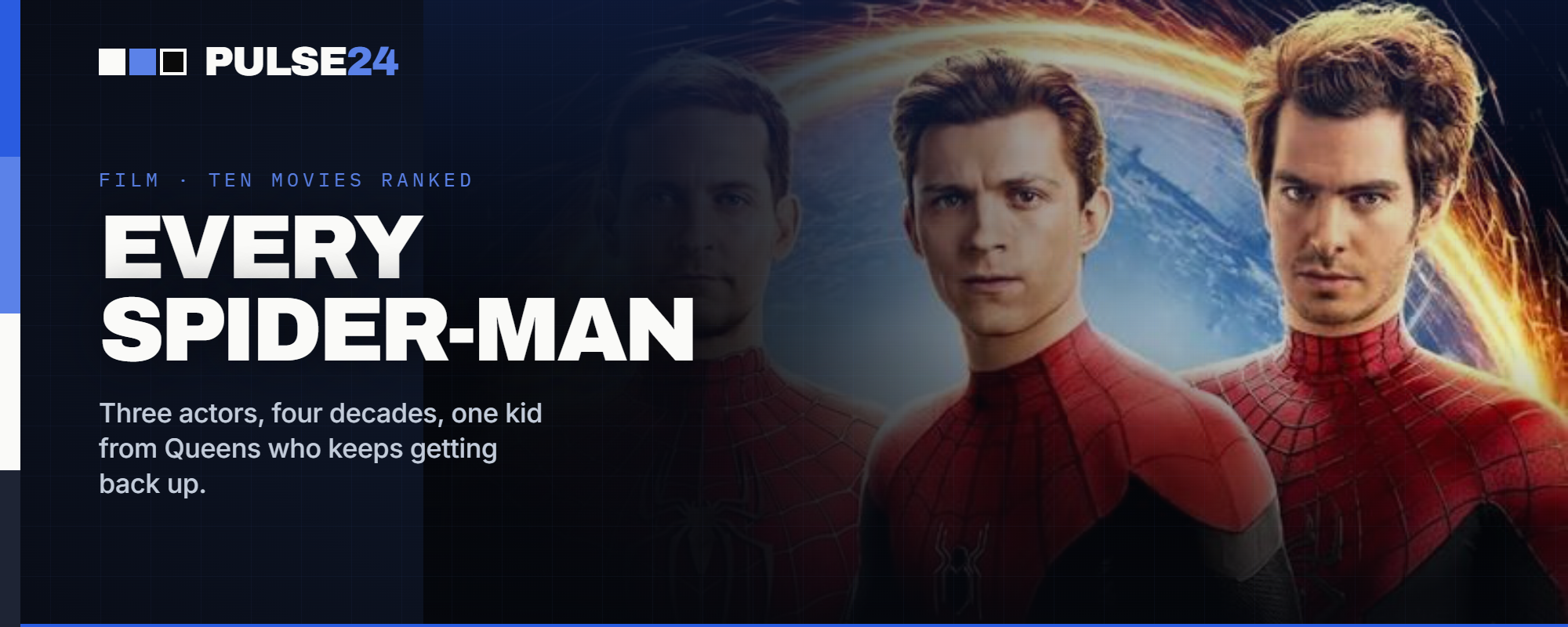
Ten movies, three actors under the mask, and one clear winner that isn't the one with the record-breaking box office. Spider-Man: Brand New Day just posted the biggest opening weekend in history, and it still isn't ranked, for the same reason Pulse24 left The Odyssey off Nolan's list: some films are too new to know if they'll last.
Ten movies. Three different actors under the mask, if you count the two who play Peter Parker, plus a version of the story where the hero isn't Peter Parker at all. Four different studios' worth of creative control, two full reboots, and one animated sequel that cost less to make than half the live-action films on this list and did more with a single wordless shot than most of them do in two hours.
That's the strange thing about Spider-Man as a franchise. Batman gets one Bruce Wayne at a time and everyone argues about which one is "theirs." Spider-Man has been rebuilt from the ground up three separate times in twenty-three years, and somehow the character has never once felt diluted by it. Every actor who's put on the suit has understood the same basic thing: this isn't really a story about powers. It's a story about a kid who gets the one thing every teenager secretly wants, the ability to matter, and finds out that mattering costs him almost everything he loves. Take that away and you're left with web-slinging and quips, which is fine for a Tuesday afternoon and forgettable by Wednesday.
So this ranking isn't just about which movie has the best fight choreography or the funniest one-liners, though those things count. It's built on six questions asked of every film: Does it understand what makes Peter Parker Peter Parker, the guilt as much as the power? Is the villain a mirror for the hero rather than just an obstacle? Does the loss in the story actually cost the character something, or does the plot reset by the credits? Does the direction have a point of view, a visual identity that's more than competent coverage? Is the humor earned, or is it there to cover for a script that doesn't trust its own emotional beats? And, the hardest one to fake, does the movie hold up on a rewatch five or ten years later, once the opening-weekend hype is gone and all that's left is whether the thing itself was any good. Here's how ten of them stack up against each other, worst to best, with an eleventh still too new to rank.
10. The Amazing Spider-Man 2 (2014)
Andrew Garfield is still one of the best actors to ever play Peter Parker, which is what makes this one so frustrating. Sony had a $200 million-plus budget, some reports put the true cost closer to $293 million once marketing is folded in, and used most of it setting up a shared universe that never happened, wedging in Rhino and a villain team-up tease for a Sinister Six movie that was never made. Jamie Foxx's Electro gets buried under CGI and a motivation that changes twice. The one thing the film does right, and it's a big thing, is Gwen Stacy's death. Emma Stone plays it with real terror and clarity, the clock tower sequence is genuinely upsetting, and for about ten minutes the movie remembers what this franchise is supposed to be about. Then it cuts to a graduation speech and undercuts its own gut punch. Rotten Tomatoes critics landed at 50%, and worldwide it made $709.7 million against a ballooning budget, numbers that told Sony everything it needed to know about a franchise trying to be several things at once instead of committing to one.
9. The Amazing Spider-Man (2012)
A reboot nobody asked for, five years after Sam Raimi's trilogy ended, and it's better than its reputation. Marc Webb, a director best known at the time for (500) Days of Summer, brought an indie sensibility to the Peter and Gwen relationship that the Raimi films never quite managed with Peter and MJ. Garfield's Peter is twitchier and more sarcastic, closer to the comic-book wisecracker, and the practical stunt work gives the swinging sequences a weight that CGI-only spectacle often lacks. Where it stumbles is Uncle Ben's death, rushed and strangely inert for a story that's supposed to hinge on it, and a lizard-man villain plot that feels bolted on from a lesser movie. It opened to $758.6 million worldwide on a $230 million budget and a 71% critics' score, respectable numbers for a film that mostly gets remembered today as the one people forget exists between Raimi and the MCU.
8. Spider-Man 3 (2007)
The most expensive of the Raimi trilogy at roughly $250 million, and the clearest case study in how too many villains kill a story rather than enrich it. Sandman, Venom, and a returning Harry Osborn all compete for screen time, and the film's most famous sequence, Peter strutting down a New York street in emo eyeliner to jazz music, has become a punchline that somewhat unfairly overshadows real strengths elsewhere in the film. Thomas Haden Church's Sandman has a genuinely tragic backstory tied to Uncle Ben's death that deserved a cleaner movie built around it alone. Kirsten Dunst and Tobey Maguire still sell the exhaustion of a relationship strained by secrets, and the guilt Peter carries about who really killed his uncle is thematically rich even when the execution gets messy. It made $895.9 million worldwide, more than either of its predecessors, and scored 62% with critics, proof that audiences showed up for the emotional throughline even when the plot buckled under its own weight.
7. Spider-Man: Homecoming (2017)
The smartest structural decision anyone has made with this character: shrink the scale down. No world-ending stakes, no dead parents on screen, just a fifteen-year-old kid in Queens trying to prove himself while juggling a chemistry test and a homecoming dance. Michael Keaton's Vulture is the best-written MCU villain of the era for one simple reason, he's not evil, he's a guy who got screwed by a government contract and started making a living the only way he saw how, and the reveal that he's Peter's date's father remains one of the single best scenes the MCU has produced, a masterclass in dread built entirely out of dialogue in a parked car. Tom Holland plays Peter as an actual teenager, eager and overconfident and constantly in over his head, which the previous six films had all skipped past in favor of a Peter who felt more like a young adult. It scored 92% with critics and made $878.7 million worldwide on a $175 million budget, and it reset expectations for what a "small" superhero movie could still accomplish. It's also, on a rewatch, the more comfortable of Holland's first two outings, content to stay a coming-of-age story rather than push into the grief and identity questions the sequel took on. That's a real strength and also the reason it lands just below Far From Home here rather than above it.
6. Spider-Man (2002)
The one that made all the others possible, and it still mostly works two decades later. Sam Raimi treats the origin story with a sincerity that would read as corny from almost anyone else and somehow doesn't here, because Raimi understood that Spider-Man only works if you play the tragedy completely straight. Uncle Ben's death and "with great power comes great responsibility" have been parodied into cliché by now, but watch the scene again: Cliff Robertson delivers the line like a man who knows he's about to die and won't get another chance to say it, and Maguire's face after Ben's murder is a kid realizing, in real time, that his own selfishness got someone killed. Willem Dafoe's Green Goblin is unhinged in a way modern superhero villains rarely are allowed to be, genuinely frightening rather than merely menacing. On an era-appropriate $139 million budget it made $822.7 million worldwide and a 90% critics' score, and it single-handedly proved a comic-book movie could be a legitimate box-office event rather than a niche genre picture.
5. Spider-Man: Far From Home (2019)
A genuinely fun globe-trotting sequel stuck with an impossible job: following its predecessor's handling of Tony Stark's death while also being a breezy summer teen comedy. Jake Gyllenhaal's Mysterio is the best MCU villain performance in the trilogy, a hall-of-mirrors illusionist whose entire arc is a meditation on how easily people believe a confident liar over an uncertain truth, which felt sharply relevant on release and hasn't aged a day since. Tom Holland's Peter spends the whole film trying to duck the responsibility Tony left him, which is the most honest a teenage Spider-Man movie has been about not wanting the mantle at all. The mid-credits reveal, Mysterio framing Peter and outing his identity to the entire world, is one of the great cliffhangers in the genre. It earned 91% from critics and $1.13 billion worldwide on a $160 million budget, becoming the first Spider-Man film to cross a billion dollars. It ranks a notch above Homecoming here for the same reason Homecoming ranks where it does: Homecoming introduced this Peter, but Far From Home is the one that made him carry real grief and a real betrayal, and the mid-credits gut punch still lands harder on a fifth rewatch than anything in the film before it.
4. Spider-Man: Across the Spider-Verse (2023)
A near-perfect sequel that raises the stakes of Into the Spider-Verse without repeating its structure, and it does something few franchise films attempt: it argues with its predecessor's own thesis. Miles Morales spent the first film learning that the mask can belong to anyone. This one is about what happens when an entire multiversal establishment, embodied by Oscar Isaac's haunted, magnetic Spider-Man 2099, insists that some tragedies are "canon events," fixed points that must happen to every Spider-Man no matter the cost, including the death of a parent. Miles refuses to accept that his father's life is owed to a cosmic rulebook, and the film refuses right alongside him, turning a multiverse full of infinite alternate heroes into an argument about free will versus fate that lands as the most purely emotional the character has ever been on screen. Every frame is animated in a different visual language depending on which universe is on screen, a technical and artistic achievement that cost roughly $100 million and looks like nothing else in the medium. It debuted to a $120.5 million opening weekend, finished with $681.2 million worldwide, and posted a 95% critics' score, trailing only its own predecessor. That it ends on a cliffhanger, waiting on a long-delayed conclusion that still hasn't arrived years later, is what keeps it here rather than higher. A film this technically dazzling built its entire second half toward a resolution the trilogy hasn't delivered yet, and until it does, it's being ranked as two-thirds of something extraordinary rather than the complete statement Spider-Man 2 and Into the Spider-Verse each are on their own.
3. Spider-Man 2 (2004)
For most of the last twenty years, this was simply considered the best superhero sequel ever made, full stop, and the case for it hasn't weakened much. Alfred Molina's Doc Ock is the platonic ideal of a Spider-Man villain: a good man who loses himself to his own invention, tethered by four mechanical arms that function as a running metaphor for the way ambition can rewire who you are. But the reason this movie endures isn't Doc Ock. It's the sequence where Peter, exhausted by a double life that's cost him his job, his grades, and nearly Mary Jane, quits. He throws the suit in a dumpster and walks away, and for a few minutes the film lets him be happy, catching a stray baseball, helping an old woman across the street, just a guy again. Then a building catches fire down the block and he can't stop himself from running toward it anyway, because the responsibility was never really the suit's to give or take. That's the whole theme of the character delivered without a single line of dialogue explaining it. On a $200 million budget it made $795.9 million worldwide and a 93% critics' score, and it remains the film every subsequent Spider-Man movie has been measured against, including several on this list that came after it. That's also why it sits above Across the Spider-Verse here despite that film's more dazzling technical achievement: Spider-Man 2 tells a complete story with a beginning, middle, and an earned ending, while Across the Spider-Verse, by its own design, is only half of one.
2. Spider-Man: No Way Home (2021)
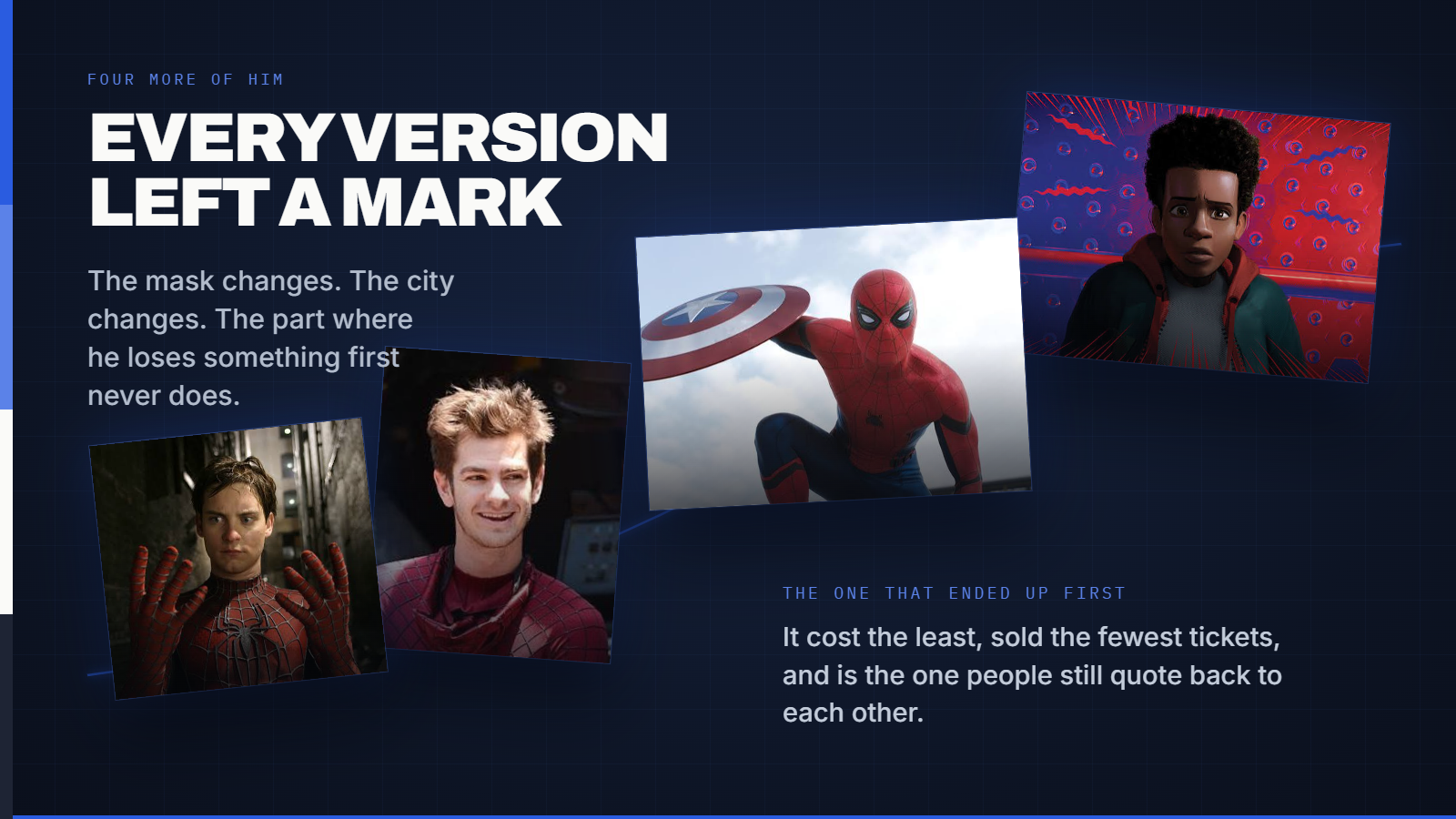
The impossible crossover that somehow earned its own hype. Three generations of Spider-Man actors sharing a screen could have been pure fan-service spectacle, and the trailers sold it that way, but the film's actual best scenes are quiet ones: Maguire's Peter, older and more at peace, telling Holland's Peter that the guilt never fully leaves, just gets easier to carry; Garfield's Peter, still processing a loss the other two haven't experienced yet, catching MJ from a fall the way he couldn't catch Gwen a decade earlier, and openly weeping with relief when he actually saves her. That single moment retroactively deepens The Amazing Spider-Man 2 more than that film ever did for itself. Willem Dafoe returns as the Green Goblin nearly twenty years later and is somehow scarier than he was the first time, a man at war with his own psyche in ways that feel genuinely upsetting rather than just villainous. And then the ending strips Holland's Peter of literally everyone who knows who he is, his aunt, his girlfriend, his best friend, leaving him more alone than any live-action Spider-Man had ever been, right as the credits roll. It grossed $1.921 billion worldwide, the highest total of any Spider-Man film and, at the time, the sixth-highest-grossing movie ever made, backed by a 93% critics' score that reflected something rarer than box office: a threequel that actually earned its own weight.
1. Spider-Man: Into the Spider-Verse (2018)
The best Spider-Man movie ever made stars a kid who, for most of the runtime, doesn't believe he's allowed to be Spider-Man at all. Miles Morales inherits the mantle after Peter Parker dies saving him, and the film spends its first act making sure that death actually registers, an older, tired, more lived-in Spider-Man than audiences had seen before, gone in a single alleyway explosion that Miles witnesses helplessly. What follows isn't a revenge story or a training montage played for laughs. It's a kid grieving a hero he barely knew while trying to become one himself, guided by a washed-up, divorced alternate-universe Peter B. Parker who's grieving an entirely different version of his own life. The film's climactic leap of faith, Miles finally trusting himself enough to fall before he can fly, is one of the most purely cathartic moments any superhero movie has produced, animated with a hand-drawn, comic-panel texture that reinvented what a big-budget animated film was even allowed to look like. It won the Academy Award for Best Animated Feature, a genre-first for a superhero film, on a comparatively tiny $90 million budget against $375.5 million worldwide, numbers that undersell how thoroughly it changed the conversation around what "prestige" could mean for a comic-book movie. A 97% critics' score, the highest of any film on this list, tells only part of the story. The rest is that ten different actors have now played some version of Spider-Man on screen, and the one who says the least, drawn rather than filmed, gave the character's central idea, that anyone can wear the mask, its truest and most moving expression.
Honorary Mention: Spider-Man: Brand New Day (2026)
This one doesn't get a ranked slot, and that's about timing, not doubt. Destin Daniel Cretton's Spider-Man: Brand New Day opened July 31 to a genuinely stunning $360 million domestic weekend, the biggest opening in box office history, edging out Avengers: Endgame's $357.1 million record, and has already crossed $1.2 billion worldwide in barely a week. It carries a 91% Rotten Tomatoes score from more than 250 reviews, with The Wrap's William Bibbiani calling it one of the genuine highlights of the whole franchise and Slant Magazine's Jake Cole writing that this Spider-Man finally "seems like what he is in the comics: the beating heart of Marvel."
The premise picks up right where No Way Home's ending left off: a spell erased Peter Parker's identity from the world's memory, so he's back to street-level crime-fighting anonymously, estranged from MJ and Ned, and dealing with his own powers evolving in ways the film treats as unsettling rather than triumphant. Pulse24 already made the case for why that stripped-down, isolated version of the character resonates harder than any amount of Stark tech ever did, and the record-breaking opening suggests audiences agree. It's also the clearest evidence yet for the argument Pulse24 made earlier this year that Holland no longer needs an exit plan from the role that made him famous. Whether it belongs above or below Homecoming, or higher still, is a real question. It's just not one anyone can answer eight days into a theatrical run. The list above only ranks films that have had time to prove they hold up once the opening-weekend numbers stop being the story. Revisit this piece in a year, and Brand New Day may well have earned its own number.
The Pulse24 Take
Line up the ten ranked films here and a pattern emerges that has nothing to do with box office or Tomatometer scores. The ones that endure are the ones willing to let Peter, or Miles, actually lose something and sit in that loss instead of rushing past it. Uncle Ben. Gwen Stacy. Tony Stark. A father who was never supposed to die on this earth at all. Every genuinely great entry on this list treats those deaths as the engine of the story rather than a somber beat to clear before the next set piece, because the character was never really built to be a power fantasy. He was built as a grief story that happens to include web-slinging, a kid trying to be good enough, fast enough, present enough to stop the next tragedy, and slowly learning that he never will be, not completely, not for everyone, and that the trying matters anyway.
That's why a fifteen-year-old in Queens and a homemade suit stitched together from a hoodie can sit at the top of a list stacked with billion-dollar blockbusters starring three different movie stars. It's also why a week-old sequel that just broke box office history the same way is being held at arm's length here rather than crowned outright. The record is real. Whether it lasts the way Spider-Man 2 or Into the Spider-Verse have is a question only time answers, and Pulse24 would rather ask it again in a year than guess wrong today. The moment audiences believe the loss, they believe everything else that follows it. Everything else is just the web.
How we read the data
Curious how we get from raw data to a take like this? Our Trader's Toolkit walks through the tools we lean on.
Explore the Toolkit