Pulse24 Original
China's Factory PMI Fell Back Into Contraction in October. Big Manufacturers Kept Growing Anyway.
October 31, 2026
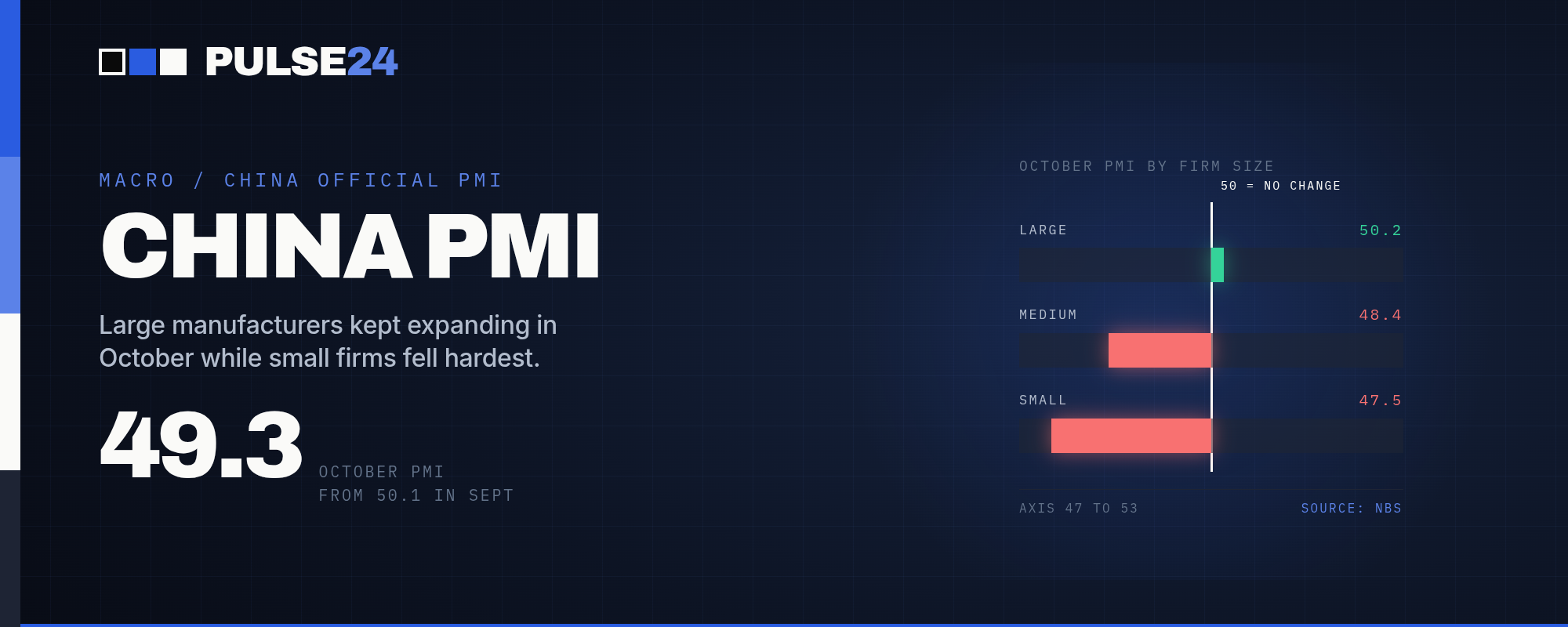
China's manufacturing PMI fell to 49.3 in October, missing forecasts and reversing September's brief return to growth. The contraction wasn't even: large manufacturers kept expanding while small firms got hit hardest.
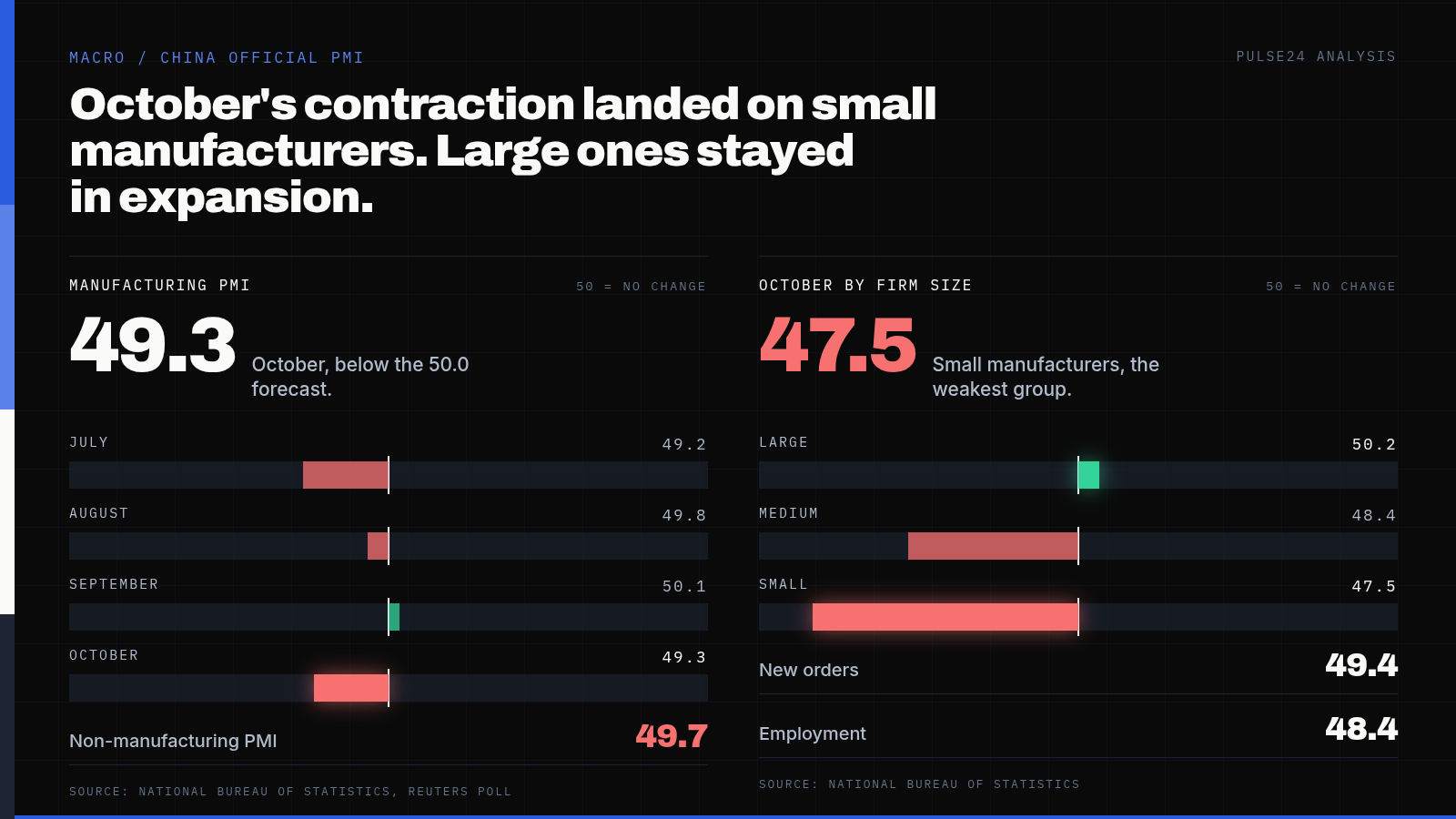
49.3. That's where China's official manufacturing PMI landed in October, the National Bureau of Statistics said Saturday, down from 50.1 in September and short of the 50.0 that a Reuters poll of economists had expected.
September's reading above 50 lasted exactly one month. Before that, factory activity had contracted in July (49.2) and August (49.8), so October's drop makes it three contractions in the last four readings, not the clean turnaround the September number seemed to promise.
What Changed
New orders fell to 49.4 in October, and the production index dropped to 49.8, both reversing most of September's gain. The employment index held at 48.4, unchanged from September, a sign factories are managing the slowdown without major layoffs.
The contraction wasn't shared equally. Large enterprises, mostly the state-linked manufacturers that dominate heavy industry and strategic sectors, stayed in expansion at 50.2. Medium-sized firms fell to 48.4. Small manufacturers took the hardest hit, dropping to 47.5, their steepest decline of the three groups.
Services told a similar story. The non-manufacturing index, which covers everything from construction to retail, fell to 49.7 from 50.2, giving back September's gain almost exactly.
One pocket of the economy didn't get the memo. Railway equipment, shipbuilding, aerospace, and computer and electronics manufacturing all posted production and new-order readings above 53, comfortably in expansion while the headline number sank.
Why It Matters
Zhang Liqun, an analyst at the China Federation of Logistics and Purchasing, which helps compile the survey, said insufficient demand is weighing on the economy and called for more policy support. That's a familiar refrain by now. What's less familiar is how cleanly this month's data splits the economy in two: the big, strategically important manufacturers are fine, and everyone smaller than them is not.
The sectors holding up best overlap almost exactly with the ones Pulse24 has tracked all year on trade data. China's chip exports barely grew in volume through September while their dollar value jumped 136%, evidence that the electronics and tech-manufacturing complex is running on a different cycle than the small manufacturers who make up most of the PMI panel.
That split shows up in commodity prices too. Copper has eased from close to $6.70 a pound early in October to about $6.49 now, a pullback that looks more like ordinary chop than a reaction to a weak PMI print. Pulse24 flagged the same disconnect a few weeks ago, when US copper stockpiles hit a record 792,000 tons and the price still wouldn't fall. The metal increasingly answers to AI infrastructure and grid demand first and Chinese factory data second.
What To Watch Next
The private Caixin PMI, which leans toward smaller exporters than the official survey, publishes its October reading in the coming days and will say whether the weakness goes as deep as the official small-enterprise number suggests. A repeat of this split, strong at the top, weak underneath, would support the case for more targeted fiscal help rather than a broad stimulus push.
On the US side, this lands in the middle of a Fed debate that doesn't need more inputs but is getting one anyway. Wall Street has spent the past two weeks pricing in a December hike with growing conviction, built mostly on strong GDP and inflation that won't come down. A softer China adds a counterweight to that story, even if it's not enough on its own to change the Fed's math.
The Pulse24 Take
The easy read on this data is that China's economy is weakening again after one good month. The more useful read is where the weakness is concentrated. Large manufacturers and the tech-heavy sectors that supply AI infrastructure, electronics, aerospace, and rail are still expanding. Small manufacturers, the ones with the thinnest margins and the least exposure to strategic industries, are absorbing almost all of the damage.
That's a different kind of slowdown than the broad-based one investors remember from 2015, and it's probably why copper and other industrial metals haven't reacted much. A broad, even contraction would be hard to ignore. One this lopsided, where the parts of the economy that move markets are still growing, is easier for traders to shrug off, right up until it isn't.
How we read the data
Curious how we get from raw data to a take like this? Our Trader's Toolkit walks through the tools we lean on.
Explore the Toolkit