Pulse24 Original
US Copper Stockpiles Hit a Record 792,000 Tons. The Price Still Isn't Falling.
October 22, 2026
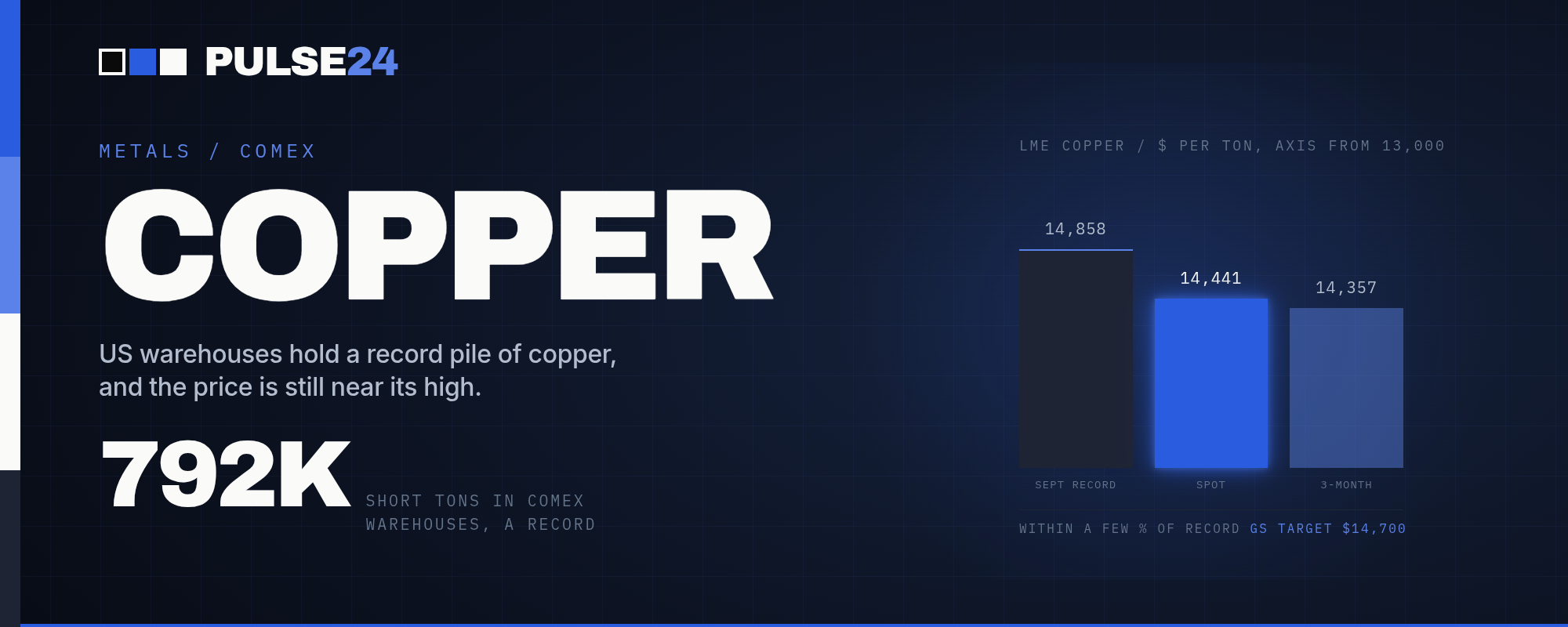
US warehouses are sitting on a record 792,000 tons of copper as traders raced ahead of tariff uncertainty, yet the price has barely dropped from its all-time high. Goldman Sachs says the rest of the world is short the metal, even while America looks flush with it.
Seven hundred ninety-two thousand short tons. That's roughly how much copper sat in COMEX-approved warehouses across the United States as of October 19, the highest total on record, according to Reuters data. A stockpile that size usually signals a glut, and gluts usually mean falling prices. Copper is still trading within a few percent of an all-time high.
What Changed The buildup traces back to Washington's on-and-off tariff push on copper. A Section 232 investigation brought a 50% duty on various copper products during 2025 and 2026, and the exact scope and timing applying to refined cathode has kept shifting even as the broader rate took hold. Traders responded the way they usually do when a tax might widen or tighten its reach: they moved the product across the border first and asked questions later. COMEX-registered stockpiles stood near 650,000 tons over the summer. By late August they were at 675,185 metric tons, a record at the time. By October 19 they had grown again, to roughly 792,000 short tons, or about 718,200 metric tons, per Reuters. Global copper supply didn't change in that window. The metal simply moved to where it might sit on the right side of whatever comes next.
The price tells a split story depending on which exchange is doing the talking. COMEX copper traded near $6.59 a pound on October 21, down from its September 9 record of $6.89. London's three-month contract sat at $14,357 a ton, with the spot price at $14,441, both a few percent below the London record of $14,858 set the same week in September. Even the London Metal Exchange's own warehouses, which track copper outside the US tariff rush, have crept higher lately: 232,175 tons on October 16, then 245,275 tons five days later, increases of roughly 3% and 5% respectively. None of that looks like the selloff a stockpile surge of this size would normally produce.
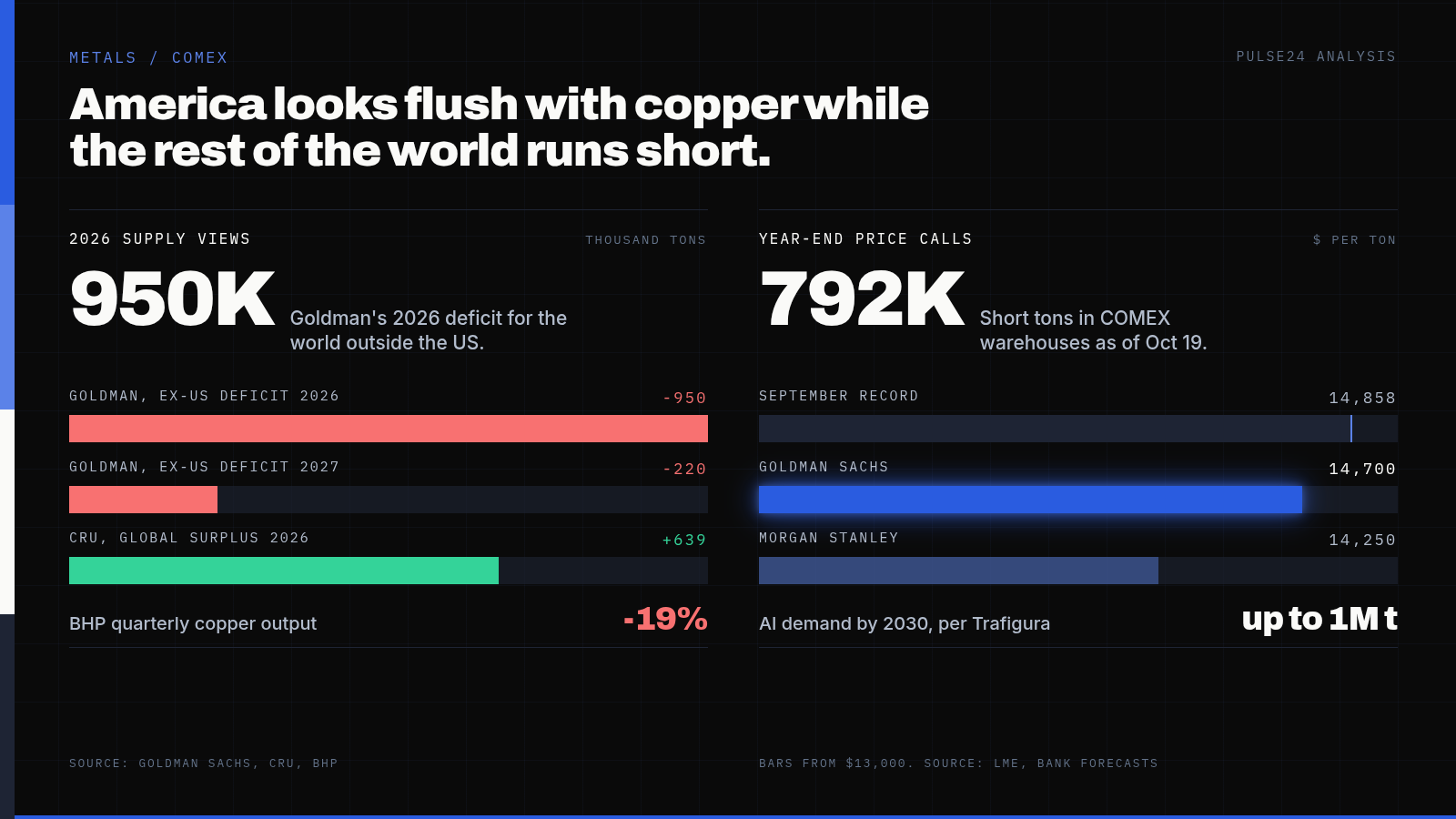
Wall Street's explanation for why prices haven't cracked splits into two camps. Goldman Sachs argues the US pile is effectively taken out of the global market, calling it stranded supply that can't easily reach buyers in Europe or Asia. The bank forecasts a 950,000-ton deficit for the rest of the world in 2026, widening to 220,000 tons in 2027, and carries a year-end price target of $14,700 a ton. CRU's Robert Edwards makes a related point: at the current pace of US imports, a year that started out looking like a global surplus now looks roughly balanced, and the market outside the US could resemble a deficit even though, in his words, the metal has simply changed location rather than disappeared. Morgan Stanley is more cautious, projecting $14,250 a ton by the fourth quarter and arguing that if US stockpiling slows, the global picture would look looser than Goldman's numbers suggest. CRU still has a formal 2026 global surplus forecast of 639,000 tons on its books, essentially betting that imports can't keep arriving at the current rate indefinitely.
Why It Matters Copper earned its old nickname, Dr. Copper, because the metal shows up in construction, electronics, and power grids alike, which made its price a rough proxy for global industrial health. That history is part of why this divergence matters. If copper were simply signaling a healthy global economy, rising prices alongside rising stockpiles would be a contradiction worth worrying about. What's actually happening is narrower and, in some ways, easier to explain. A trade-policy fight nobody has fully settled is distorting where the metal physically sits, while a separate and genuinely structural demand story, spanning AI infrastructure, grid modernization, and electric vehicles, is colliding with real supply problems at the mine level.
BHP, one of the world's largest copper producers, reported quarterly output down 19% from a year earlier to 400,700 tons, citing disruptions at its operations in Chile and Australia. That's not a tariff story or an inventory story. Those are lost tons that no warehouse anywhere can replace. Set that against demand: Trafigura estimates AI and data centers could add up to 1 million tons of copper demand by 2030, a figure that sits on top of, not instead of, the copper already earmarked for grid upgrades and EV production. Utility stocks built around that same AI power boom have had a rough year despite surging demand forecasts, a reminder that a strong demand story and a strong market chart don't always arrive on the same schedule.
Some of that demand is easy to put a number on. Moody's estimates US data centers will need roughly $110 billion of new power plants, about 45 gigawatts worth, through 2030, and that figure doesn't even include the transmission lines, transformers, and substations needed to move that power once it is generated. None of that shows up in a COMEX warehouse count today. It shows up years from now, when those orders actually get placed.
What to Watch Next The single biggest swing factor is the tariff fight itself. If Washington locks in a broader, clearer rate on refined cathode, the US pile becomes a more permanent fixture and traders lose some of their incentive to keep shipping extra metal across the border, which could let domestic premiums normalize even as the rest of the world stays tight. If the rules loosen or narrow instead, some of that copper could flow back out of US warehouses, and the stockpile that looks so bearish today could unwind just as quickly as it built up. Either outcome will show up first in the weekly COMEX inventory data, not in a headline.
Mine supply is the other variable worth tracking. Watch for updated guidance from BHP and other major producers on whether Chilean and Australian output stabilizes or keeps sliding. And with the Federal Reserve's meeting on October 27 and 28 landing the same week several hyperscalers report earnings, any fresh commentary on AI data center capital spending plans will say something about whether Trafigura's roughly 1-million-ton demand estimate is on track, or needs revising in either direction.
The Pulse24 Take Both sides of this story are technically correct, which is what makes it an uncomfortable one. The headline price says copper is scarce. The warehouse data says it's piling up. The honest answer depends on where you're standing: scarce outside the United States, arguably not scarce at all inside it, at least for now. That's a less satisfying conclusion than a clean shortage or a clean glut, but it's the more accurate one.
The clearest sign of how unsettled this is sits in the forecasts themselves. Goldman wants $14,700 by year-end. Morgan Stanley wants $14,250. CRU has a formal surplus on the books for the same twelve months Goldman expects a nearly million-ton deficit outside the US. These aren't rookie analysts guessing in the dark. They're looking at the same inventory data and customs figures and drawing different conclusions about how much of the current stockpile is real supply versus a one-time distortion from a trade fight that still hasn't fully settled. When forecasters this far apart are all working from the same numbers, the honest takeaway isn't that one of them is wrong. It's that the real answer is still being written, and it will likely turn on a policy decision in Washington rather than anything happening in a mine in Chile or a data center under construction.
How we read the data
Curious how we get from raw data to a take like this? Our Trader's Toolkit walks through the tools we lean on.
Explore the Toolkit