Pulse24 Original
Brent Crude Is $45 Higher Than a Year Ago. OPEC+ Held Its Output Steady for a Third Straight Month.
November 3, 2026
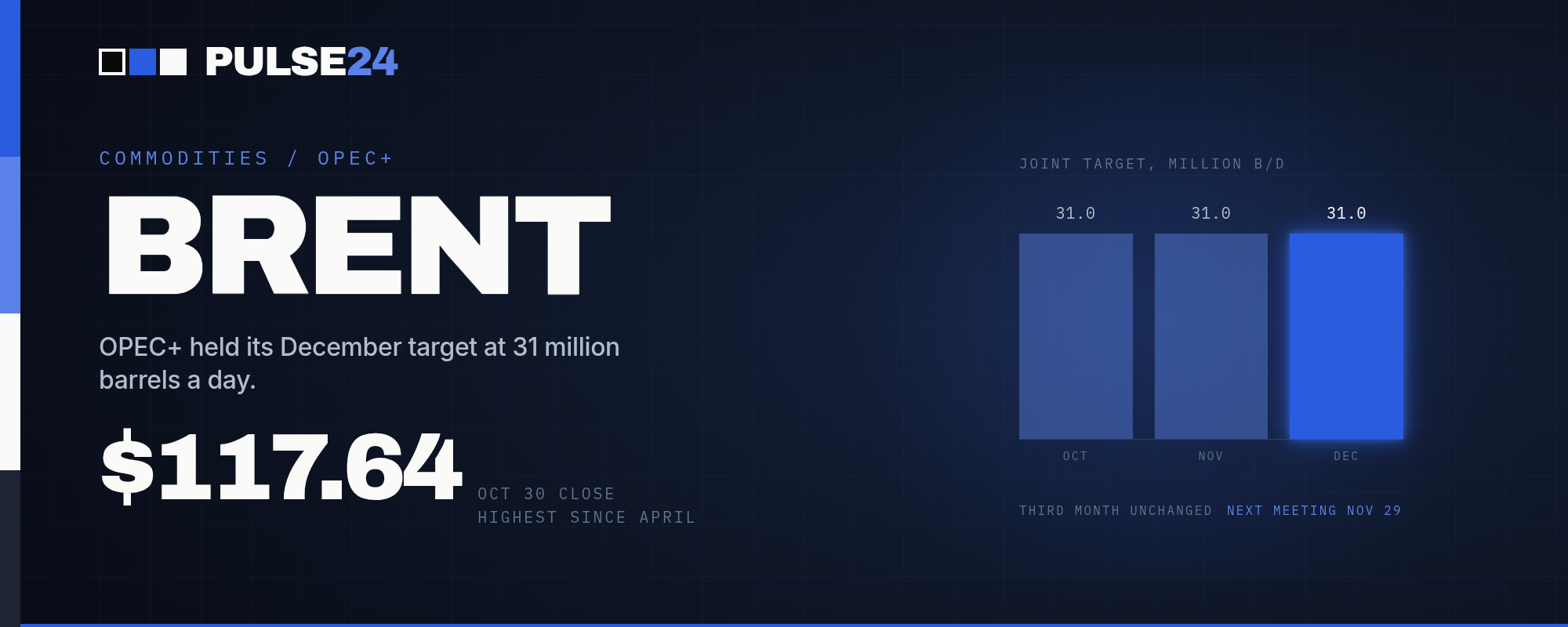
OPEC+'s core producers left December's oil quotas exactly where they were in October and November, keeping 2 million barrels a day off the market even as prices sit near their highest levels since April. The real decision on whether those barrels return waits until November 29.
Brent crude closed at $117.64 a barrel on October 30. That was its highest settlement since April, and for a few days it looked like oil was breaking out of the range it had traded in for most of 2026. Then it gave a chunk of that move back, drifting into the $100s as traders digested diplomatic signals about Gulf shipping lanes. Lost in that back and forth was a decision made on November 1 that tells you more about where oil is headed than any single day's headline: the core group of OPEC+ producers looked at December and decided to change nothing at all.
What Changed
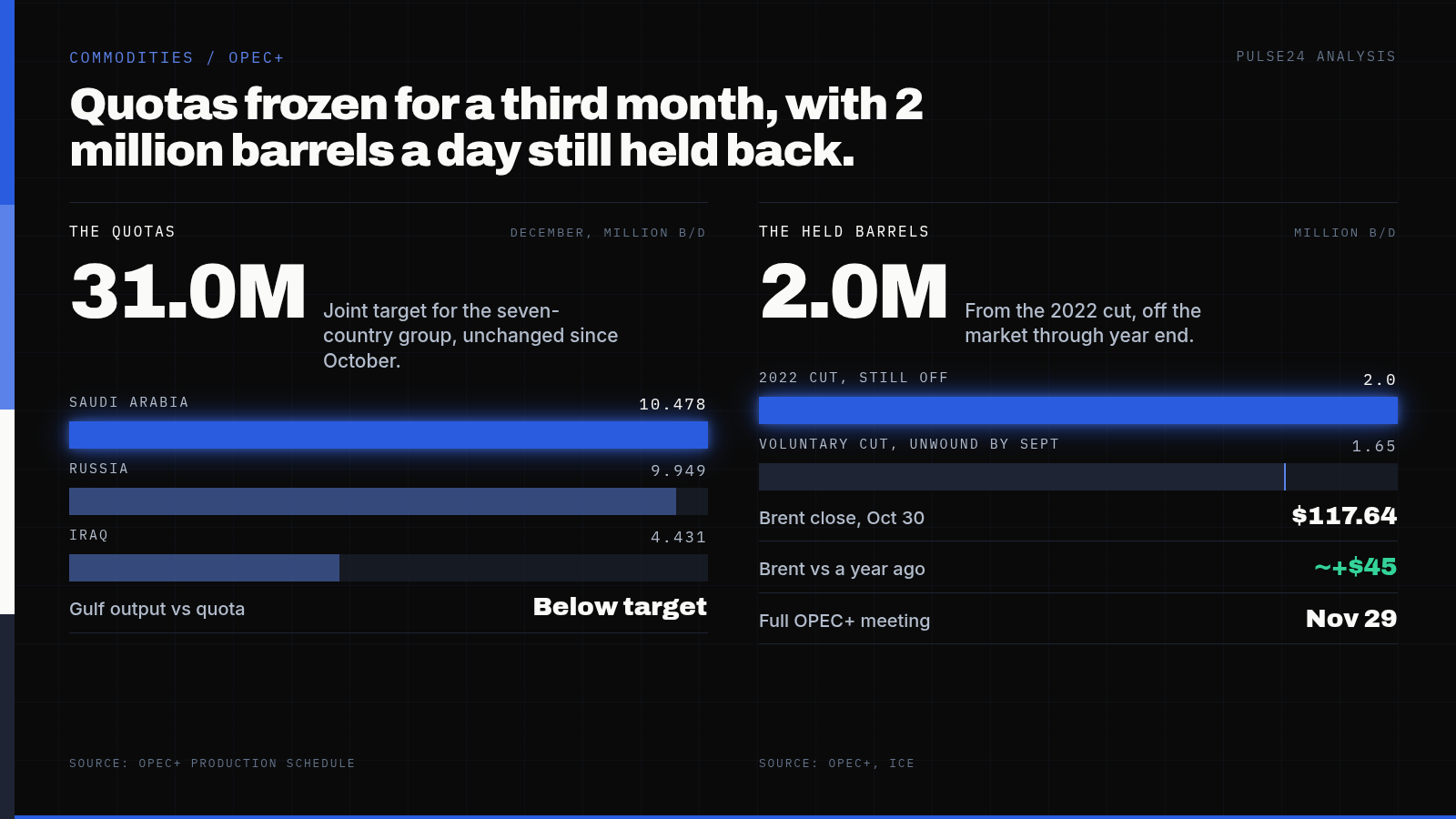
Seven countries inside OPEC+, Saudi Arabia, Russia, Iraq, Kuwait, Algeria, Kazakhstan and Oman, met online on November 1 and kept the group's joint production target at 31 million barrels a day for December. That number hasn't moved since October. Individually, Saudi Arabia's quota is 10.478 million barrels a day and Russia's 9.949 million, with Iraq allocated 4.431 million, according to the group's own schedule. Actual output from several Gulf members is running well below those targets, a separate wrinkle from the quota decision itself.
The holding pattern only tells half the story. Earlier this year, OPEC+ unwound 1.65 million barrels a day of voluntary cuts that several of its members had carried since 2023, and that supply fully returned to the market by September. A second, larger tranche agreed to back in 2022, worth about 2 million barrels a day, has stayed parked. Those barrels are still sitting on the sidelines, and nothing that happened on November 1 changes that.
A capacity review that was supposed to shape the next move has been pushed back, and the group's full 21 members don't meet to set 2027 policy until November 29. That meeting, not this week's subgroup call, is where the actual decision gets made on whether the remaining 2 million barrels come back next year.
Why It Matters
Energy costs feed directly into the inflation numbers the Fed is watching. Gasoline prices have climbed sharply this year, and that kind of move shows up in headline CPI within weeks, then lingers in core measures longer than most people expect. The Fed held its benchmark rate at 3.75% to 4% in a 10-2 vote on October 28, and sticky energy prices were part of the reasoning two governors cited when they pushed for a hike instead.
Wall Street has mostly come around to their view. Nearly every major bank now expects another hike in December, even with gold down more than $130 from its October peak. An oil market that's still $45 above year-ago levels, holding near its highest point since spring, gives that call more room to run than it would have had six months ago.
For the producers themselves, this is the oldest trade-off in the business. Keep barrels off the market and prices stay supported, which is good for government budgets in Riyadh and Moscow. Let them back and market share improves, but prices likely give up some of this year's gains. OPEC+ chose to sit on its hands for a third month rather than make that call, which says something about how little consensus exists inside the group right now.
What to Watch Next
November 29 is the date that matters. That's when all 21 OPEC+ members gather to set the 2027 framework, and the central question is whether the remaining 2 million barrels a day get a release schedule or stay locked up for another year. The capacity audit that was due to inform that call is still pending, which could push the real decision even later.
The IEA and other forecasters have already flagged the risk on the other side of that decision: if OPEC+ adds those barrels back into a market where US, Brazilian and Guyanese output keep growing regardless of what Vienna decides, 2027 could tip from tight to oversupplied fairly quickly. Watch gasoline prices into the winter heating and holiday travel season too. Another leg higher keeps pressure on the Fed's December decision; a steady retreat gives the central bank more room to argue the energy shock is fading.
The Pulse24 Take
OPEC+ didn't really decide anything this week. It deferred. Holding December's quota flat for a third straight month is the policy equivalent of leaving a decision on the table because every option still looks uncomfortable: open the taps and risk giving back a year of price gains, or keep them shut and risk losing market share to producers who don't answer to Vienna or Moscow. Prices near $110 to $118 a barrel look great on a government budget spreadsheet right now. They look a lot less comfortable if demand growth keeps cooling while 2 million barrels a day wait in the wings for 2027. November 29 is when that tension finally has to resolve into an actual choice.
How we read the data
Curious how we get from raw data to a take like this? Our Trader's Toolkit walks through the tools we lean on.
Explore the Toolkit