Pulse24 Original
BlackRock Files a Third Bitcoin ETF. This One Trades Upside for a Downside Floor.
October 20, 2026
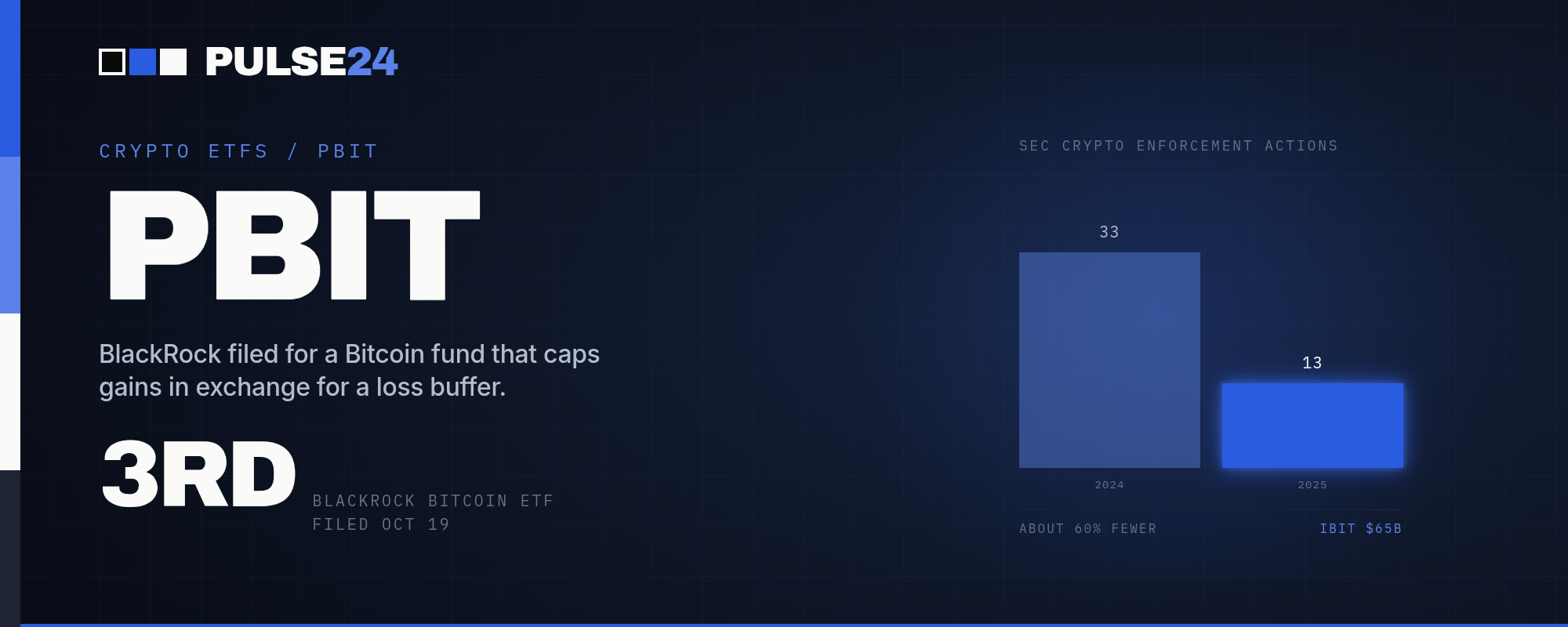
BlackRock has filed for a third Bitcoin ETF, one that caps gains in exchange for a built-in loss buffer. The move lands as the SEC pulls back on crypto enforcement and rivals already sell a similar product themselves.
BlackRock asked the Securities and Exchange Commission on Monday to approve its third Bitcoin exchange-traded fund, and this one is built to do something IBIT was never designed to do: lose less.
The filing, flagged by Bloomberg Intelligence analyst James Seyffart, names the fund the iShares Bitcoin Managed Protect ETF and assigns it the ticker PBIT. Structured as a 1940 Act fund, PBIT would track the performance of IBIT, BlackRock's $65 billion spot Bitcoin fund and the largest of its kind, but only up to a cap the filing doesn't specify. In exchange, the fund would absorb a defined portion of losses over a set outcome period, engineered with options rather than by holding Bitcoin outright.
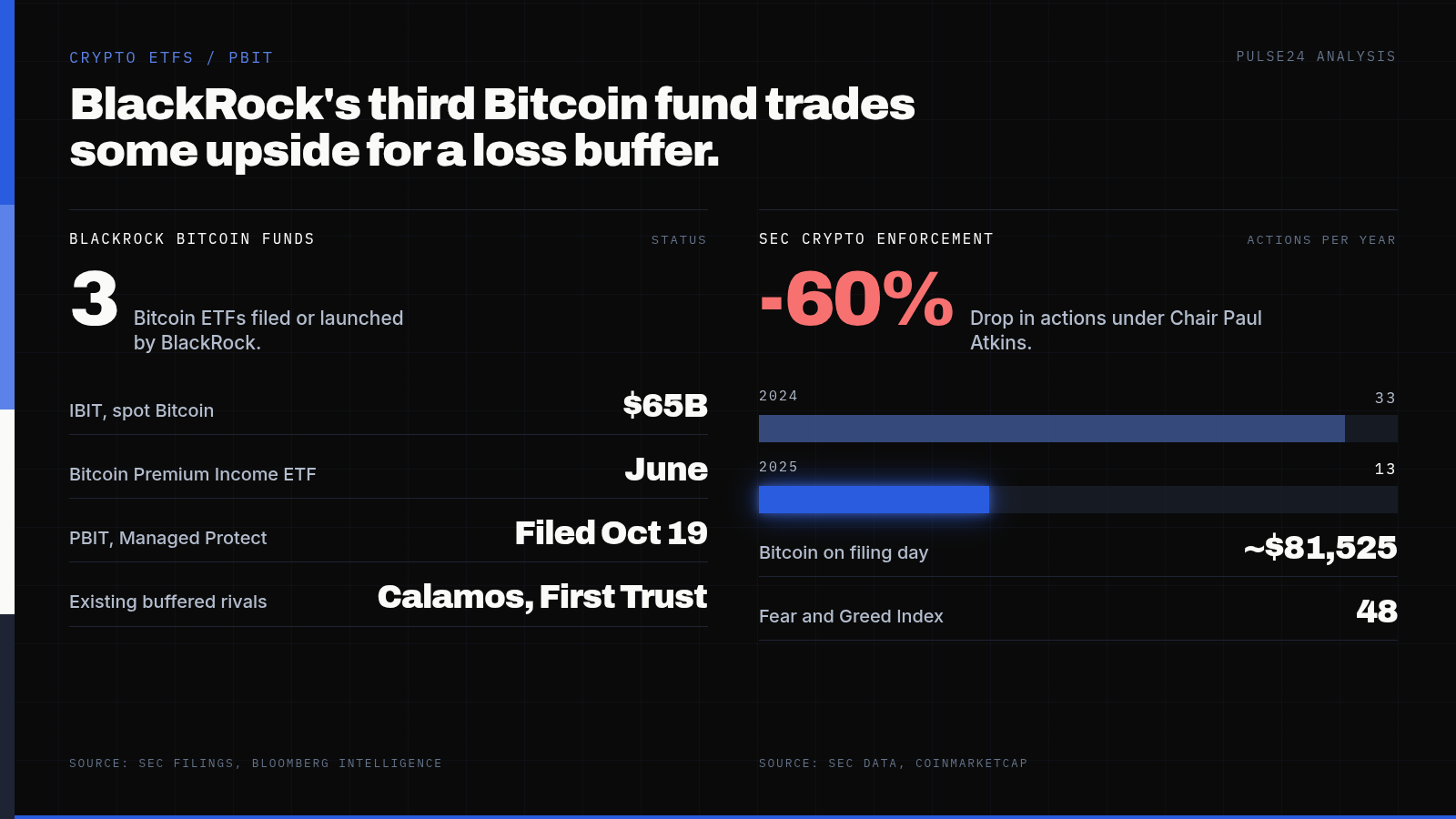
What Changed Three Bitcoin products now sit under BlackRock's iShares brand. IBIT launched in January 2024 and has since grown into the largest Bitcoin ETF by assets, a scale that gave the firm the standing to treat crypto like any other shelf product. In June, BlackRock added the iShares Bitcoin Premium Income ETF, which sells call options against Bitcoin exposure for monthly income. PBIT would be the third leg: a fund for investors who want Bitcoin's price exposure without its full downside, the kind of allocator who has sat out spot Bitcoin entirely because a 20% drawdown in a week doesn't fit their mandate.
None of this is new, exactly. Calamos and First Trust already sell defined-outcome Bitcoin ETFs on a similar premise: a ceiling on gains in exchange for a floor under losses. What's new is who's doing it. Seyffart pointed out that BlackRock's crypto lineup, even with PBIT added, still covers only Bitcoin and Ether, while smaller rivals have already pushed into funds tied to XRP, Solana, and Dogecoin. BlackRock is moving slower and narrower than the rest of the field, but when the world's largest asset manager files for a product, competitors tend to read it as confirmation the category has arrived, not evidence that it's still experimental.
Why It Matters Buffer products exist because volatility, not just price, is what keeps money on the sidelines. A pension fund or a registered investment advisor can tell a client that Bitcoin might return 40% in a strong year, and the client generally likes hearing that. It's the kind of 65% drawdown Bitcoin pulled off in 2022 that keeps the allocation at zero. A fund that caps the upside for a measured floor under the downside is really a pitch to that second group, the fiduciaries who need an answer for the quarter when Bitcoin falls and the line on a client's statement doesn't fall with it.
The timing lines up with a regulator that has largely stepped back from the sector. The SEC under Chair Paul Atkins brought 13 crypto-related enforcement actions in 2025, down from 33 in 2024, a nearly 60% drop to the lowest case count since 2017. Total fines fell further still, to about $142 million, under 3% of the prior year's figure. Atkins has traded sweeping registration cases for a smaller number of fraud actions and has leaned on rulemaking and guidance over lawsuits to set the rules of the road. Whatever one makes of that shift, it has given asset managers more room to file novel wrappers like PBIT without waiting years for an answer.
It also follows a separate tightening at the index level. MSCI's new rule puts a November 30 deadline on how much balance-sheet Bitcoin a company can hold and still qualify for MSCI's standard equity indexes, a change aimed squarely at Strategy's leveraged bitcoin treasury bet. Read alongside this filing, a pattern emerges: passive index providers are narrowing one back door into Bitcoin exposure, the corporate-balance-sheet route, while regulated asset managers build new front doors, in the form of ETFs, to take its place. That's a rotation in how institutional money is allowed to touch Bitcoin more than it is any verdict on whether institutional money should.
Bitcoin itself barely reacted. The coin traded near $81,525 on Tuesday, down about 0.9% over 24 hours, and CoinMarketCap's Fear and Greed Index sat at a neutral 48. That tracks with Pulse24's note earlier this week that Bitcoin's price chart has gone unusually quiet by its own recent standards. A filing for a product that won't trade for months, aimed at buyers who aren't speculating on this week's candle anyway, was never going to move the tape.
What to Watch Next The SEC still has to review the filing, and nothing in it is final yet. An amended filing should eventually fill in the blanks, naming the actual upside cap and buffer depth. From there, the questions worth tracking are whether BlackRock sets a launch date before year-end, and whether Fidelity or Ark follow it into the buffer format the way they followed it into spot Bitcoin back in 2024.
The next real test of all this arrives regardless of PBIT's own timeline. The Fed's October 27-28 meeting, where another rate hike is reportedly still on the table, is exactly the kind of event that separates funds which merely cap losses on paper from funds that get tested by one.
The Pulse24 Take A buffer ETF is an admission more than a wager. Most of the money that hasn't bought Bitcoin yet was never held back by doubts about the asset so much as by what a single bad month does to a client meeting. BlackRock didn't invent that insight; Calamos and First Trust got there first. But BlackRock's $65 billion IBIT franchise is what turns a niche product into a category that rivals have to answer.
Pair that with a regulator that has stepped back and an index world that is simultaneously stepping up scrutiny elsewhere, and the picture here is less about Bitcoin's price this week than about which door institutional money ends up walking through. PBIT, if it launches with terms that hold up, would be one more door. Whether it's a good one depends entirely on numbers this filing hasn't disclosed yet.
How we read the data
Curious how we get from raw data to a take like this? Our Trader's Toolkit walks through the tools we lean on.
Explore the Toolkit