Pulse24 Original
MSCI's New Index Rule Puts a November 30 Deadline on Strategy's Bitcoin Bet
October 18, 2026
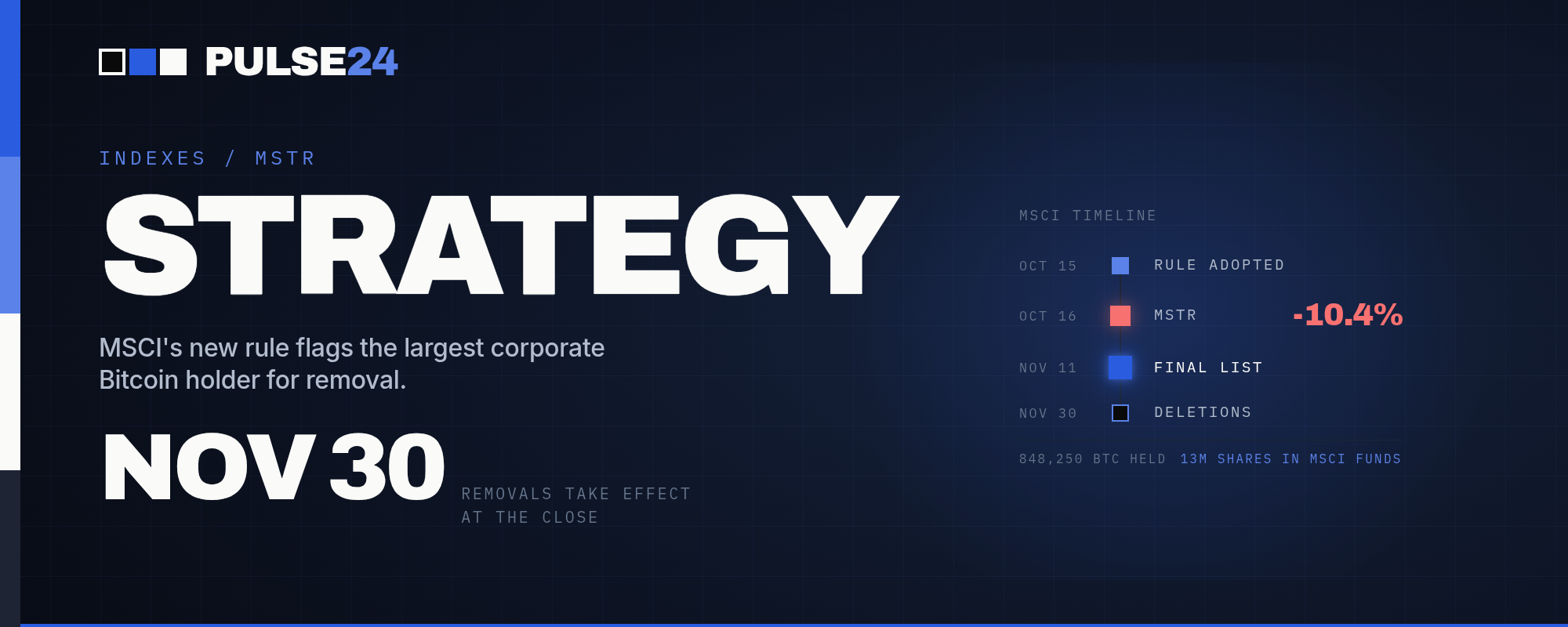
MSCI changed how it defines an operating company, and Strategy, the largest corporate Bitcoin holder, failed the test. Index funds holding roughly 13 million of its shares now have until November 30 to find out what happens next.
Strategy has spent four years building the largest corporate Bitcoin position on earth. On October 15, MSCI decided that doesn't make it an operating company.
The index provider finalized a rule it first proposed in August, and the practical effect is simple: a company whose balance sheet is mostly a stockpile of something other than its own business, rather than the equipment, inventory, or cash flow of a functioning business, no longer qualifies for MSCI's Global Investable Market Indexes. Strategy, the software company formerly known as MicroStrategy, owns 848,250 Bitcoin worth tens of billions of dollars, attached to an enterprise analytics business that generates a small fraction of that in annual revenue.
What Changed
MSCI's new screen runs in two stages. The first checks whether a company's balance sheet holds substantial operating assets. Companies that fail move to five financial ratios: operating asset intensity, expense intensity, operating cash flow, non-operating fair value intensity, and capital dependence. Failing at least four of the five makes a company ineligible.
Existing index members get a grace period that new applicants don't. They're removed only after failing both of their last two annual reporting periods, while a company applying for the first time is blocked after a single failed period. That buffer is why Strategy isn't gone from the index yet. MSCI will name every affected company on November 11, with the change effective at the close of trading on November 30.
The new rule replaces a temporary patch from January that applied only to companies holding digital assets worth more than half of total assets, and simply froze their index weighting rather than removing them outright. This version is broader and more permanent. It would just as easily catch a company stockpiling gold or uranium as one stockpiling Bitcoin, which is why Yellow Cake, a London-listed uranium investment vehicle with no Bitcoin exposure at all, shows up in MSCI's own simulation as a likely deletion alongside Strategy and Metaplanet.
Why It Matters
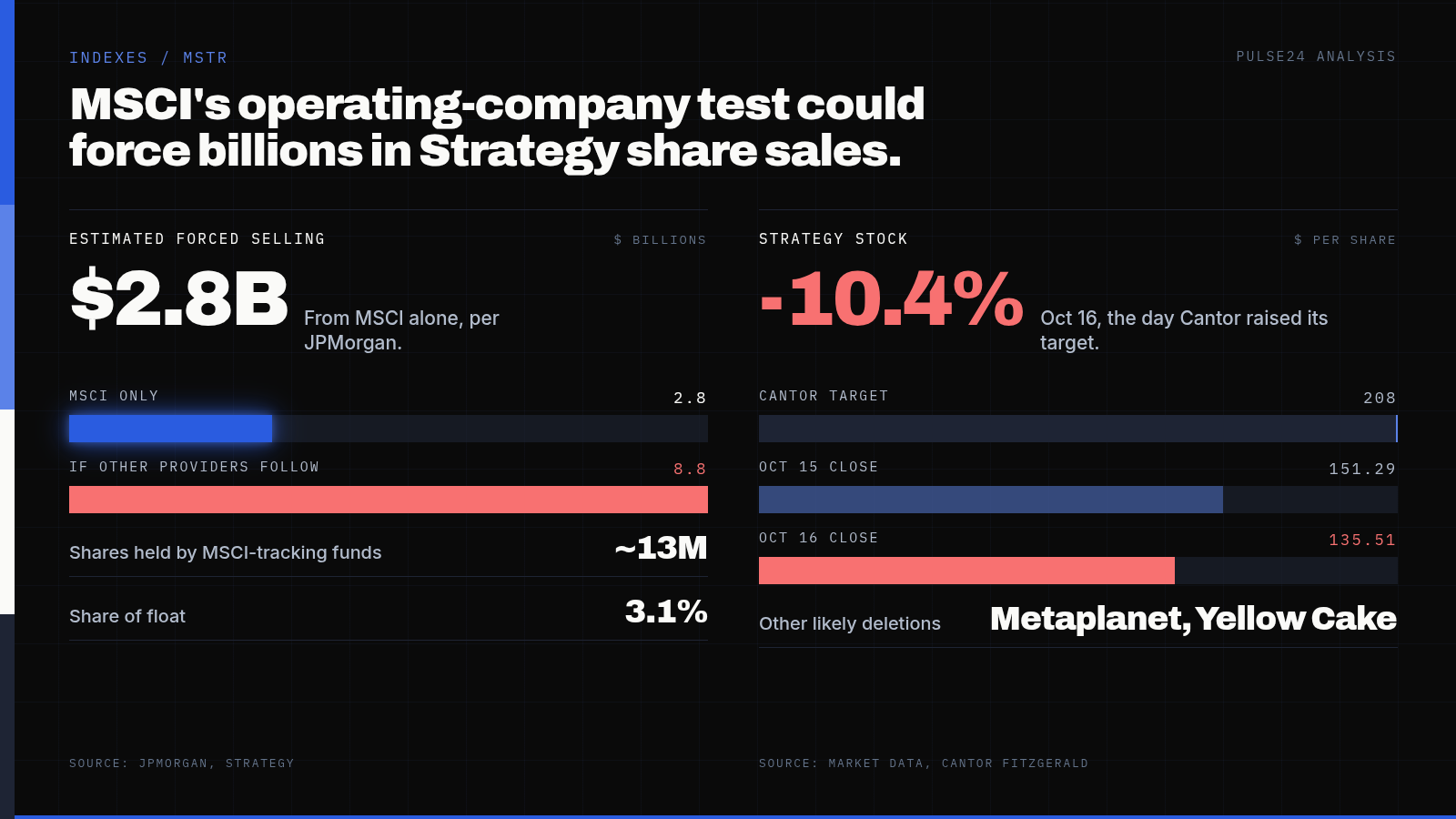
Passive funds don't choose what they own. They buy whatever sits in the benchmark they are built to replicate, in the weight the benchmark assigns, and they sell the moment that weight goes to zero regardless of what they think the company is worth. Strategy puts that forced pool at roughly 13 million of its shares, 3.1% of its basic share count, held across funds tracking MSCI's indexes, and argues that is less than a single day of average trading volume. JPMorgan's math, estimated under an earlier version of MSCI's proposal, points to a wider range: roughly $2.8 billion in outflows from MSCI's screen alone, climbing toward $8.8 billion if FTSE Russell, S&P Dow Jones, and Nasdaq's index arms adopt similar rules of their own.
The mechanism matters as much as the dollar figure. Strategy's financing model depends on investors paying a premium for its shares above the value of the Bitcoin sitting on its balance sheet, a multiple known as mNAV. When that multiple sits comfortably above 1, the company can sell new shares, use the proceeds to buy more Bitcoin, and grow Bitcoin-per-share even while diluting existing holders. That premium has spent much of the past year grinding down from a peak above 3.8 in late 2024 toward parity, and a mechanical new source of selling pressure is the last thing a strategy built on perpetual share issuance can afford.
Bitcoin itself, trading near $82,500 this past week after defending its $83,000 floor against a wave of short sellers, doesn't move when Strategy's stock does. The company isn't forced to sell a single coin to satisfy an index rule change. It only has to find buyers willing to absorb the shares that index funds are forced to shed. Confusing the two, a Bitcoin treasury stock getting cut from an index with Bitcoin itself losing favor, is the kind of leap that misleads more investors than it informs.
What's Already Showing Up in the Stock
Strategy's Nasdaq-listed shares closed at $151.29 on Thursday. By Friday, they had fallen 10.4% to $135.51, erasing the week's gains in a single session. Cantor Fitzgerald raised its price target the same day, lifting it from $186 to $208 while keeping an Overweight rating, a reminder that Wall Street's long-run view on Bitcoin exposure and the market's short-run reaction to index mechanics are two different conversations happening at the same time.
What to Watch Next
November 11 turns speculation into a published list. That's when markets learn exactly which companies failed MSCI's screen, including how many of the smaller names on its watchlist, Ethereum treasury firm SharpLink among them, join Strategy and Metaplanet in the removal column.
Whether other index providers copy MSCI's approach is the bigger question heading into 2027. FTSE Russell and S&P Dow Jones Indices run their own versions of the broad benchmarks that passive money tracks, and neither has adopted a matching rule yet. If they do, JPMorgan's higher estimate of $8.8 billion in combined outflows moves from a hypothetical to a forecast.
Strategy's own response is worth watching too. The company still has billions in at-the-market share capacity available to issue new equity, and management has already signaled a willingness to use Bitcoin itself to help fund preferred-stock dividends if needed. A de-indexing event that pressures the share price makes any future capital raise more expensive, right as cheap capital-raising is the engine the company's entire model runs on.
The Pulse24 Take
Index exclusions rarely change what a company actually does. They change who is allowed to own it without having to think twice. For several years, owning Strategy worked as a backdoor way to hold Bitcoin inside a retirement account or an index fund that technically couldn't buy crypto directly. MSCI has effectively started closing that backdoor, and it wrote a rule general enough to apply to any company that turns its balance sheet into a storage locker for something other than its own business.
The bigger lesson isn't really about Bitcoin. It's about financial engineering outrunning the infrastructure built to classify it. Strategy pioneered the corporate Bitcoin treasury faster than benchmark providers could decide whether that structure was a software company, an investment fund, or something else entirely. The index providers are now answering that question one company at a time, and the firms that built their capital strategy on staying index-eligible are finding out what happens once the rules catch up to them.
None of this settles the separate argument over whether Bitcoin treasury companies deserve to trade above the value of their holdings in the first place. It only removes one source of demand that never had to answer that question to begin with.
How we read the data
Curious how we get from raw data to a take like this? Our Trader's Toolkit walks through the tools we lean on.
Explore the Toolkit