Pulse24 Original
Apple's New CEO Beat on Revenue and EPS in His First Quarter. The Stock Fell on a Memory-Cost Warning Anyway.
November 4, 2026
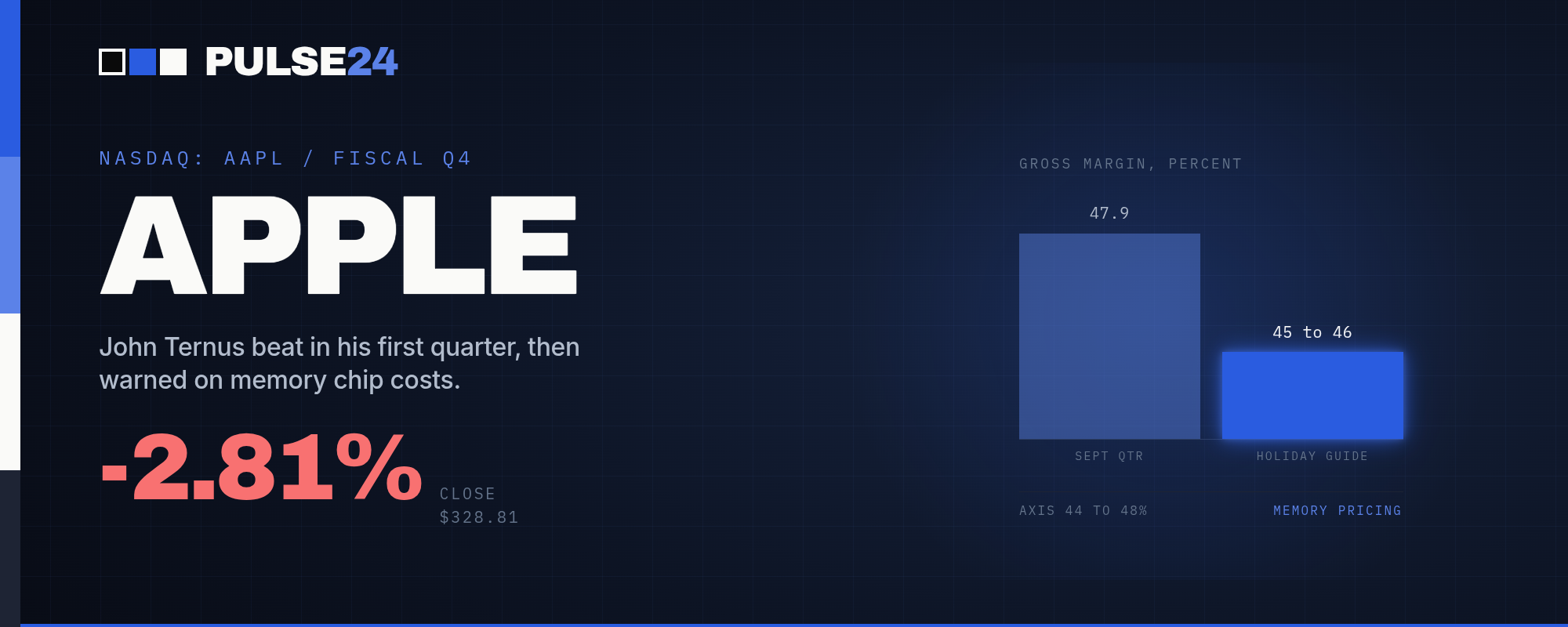
Apple beat Wall Street on revenue and earnings in CEO John Ternus's debut quarter, but the stock fell anyway after the company warned that "unprecedented" memory chip pricing will squeeze margins through the holidays. A Greater China miss and slower Services growth added to the unease.
John Ternus took over as Apple's chief executive on September 1, inheriting the title from Tim Cook, who moved into the newly created role of executive chairman. Two months later, on his first earnings call as CEO, Ternus had to tell investors that the chips inside every iPhone, Mac and iPad were getting more expensive, and that the trend had further to run.
Apple's fiscal fourth quarter, covering the three months through late September, beat on nearly every headline number. Revenue reached $114.48 billion, up 12% year over year and about $1.09 billion ahead of the LSEG consensus. Net profit rose to $30.71 billion from $27.47 billion a year earlier, and earnings per share of $2.10 topped estimates by roughly 11 cents. iPhone revenue came in at $57.58 billion, Services brought in $31.57 billion, and the Mac line added $10.79 billion.
None of that stopped the stock from falling. Apple shares dropped as much as 4.4% in after-hours trading before paring the decline to 2.81%, closing the extended session at $328.81 with an intraday low of $323.33 reached during the call itself. Shares had initially ticked higher on the headline beat, then reversed as Ternus and the finance team worked through the outlook.
What Changed
The outlook is where the trouble started. Apple guided next quarter's gross margin to a range of 45% to 46%, down from the 47.9% it just reported for the September quarter, a drop of roughly a point and a half at the midpoint. Ternus described current memory pricing as "unprecedented" and said the company expects further increases beyond the holiday quarter, with the cushion from older, cheaper component inventory running out. Price increases on some products and savings elsewhere are only partly offsetting the hit.
Greater China added to the unease. Revenue there grew 21% to $17.54 billion, a healthy number on its own, but it still missed the roughly $18.58 billion analysts had modeled, a reminder that Apple's largest overseas market remains its least predictable. Services, the business with Apple's fattest margins, is guided to grow just 8% to 9% next quarter, versus the 10.7% Wall Street had expected. Memory supply is also expected to constrain how many Mac and iPad units Apple can build through December, layering a supply problem on top of a cost one.
The quarter also marked the market debut of the iPhone Duo, Apple's first foldable, which reached customers in October and so contributed nothing to the September quarter's results. Ternus said demand is running ahead of supply, without offering a date for when the two catch up, and noted that a small share of early units have been swapped out over display issues. No independently verified return rate exists yet.
Why It Matters
Apple's margin guide is the clearest sign yet that the memory shortage Pulse24 has been tracking is no longer a problem confined to chipmakers and cloud providers. DRAM prices hit an all-time high in October, and South Korea's chip exports jumped 259% as Samsung and SK Hynix rode the same wave. Those numbers describe the supply side of a shortage driven largely by AI data center buildout soaking up memory capacity. Apple's earnings call is the demand side showing up: a company that buys memory by the hundreds of millions of units a year is now telling investors, in plain language, that it cannot fully pass the cost through and still protect margin.
That has a wider read-through. If the world's largest buyer of consumer-grade memory is absorbing a margin hit rather than fully passing costs to customers, other hardware makers with less pricing power, think PC vendors, game console makers and lower-margin phone brands, are likely feeling it harder. The AI capex boom has already reshaped credit markets and chip-stock valuations this year. Apple's quarter is evidence that it is now reaching into the cost structure of ordinary consumer electronics, right as the holiday shopping season begins.
The China miss and the Services slowdown are smaller signals pointing the same direction: growth that looks fine at the top line can still mask softening underneath. None of these figures is an alarm bell on its own. Together, they are why a revenue beat and an EPS beat still bought Apple a lower stock price.
What to Watch Next
The next data points worth tracking are whether memory prices keep climbing into 2027 or start to ease as new DRAM and NAND capacity comes online, whether other consumer hardware makers echo Apple's margin warning when they report their own holiday-quarter guidance, and how December-quarter China revenue lands given the pattern of misses this year. The iPhone Duo's supply-demand gap deserves attention too heading into the holidays. A popular, supply-constrained new product category can mask softness in the core iPhone line just as easily as it can become a genuine growth lever, depending on how quickly Apple scales production.
The Pulse24 Take
Apple delivered one of its stronger quarters in recent memory and got punished for it anyway, which says more about what investors are pricing than about the business itself. A beat on revenue and EPS used to be most of the story. Now the market wants to know what margin looks like six months out, and in an environment where memory costs are "unprecedented" by the CEO's own description, that answer is genuinely uncertain. This is not a reason to write off Apple, whose Services business and installed base remain real advantages, but it is a reason to stop treating AI-era component inflation as someone else's problem. It showed up in a company that does not even sell AI chips. That is the nuance worth sitting with: the AI buildout's costs are diffusing through the economy in ways that will keep surprising investors who are only watching the chipmakers.
How we read the data
Curious how we get from raw data to a take like this? Our Trader's Toolkit walks through the tools we lean on.
Explore the Toolkit