Pulse24 Original
What Happens When an F1 Team Breaks the Cost Cap? It's Happened Once, and the Fine Wasn't the Real Penalty.
August 6, 2026
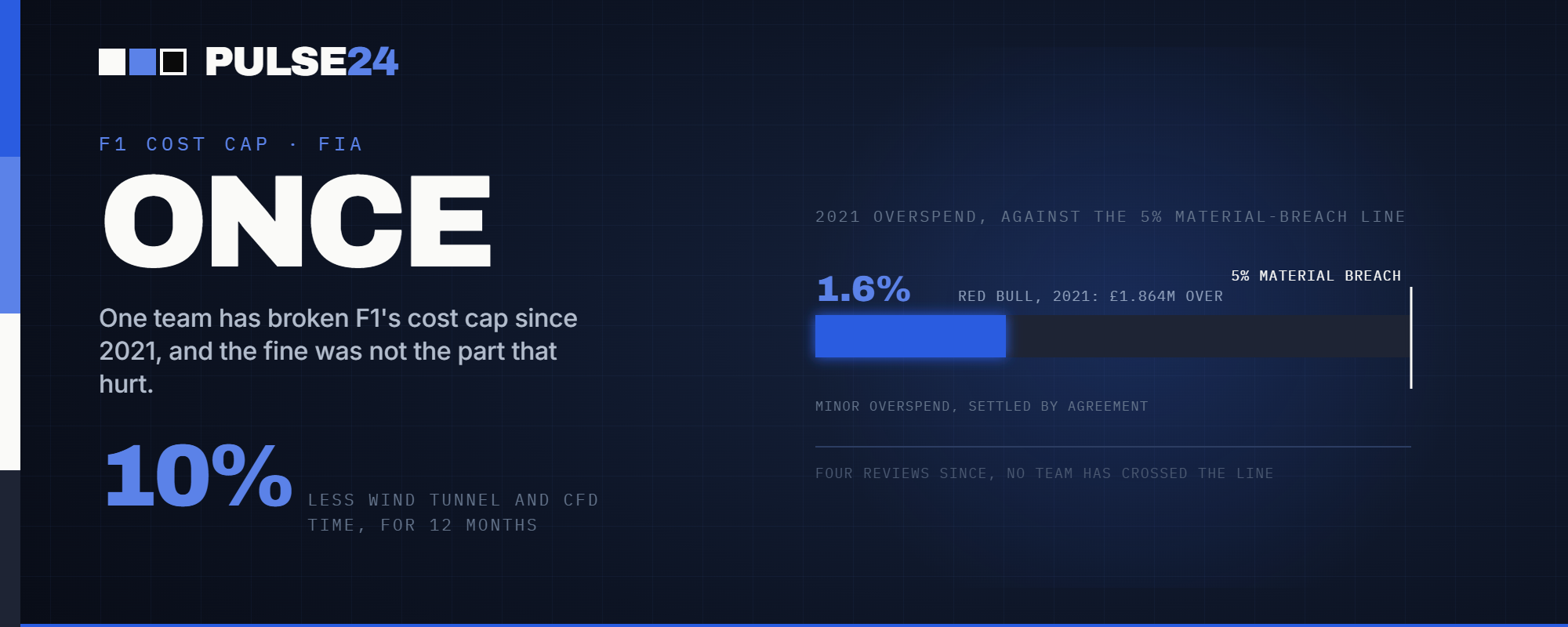
F1's cost cap has only been broken once, by Red Bull in 2021. Here's how the penalty tiers actually work, what happened in that case, and why the punishment cost more on track than on the balance sheet.
Most of what follows traces directly to the FIA's own published findings and the Accepted Breach Agreement it reached with Red Bull, rather than to reported estimates. That's a meaningfully higher bar of certainty than most cost cap coverage clears, and it's worth knowing upfront.
Formula 1's cost cap has existed since 2021, applies to every constructor on the grid, and has been broken exactly once. That single case, Red Bull in 2021, is the only real data point the sport has for how its penalty system behaves once a team actually crosses the line, and both the finding and the punishment turned out to be more specific, and more instructive, than the phrase "budget cap breach" usually suggests.
Two questions tend to come up whenever the topic resurfaces. Could a team actually lose a championship over this? And did Red Bull get away with something in 2021? The honest answer to both starts with understanding that the FIA built two entirely different tracks for handling an overspend, depending on how large it is.
The Two-Tier System: Why 5% Is the Line That Matters
F1's financial regulations don't treat every overspend the same way. Cross the cost cap by less than 5% and the FIA classifies it as a minor overspend breach. Cross it by 5% or more and it becomes a material overspend breach, a different category with a different process and, under the regulations, penalties that can include suspension from an entire competition and exclusion from the championship. No team has been found in the material category since the cap took effect in 2021.
That threshold shapes what happens next as much as the number itself. Procedural and minor breaches are eligible for something called an Accepted Breach Agreement, a settlement process where the team and the FIA's Cost Cap Administration agree on the facts and the penalty together, similar in spirit to a plea agreement. A material breach doesn't get that option. It goes straight to the Cost Cap Adjudication Panel, a full hearing with the sport's harshest sanctions on the table, tools the FIA has written into its regulations but never actually had to use.
What Actually Happened to Red Bull in 2021
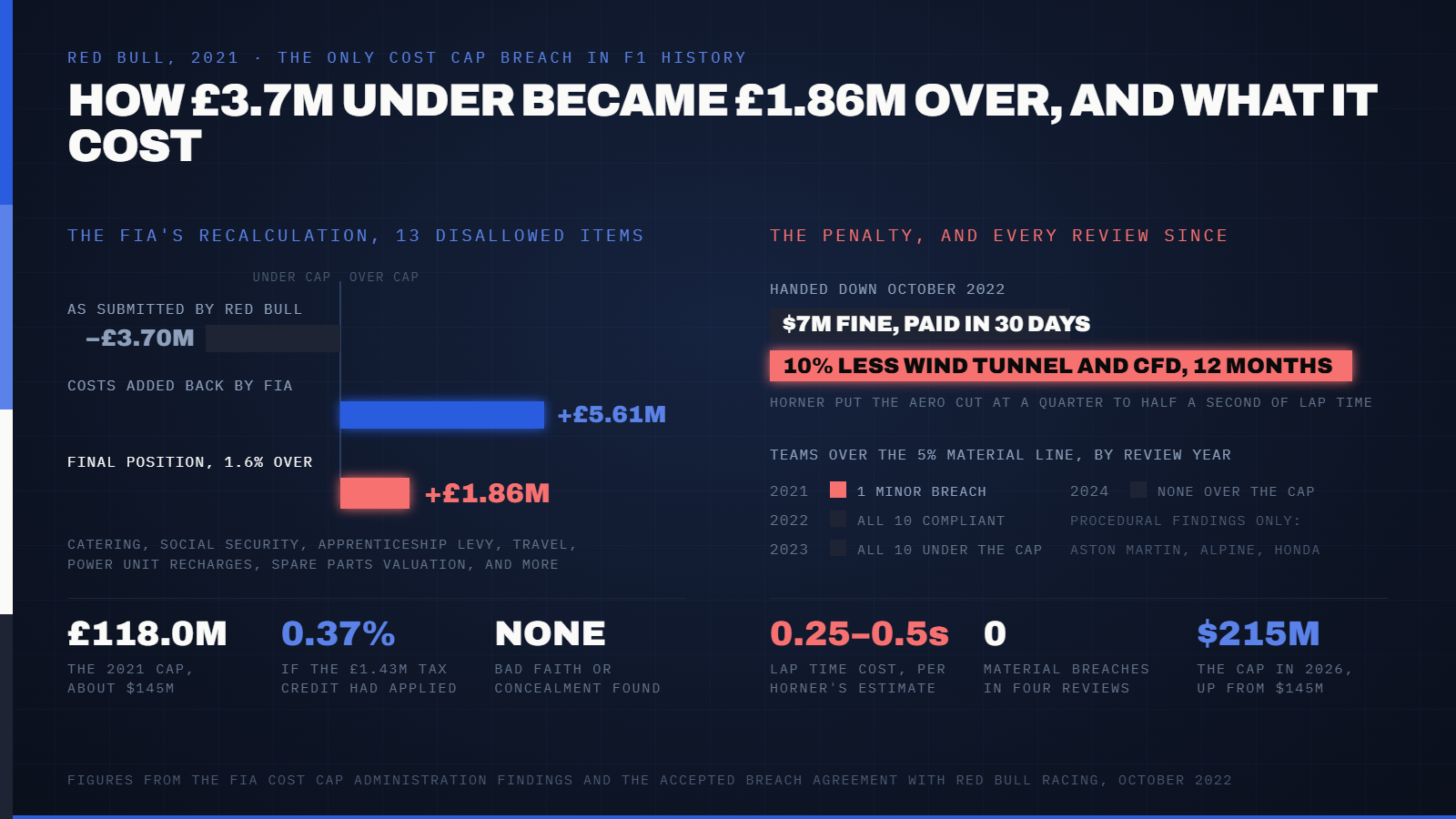
Red Bull's own submitted accounts for 2021 showed the team roughly £3.7 million under that year's £118.036 million cap. The FIA's Cost Cap Administration didn't accept that submission at face value. Its review identified thirteen separate cost items, worth £5.607 million combined, that Red Bull had excluded or misclassified: catering, employee social security contributions, apprenticeship levies, power unit cost recharges, travel, facility maintenance, and how the team valued unused spare parts, among others.
Add those thirteen items back in, and Red Bull's spending landed £1.864 million over the cap, a 1.6% overspend. That's comfortably inside the minor-breach category, more than three times below the 5% line that would have triggered a material finding.
One detail makes the case murkier than a simple accounting failure. Red Bull had a £1.431 million notional tax credit in its submission that, applied correctly, would have cut the final overspend to £432,652, just 0.37% over the cap, roughly a fifth of the number the FIA ultimately used. The FIA didn't allow that adjustment, but its own report was explicit about what it did and didn't find. In the regulator's words, there was "no accusation or evidence that RBR has sought at any time to act in bad faith, dishonestly or in fraudulent manner, nor has it wilfully concealed any information from the Cost Cap Administration," and the team "acted cooperatively throughout the review process."
That's the case in full. A team's accounting interpretation of a genuinely new and complex set of financial rules didn't survive contact with a regulator reviewing them for the first time. Nothing in the record points to concealment, and the FIA said so in its own words. F1's financial regulations were brand new in 2021, and nobody, including the team that ended up in breach, had settled precedent for how thirteen different cost categories should be classified.
The Fine Wasn't the Whole Punishment
$7 million sounds significant until it's measured against an operation spending close to $145 million that year. Christian Horner, Red Bull's team principal at the time, actually called the fine itself "an enormous amount of money," one payable within 30 days. He reserved his sharpest language for the other half of the penalty: a 10% reduction in the team's wind tunnel and CFD allocation for 12 months, starting October 26, 2022. That, Horner said, was "the more draconian part," and he estimated it cost Red Bull somewhere between a quarter and half a second of lap time.
The distinction matters because it shows where the FIA's penalty system actually bites. A fine is a one-time balance sheet cost a team the size of Red Bull can absorb. Development time isn't something a team can simply buy back later. It compounds across an entire season of car updates, and in a sport this technically constrained, a quarter second is the kind of gap that separates pole position from third on the grid. The FIA didn't just make Red Bull pay for 2021. It made the team develop its next car with less of the tools every rival still had.
Why the System Still Holds
Every cost cap review since Red Bull's has come back clean in the sense that actually matters: no team has crossed the 5% line. The FIA found all ten teams fully compliant for 2022. For 2023, all ten teams again stayed under the cap, though Alpine and Honda were separately found in procedural breach on the power unit side, unrelated to team overspending and resolved without any finding that either had exceeded its limit. For 2024, nine of ten teams were fully compliant, and the tenth, Aston Martin, was found in a procedural breach "of a very minor nature" for missing its audited-accounts deadline after a delayed signature, not for spending too much. The FIA confirmed Aston Martin hadn't exceeded the cap at all.
The cap itself hasn't stayed fixed while all this played out. It's climbed from $145 million in 2021 to $215 million heading into 2026, largely to absorb the cost of the sport's new power unit regulations. Pulse24 covered how that increase is playing out unevenly across the grid. A rising ceiling doesn't make a breach less likely in theory, but four straight years without one suggests the deterrent, an eight-figure fine stacked on a development-time penalty that shows up in actual lap times, has done its job.
What Would Actually Happen If a Team Crossed 5%
Nobody has tested this in practice, which is itself informative. The FIA's financial regulations put suspension from an entire competition and exclusion from the championship on the table specifically for a material breach, penalties Red Bull's case never came close to triggering. A team facing an actual material finding wouldn't get the negotiated, cooperative process Red Bull went through. It would go to the Cost Cap Adjudication Panel, in public, with no settlement route and the sport's most serious sanctions available to whoever hears it.
That gap between what's written into the rules and what's ever actually happened is the honest answer to the question people usually mean to ask. Yes, in theory, a team could lose a championship over its cost cap. In four seasons of the cap actually operating, no team has spent enough over the line to find out how that would really play out.
The Pulse24 Take
The cost cap's real power was never about the size of the fine. It was about ending an era where a team's competitiveness was mostly a function of how much money it could burn, and replacing it with a system where breaking the ceiling costs a team the very development time that ceiling exists to ration in the first place. Red Bull's case is the system working close to as intended. A genuine accounting dispute, resolved without any accusation of dishonesty, still cost the team something that showed up on track rather than just on a balance sheet. Four seasons later, it's still the only time it's happened, and the deterrent looks stronger, not weaker, for having only been tested once.
How we read the data
Curious how we get from raw data to a take like this? Our Trader's Toolkit walks through the tools we lean on.
Explore the Toolkit