Pulse24 Original
F1's 2026 Cost Cap Went Up by $80 Million. Half a Season In, Here's Who That Money Actually Helped.
August 1, 2026
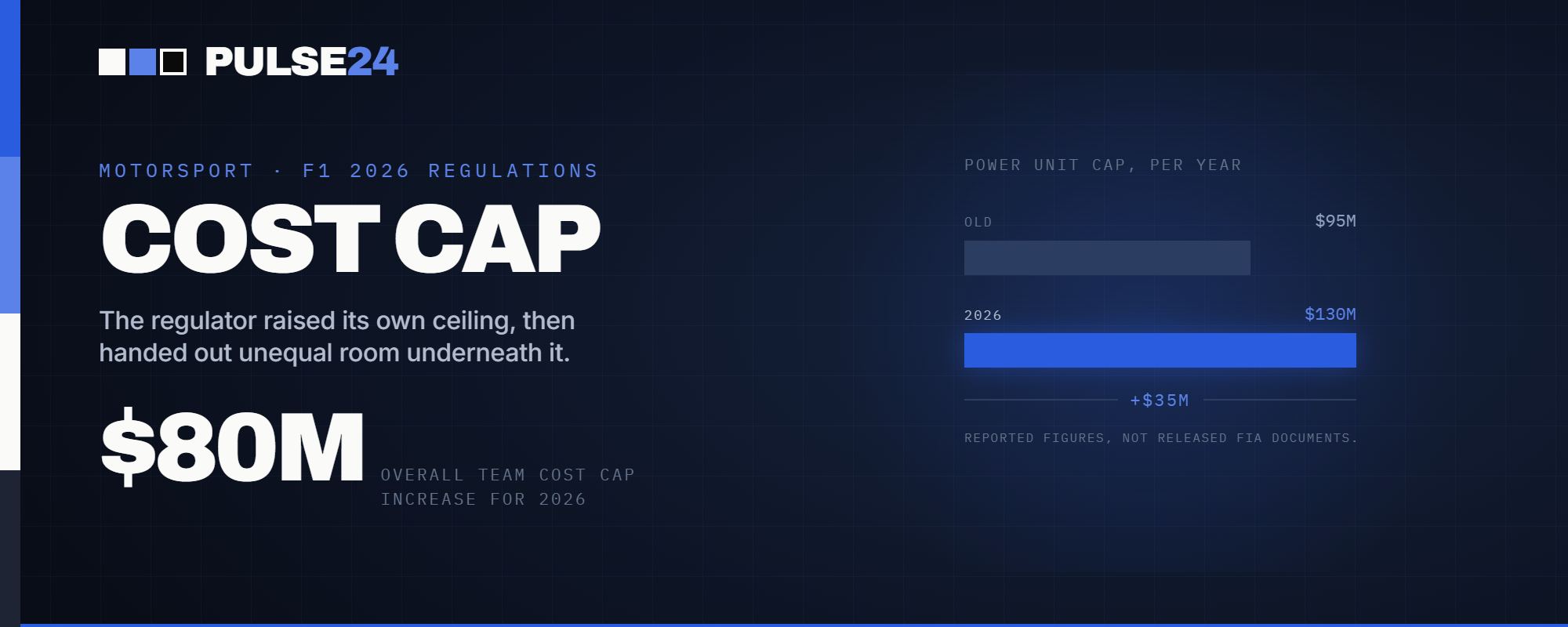
F1 raised its cost cap by $80 million for the 2026 rules reset. Eleven rounds in, here's how that money is actually splitting Mercedes, Ferrari, Red Bull, Audi, and Honda, and what the cap increase did and didn't fix.
Every figure above is reported through F1 media and cost trackers, not released FIA documents. Teams don't publish these numbers, so treat exact totals as directional rather than audited.
Why the Cap Had to Move
F1's cost cap exists to stop outspending from deciding championships. Raising it isn't routine. It's the regulator admitting the thing it's supposed to contain got structurally more expensive. Stripping the MGU-H, nearly tripling MGU-K output, and switching every team to sustainable fuel at the same time isn't a tuning update, it's a clean-sheet redesign, and the FIA priced that reality into the cap itself rather than pretending the old ceiling would still hold.
That the cap moved is confirmed. What it actually bought each team is the more interesting question, and the answer isn't the same for everyone.

Team by Team: Where the Money Went
Mercedes
Entered the season as the presumptive favorite, and a compression-ratio advantage discovered ahead of Melbourne drew complaints from rivals before a single race had run. What that advantage hasn't done is stay contained to one team. Mercedes power units also run in McLaren and Williams, among others, which means a strong Mercedes engine compounds across multiple constructors' results, not just its own. That's the structural point worth sitting with: a power unit edge under this cap doesn't just help the works team, it multiplies through every customer on the list. It's also the edge that's carried Kimi Antonelli to a 50-point championship lead heading into F1's summer break.
Ferrari
The clearest single-team illustration of what "power unit deficit" actually costs on track. Widely reported to be carrying one of the sport's stronger chassis for cornering, and one of its weaker straight-line packages, a gap Lewis Hamilton described directly after a race in China: on raw performance, he said, the team is "hugely down to the Mercedes engine." Estimates put the deficit in the range of 20 horsepower. Ferrari's early opposition to these regulations, real enough to get the manufacturer excluded from a manufacturers' meeting before eventually signing on, reads differently in hindsight. The team that fought the rules hardest is also the team whose season the rules have most visibly shaped.
Red Bull Powertrains-Ford
The newcomer nobody expected to contend immediately, team principal Laurent Mekies himself called it "silly" to expect the new engine to rival Mercedes or Ferrari out of the gate. Reports from the first ADUO checkpoint suggest the opposite happened: Red Bull's engine is understood to be the season's actual benchmark. If that holds, it's the clearest evidence yet that the cap increase bought real competitiveness for a manufacturer building a program from nothing, exactly the outcome the FIA's layered allowances were designed to make possible.
Audi
The most difficult transition of the five. Entering as a full manufacturer for the first time by rebranding the former Sauber operation, and doing it with two cars gathering development data against Mercedes' eight and Ferrari's six. Team principal Mattia Binotto has been direct about where the shortfall lives: most of the gap to the top teams is from the power unit, which he called not unexpected. Pre-season estimates put Audi's deficit as high as 31 horsepower behind Mercedes, and the team's early results reflected it. Audi's situation is the cleanest test case for whether ADUO's catch-up grants and development tokens can meaningfully close a gap this size within the two-year window the mechanism allows, a question this season and next will actually answer, not a prediction worth making in August.
Honda
The quiet case. Reported to run the least powerful combustion engine on the grid, yet narrowly missed qualifying for a larger ADUO allowance, landing in the same performance bracket as Mercedes and the rest rather than the wider gap tier. For a team still working through a genuinely difficult season, that's a real cost: a few percentage points kept it from the extra development room its actual competitive position might have justified.
What This Actually Means Going Into 2027
ADUO grants aren't cumulative within a season, and a manufacturer only qualifies for a tier the first time it's measured, which means this isn't a mechanism that quietly keeps paying out. Whoever's behind now gets a defined, time-limited chance to close the gap using real development tokens and dollar figures, not an open-ended subsidy. Whether that's enough to meaningfully reshape the grid by 2027, or whether Mercedes' customer-network advantage and Ferrari's straight-line deficit prove too structural for a two-year catch-up window to fix, is the actual question this cost-cap increase was built to answer. Half a season in, the honest read is that it's working exactly as designed for Red Bull, and not yet for Audi.
The Pulse24 Take
An $80 million cap increase sounds like a number that helps everyone equally. It doesn't. It sets a new ceiling, then hands out unequal room underneath it based on how far behind you started, how many customer teams share your engine, and how many cars you've had gathering data since testing began. The FIA didn't just make F1 more expensive for 2026. It built a financial mechanism that's actively deciding, in real time, which of that expense gets closed and which doesn't.
How we read the data
Curious how we get from raw data to a take like this? Our Trader's Toolkit walks through the tools we lean on.
Explore the Toolkit