Pulse24 Original
Kimi Antonelli Was Supposed to Be the Backup Plan. He's Taking a 50-Point Lead Into F1's Summer Break.
July 26, 2026
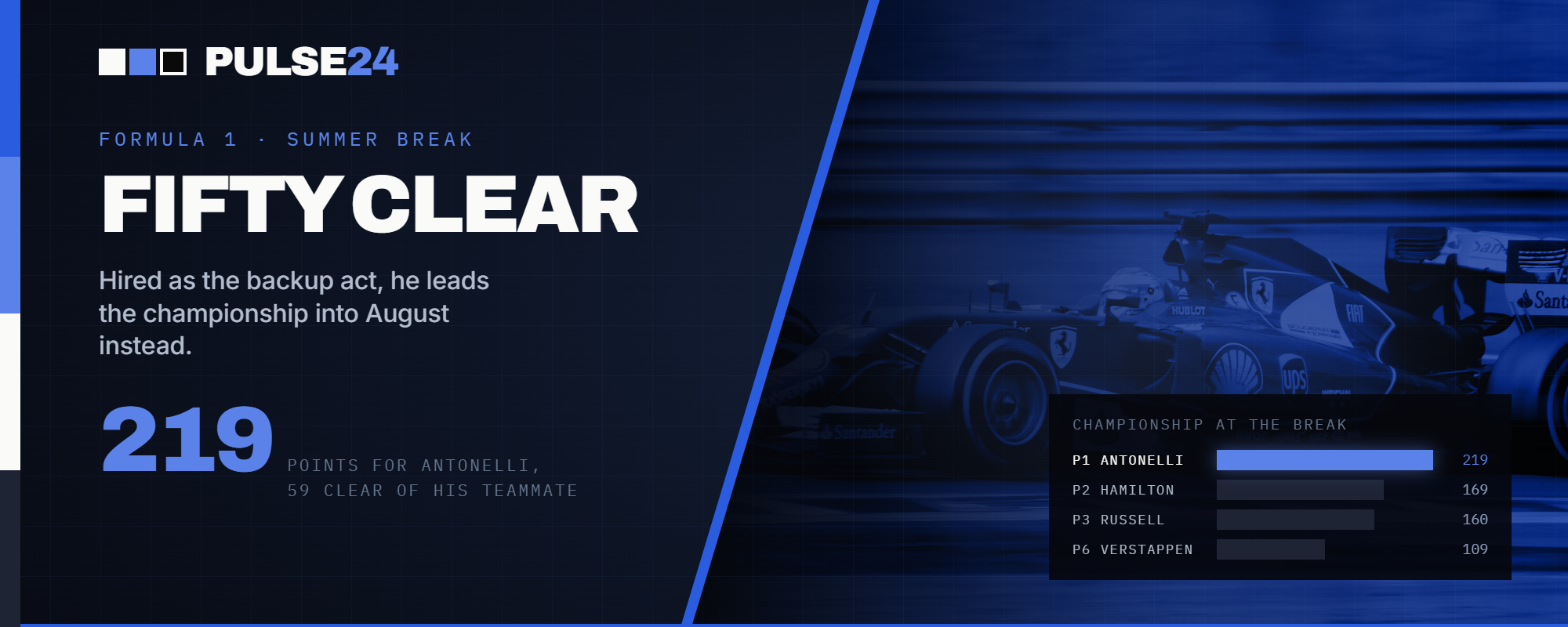
Kimi Antonelli was supposed to be George Russell's backup act. He heads into F1's summer break with a 50-point championship lead instead, a red hot Red Bull on his tail, and a second half that already reeks of grid penalties.
Lando Norris crossed the line in Hungary and Formula 1 broke for the summer with practically every storyline it could want. Norris's first win of 2026 was almost a footnote. The number that actually matters going into August sits at the top of the championship table. Kimi Antonelli, 219 points, 50 clear of Lewis Hamilton, and 59 clear of the Mercedes teammate who was supposed to have this title wrapped up by now.
That teammate is George Russell. At the start of the year the form line was obvious. Russell was the incumbent, the reference point, the driver Mercedes built its 2026 car around after Hamilton left for Ferrari and handed the other seat to a teenager back in 2025. Antonelli's rookie year had flashes of speed mixed with the mistakes everyone expected from an eighteen year old. Going into year two, he was still filed under future prospect. Nobody outside Brackley expected him to be the present too, not this soon.
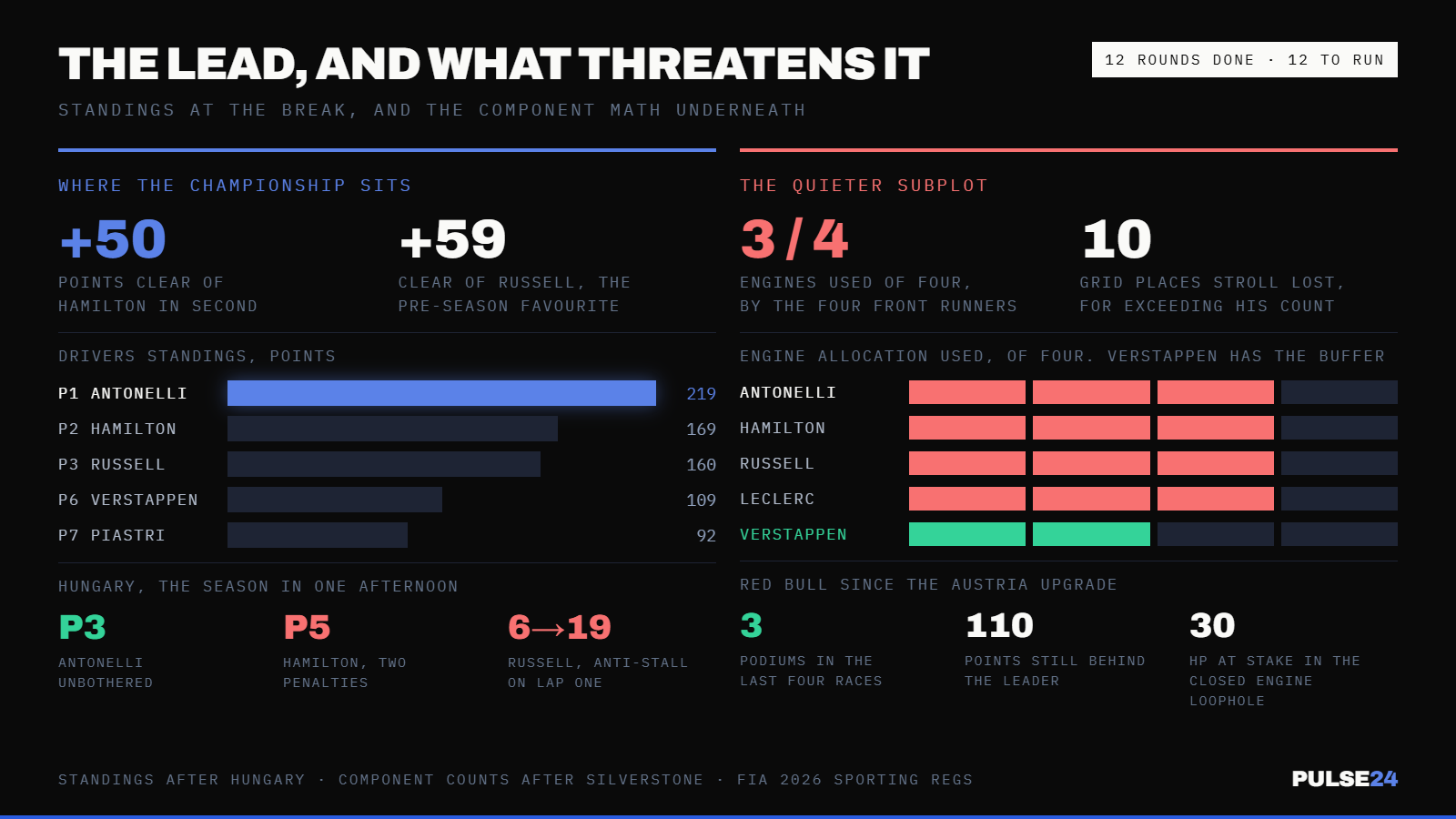
He is anyway. Antonelli won the Belgian Grand Prix and turned a 25 point cushion into 45 in a single afternoon, then stretched it further in Hungary while Russell's race unraveled before the first corner even finished. An anti-stall off the line sent Russell from sixth on the grid to nineteenth on lap one. He fought back to seventh by the flag. Antonelli finished third, comfortable, unbothered, 50 points clear of second place. Russell has admitted as much himself, saying Antonelli "deserves to be ahead" and that he needs "to be better." That is not the sentence a driver says when he expects to win the title, and it fits a pattern Pulse24 traced back to Bahrain and Monaco months before Spa ever became the story.
Kimi's Lead, and Whether Lewis Can Close It
Fifty points sounds enormous with eleven races left, and it is, but it is not the kind of gap Hamilton is willing to concede in July. "I really believe that we can fight," he said heading into Hungary. "Still a lot of work to do, still a mountain to climb in the second half of the season, but I'm more focused than ever." He backed that up with a blunt admission too. Ferrari should have won two of the last few races outright if the team had "perfected the weekend."
Hungary was a version of that argument in miniature. Hamilton qualified on the front row, then lost three places for impeding Piastri in Q3, started fifth, sliced past Leclerc early, clipped wheels with Verstappen doing it, picked up a five second penalty for speeding in the pit lane, and finished fifth behind his own teammate. Ferrari has the pace to be in the fight most weekends. It keeps finding new ways to leave points on the table while it's there. Close that gap and 169 becomes 200 quickly. Keep leaving five second penalties and grid drops on the table and fifty points turns into a canyon.
Ferrari Wanted the Rulebook to Behave Too
Some of Ferrari's frustration this year has had nothing to do with driving. New engine rules for 2026 rewired the entire power unit formula, and the regulations arrived with enough grey area that Fred Vasseur spent the spring publicly demanding the FIA pin them down. "With the new regulations on the battery, on the engine, on the chassis, on the tyres and the sporting regs, we were going into the direction where we have grey areas," Vasseur said. "What we need is to have it clear cut that it's now like this."
The specific flashpoint was Mercedes's engine. Rivals suspected the power unit measured a legal 16:1 compression ratio when cold, then crept toward the previously permitted 18:1 once it reached race temperature, worth anywhere from three horsepower by Wolff's estimate to thirty by Verstappen's. The FIA closed the loophole from June 1, measuring compression at both ambient and operating temperature, a change all five engine manufacturers approved unanimously. Wolff called the whole saga "a storm in a teacup" and said the ruling changed nothing for Mercedes either way. Whether that's true, or simply what a team says once a rule finally goes against it, is exactly the kind of question the second half will help answer, because Antonelli hasn't slowed down since.
Red Bull's Second Wind
If Ferrari has been arguing with the regulations, Red Bull has spent the last month quietly solving its car instead. A major upgrade introduced three races ago in Austria has turned Max Verstappen from an afterthought into the form driver of midsummer. Podiums at the Red Bull Ring, at Spa, and now second in Hungary behind only Norris, passing Hamilton around the outside at Turn 1 along the way. "It's been in general an upward trend the last few races," Verstappen said. "We're making nice improvements."
None of it moves Verstappen into the title conversation this year. He sits sixth with 109 points, 110 behind Antonelli, a gap no upgrade closes in eleven races. What it does is change the shape of every race weekend left on the calendar. A Red Bull that can fight Ferrari and occasionally beat McLaren outright decides who finishes where among the cars actually chasing the championship, and that matters enormously to Hamilton and Antonelli whether Verstappen ever gets to fight for the trophy himself.
One Housekeeping Note for the Second Half
F1's 2026 rules cap each driver at four internal combustion engines, turbochargers, and exhausts per season, and three each of the MGU-K, energy store, and control electronics, with grid penalties for going over. Antonelli, Hamilton, Russell, and Leclerc were all already on three of their four allocated engines after the British Grand Prix, and Lance Stroll has already taken a ten place drop this year for exceeding his own allocation. Verstappen, by contrast, is only into his second set of parts. It is the kind of thing that happens most seasons once cars rack up enough mileage. Worth knowing heading into the back half. Not the story.
The Pulse24 Take
The story F1 sold before the season was Russell versus the field. The story it delivered instead is a second year driver who has already outgrown his apprenticeship, a seven-time world champion trying to out execute his own team's mistakes, a Ferrari fighting the rulebook as hard as the grid, and a Red Bull quietly building the fastest car nobody's ready to race for the title yet.
Fifty points is a real gap, and Antonelli has looked like the calmest driver on the grid all year, which is its own kind of terrifying for everyone chasing him. Hamilton has the pace to close it and keeps handing pieces of it back with penalties and mistakes of his own making. Ferrari spent the spring arguing with the rulebook as much as the stopwatch, and Red Bull is quietly building the car nobody wants to face once Verstappen's momentum turns into results that count. That is the actual fight heading into August. Not just whether Antonelli's lead holds, but whether anyone chasing him stops beating himself first.
How we read the data
Curious how we get from raw data to a take like this? Our Trader's Toolkit walks through the tools we lean on.
Explore the Toolkit