Pulse24 Original
America Is Building $390 Billion in Chip Plants. It Doesn't Have the Workers to Run Them.
September 18, 2026
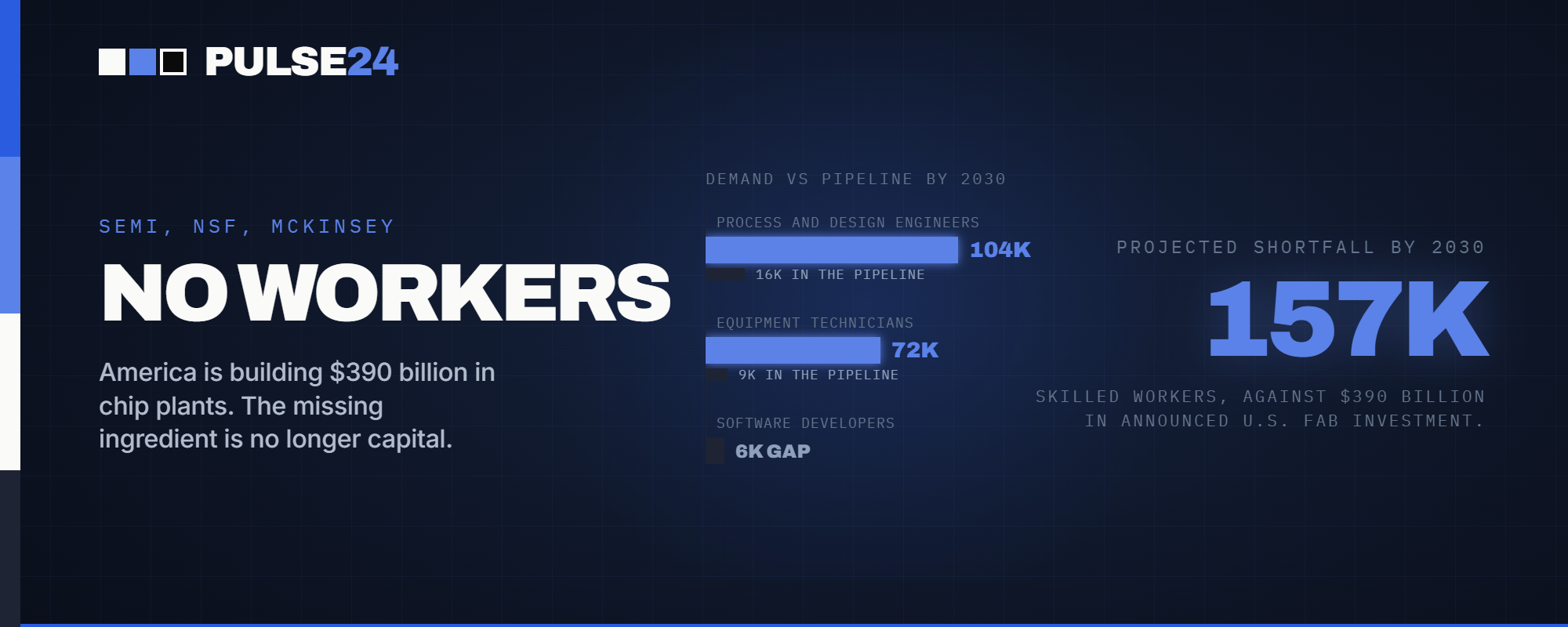
A joint industry report says America's chip buildout could be short as many as 157,000 skilled workers by 2030, and Samsung, TSMC, and Micron are already feeling it on fabs under construction today. The gap threatens hundreds of billions in planned semiconductor investment, and this time the missing ingredient isn't capital.
Up to 157,000. That's how many skilled semiconductor workers the United States could be short by 2030, according to a joint analysis from the SEMI Foundation, the National Science Foundation, and McKinsey published this summer. Samsung, TSMC, and Micron aren't waiting for 2030 to feel it. Each is running into recruiting walls on fabs that are already under construction, years before the shortfall the report describes is even supposed to peak.
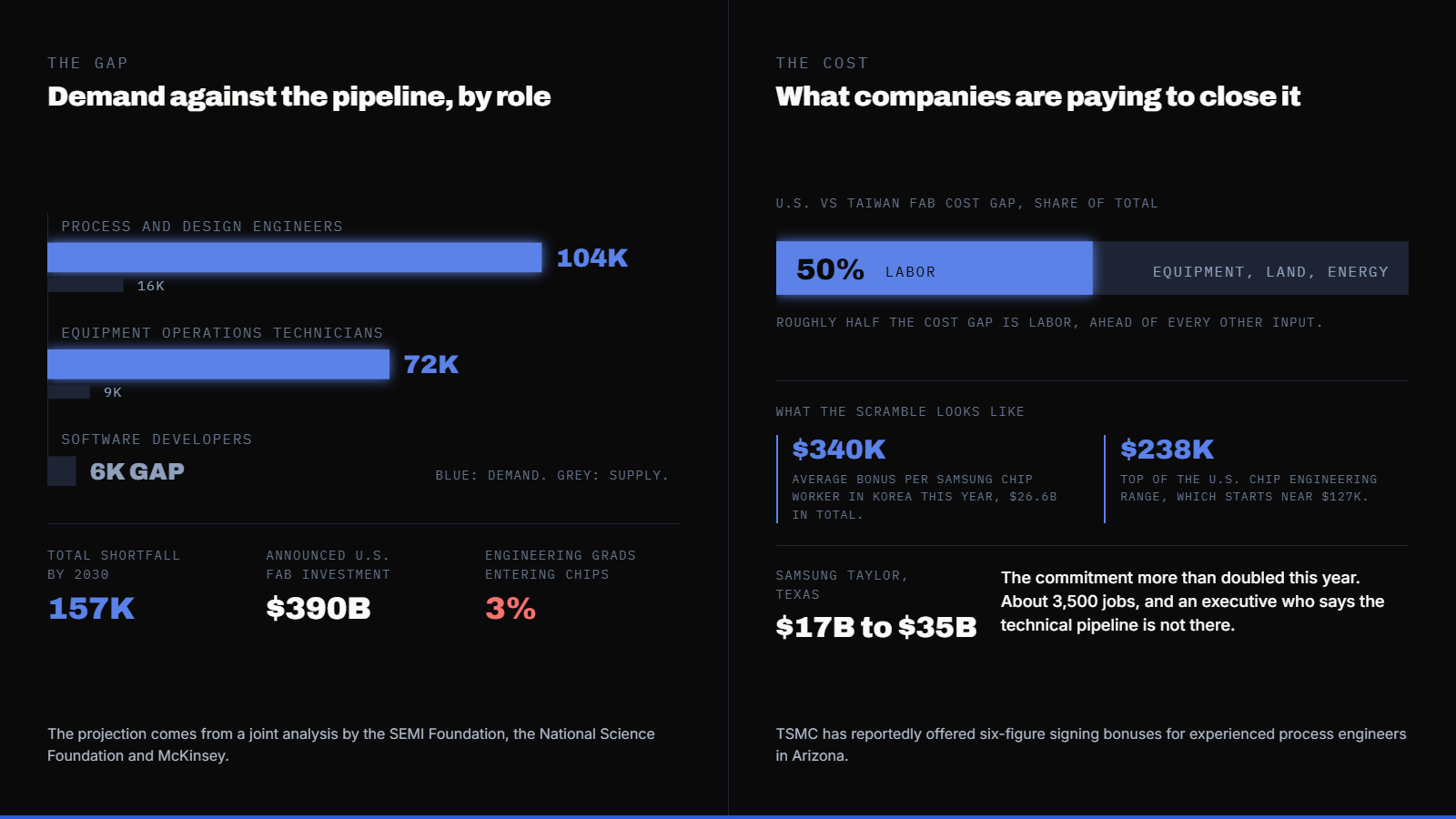
Samsung's experience in Taylor, Texas captures the pattern. The company more than doubled its investment there this year, from an original $17 billion pledge to roughly $35 billion, on a facility expected to add about 3,500 jobs as it starts producing advanced logic chips in late 2026. Jon Taylor, an executive vice president at Samsung's Austin semiconductor operation, put the staffing problem in plain terms: engineers, not funding, are the constraint now. "I'm concerned," he said. "We just don't see that there's enough technical people in the pipeline."
What Changed
For most of the CHIPS Act era, the story of America's semiconductor rebuild was a financing story. Companies wanted subsidies, tax credits, and state incentive packages, and once those showed up, construction followed. That phase is largely behind the industry now. TSMC has pushed its total Arizona commitment to $265 billion across at least four additional 2-nanometer fabs, a buildout that's also had to navigate equipment bottlenecks of its own. Micron broke ground on a $100 billion memory campus in Clay, New York, while Intel has committed roughly $28 billion to its Ohio site, though that project has already slipped its opening target more than once, most recently to 2030 or 2031. The capital keeps showing up. What's missing is the workforce to run what gets built with it.
The SEMI-NSF-McKinsey analysis breaks the gap down by role. Process and design engineers account for the largest hole, with demand for roughly 104,000 positions against a supply pipeline of only about 16,000. Equipment operations technicians, the people who run and maintain the cleanroom tools that actually make a chip, show a similarly wide mismatch, with about 72,000 needed against roughly 9,000 available. Software developers round out the list with a smaller but still real gap of around 6,000. Add the categories together and the shortfall approaches 157,000 workers, threatening an estimated $390 billion in announced manufacturing investment nationally.
Why It Matters
A chip fab runs nothing like a traditional factory. It operates continuously, requires cleanroom-certified staff, and depends on process engineers who typically need years of specialized training before they're productive on advanced nodes. Construction crews can put up the building in 18 months. Training the workforce that runs it takes considerably longer, and that mismatch is now the pacing item for how fast new U.S. capacity actually comes online, more than the pace of concrete pours or tool deliveries.
Only about 3% of U.S. engineering graduates go into semiconductors each year, largely because software and AI roles pay comparably well with far less exposure to rotating shifts and cleanroom protocols. Compensation for chip engineering roles in the U.S. now runs roughly $127,000 to $187,000, with senior positions reaching $238,000, and TSMC has reportedly begun offering six-figure signing bonuses to lure experienced process engineers into open Arizona roles. Back in South Korea, Samsung handed its own chip workforce about $26.6 billion in bonuses this year, an average of roughly $340,000 per worker, and SK Hynix employees stand to clear more than $500,000 if the company hits its profit targets. None of that is normal compensation behavior for an industry with plenty of people to hire.
Labor costs also help explain why building in the U.S. costs more than building in Taiwan in the first place. Roughly half of the total cost gap between a Taiwanese fab and a comparable American one comes down to labor, according to the report, ahead of equipment, land, or energy. Tax credits can change the price of capital. They can't manufacture a trained process engineer, and that's the piece of this buildout money alone was never going to fix.
What to Watch Next
Watch whether any of the four companies named in the report, TSMC, Samsung, Micron, or Intel, pushes back a stated opening date and cites staffing rather than construction or equipment delivery as the reason. That would be the clearest signal yet that the labor gap, not capital availability, has become the binding constraint on the U.S. chip buildout. Also worth tracking: how quickly the more than 80 community college semiconductor programs launched since 2022, along with expanded curricula at Purdue and Arizona State, start producing certified technicians at meaningful volume. Those pipelines take years to mature, and the report's own timeline assumes they scale faster than they have so far.
The Pulse24 Take
The AI buildout narrative has mostly been told through capital: how many billions Oracle, Microsoft, or Nvidia are committing, how fast data centers are rising, whether the debt behind it all is sound. Semiconductor manufacturing capacity is the layer underneath all of that, and its constraint doesn't show up on a capex slide. It shows up in a Samsung executive telling reporters, on the record, that he can't find enough engineers for a fab that's already under construction. Money solved the first problem in the U.S. chip rebuild. It's proving far worse at solving the second one, and workforce pipelines don't scale on the same timeline as a wire transfer. That gap deserves more attention than the next headline capex number, because it's the one figure in this buildout that a check can't fix quickly.
How we read the data
Curious how we get from raw data to a take like this? Our Trader's Toolkit walks through the tools we lean on.
Explore the Toolkit