Pulse24 Original
A $50 Concert Ticket Can Carry About $14 in Fees. Ticketmaster Doesn't Keep All of It.
September 13, 2026
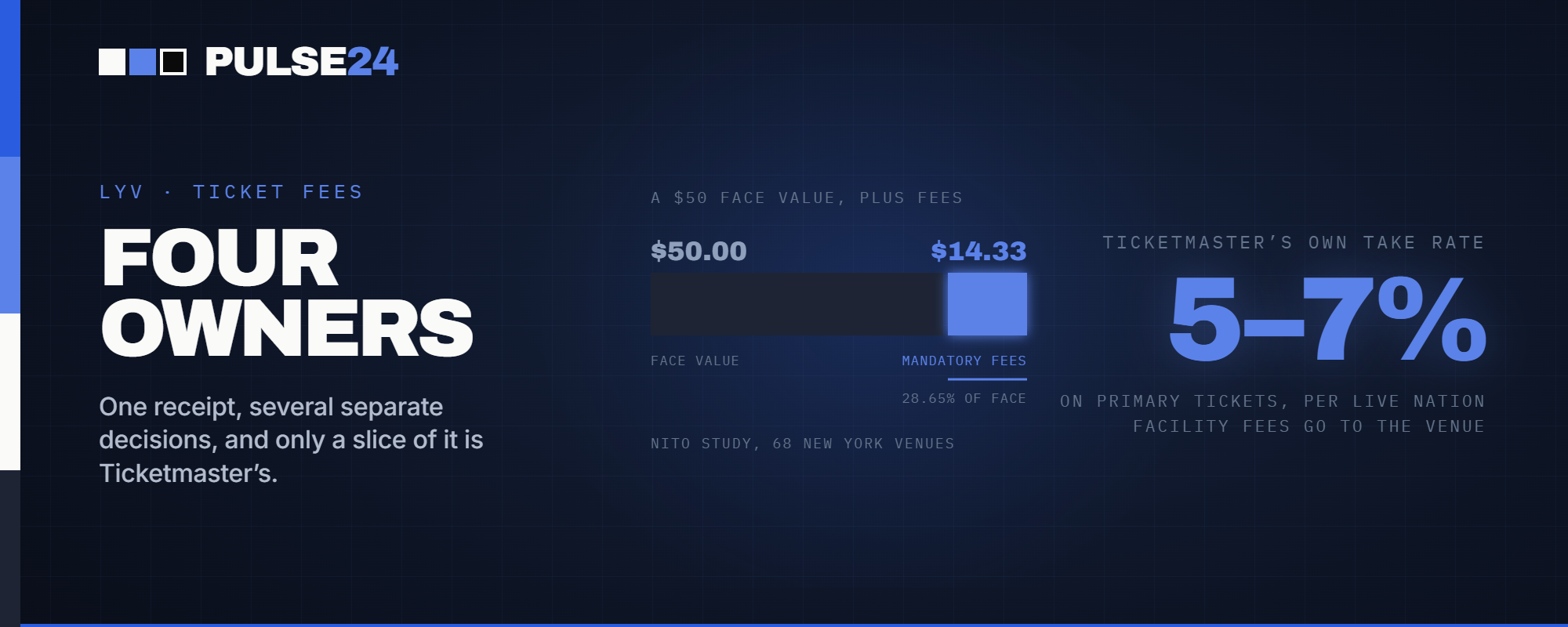
A New York study of 68 venues found primary ticket fees averaging 28.65% of face value. Separately, Live Nation says Ticketmaster retains a roughly 5% to 7% take rate for its share of primary-ticket service fees. A federal jury has ruled that Ticketmaster illegally maintains a monopoly over major-venue ticketing, and all three findings describe different problems that are easy to mix up.
A federal disclosure rule has required ticket sellers to show the full mandatory price upfront since May 2025. It exists because for years the opposite was standard practice. A National Independent Talent Organization study of 68 New York venues, published in October 2025, found primary-market fees averaging 28.65% of face value, meaning a ticket with a $50 face value carries roughly $14.33 in mandatory fees at that average. Untangling where that markup goes, and who decided to charge it, means separating several different stories that usually get told as one.
The fee is split before Ticketmaster gets paid
Apply NITO's 28.65% New York average to a $50 ticket and the fees add up to roughly $14.33. How that amount breaks down varies by venue and by contract, since ticket fees aren't one standardized line item. Ticketmaster's own help center says the facility fee goes entirely to the venue, covering costs like staffing, insurance, and supplier payments, while the service fee is "negotiated and shared between various parties involved in organizing the event," typically the venue and Ticketmaster itself. Testifying before the Senate, Live Nation executive Daniel Wall put a number on Ticketmaster's piece specifically: a 5% to 7% "take rate" on primary tickets, which he contrasted with the 25% to 40% commissions resale marketplaces charge. That figure is Live Nation's own characterization rather than an independently audited market average, and it isn't necessarily measured against the same base as NITO's 28.65% figure, so the two shouldn't be read as directly comparable shares of one pie.
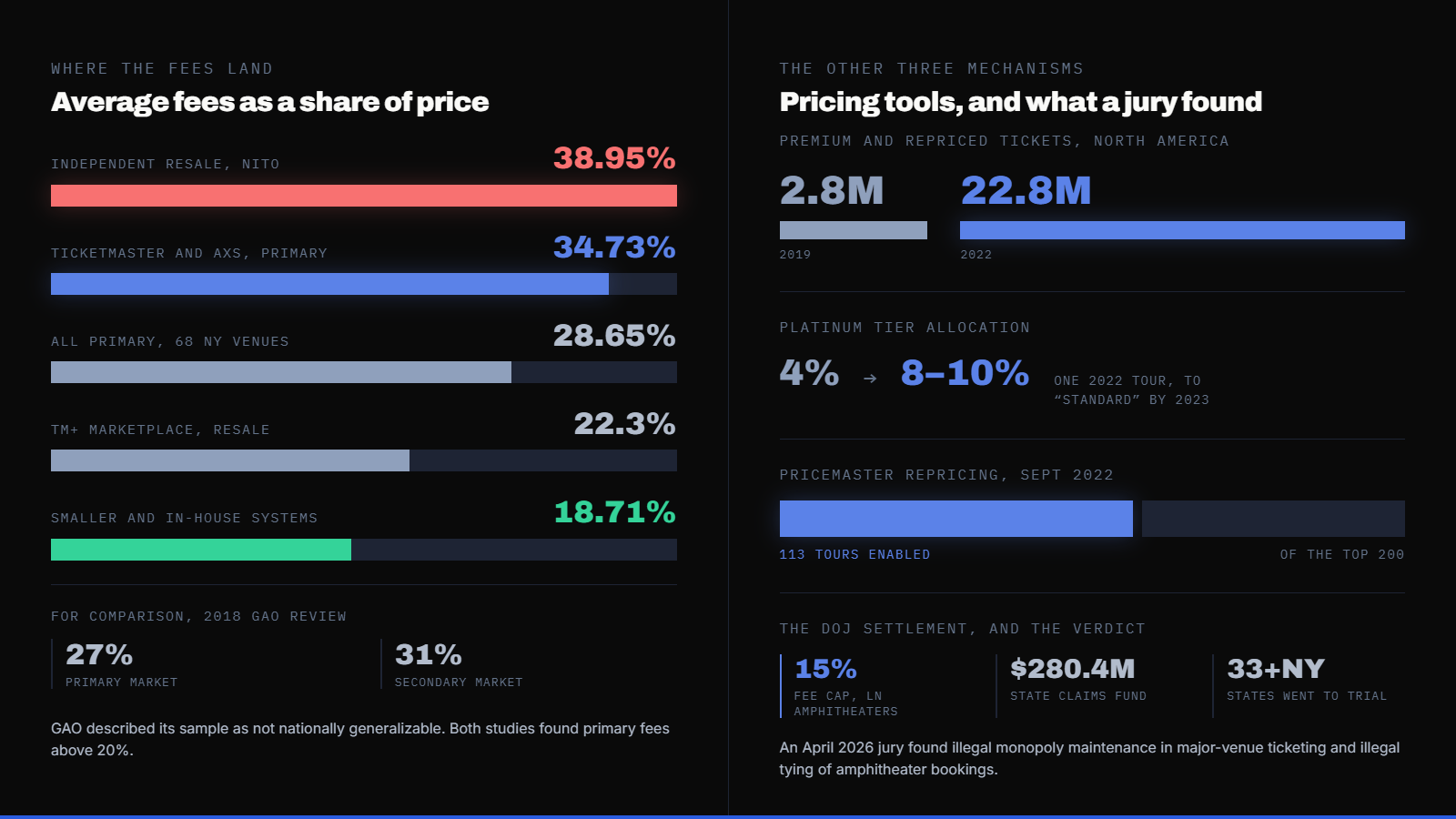
NITO's underlying study, based on 500 tickets across 68 venues (40 outside New York City's five boroughs, 28 within), also found real variation by platform. Major ticketing systems, including Ticketmaster and AXS, averaged 34.73% in fees, compared with 18.71% at smaller or in-house platforms. A 2018 GAO review found average primary-market fees of 27% in the events it examined, though GAO explicitly described that sample as not nationally generalizable. Despite their different samples, both studies found primary-market fees averaging well above 20% in the transactions they examined.
Dynamic pricing is a different question
The fee split still doesn't explain why the underlying ticket price moves. Ticketmaster's official position is that event organizers, not Ticketmaster, set face values and choose whether to use pricing tools like dynamic or "Platinum" pricing. A U.S. Senate report released in March 2026 complicates that framing by documenting how aggressively Ticketmaster built and promoted those tools, including using dynamic-pricing adoption as an internal performance metric and using its own data to recommend that artists and venues increase the share of dynamically priced tickets. One 2022 internal document flagged a tour with just 4% of its inventory in the Platinum tier, a category priced above face value, as an opportunity to expand it, and by 2023 the company's own guidance described an 8% to 10% Platinum allocation as standard. Across North America, the volume of Platinum, VIP, and Pricemaster-adjusted tickets grew from 2.8 million in 2019 to 22.8 million in 2022.
The same report describes Ticketmaster's "Pricemaster" repricing system, enabled on 113 of the company's top 200 tours by September 2022. It also cites internal communications from Morgan Wallen's 2021 presale describing requests to pause the ticket queue mid-sale so inventory could be repriced before more seats were released, and other internal messages describing a goal of keeping fans unaware that standard, non-Platinum inventory was being dynamically priced at all.
Resale adds another layer
Resale introduces a second fee structure. NITO's New York study found fees on independent resale platforms, StubHub, SeatGeek, and Vivid Seats, averaging 38.95% of the listed price, while a 2018 GAO review found secondary-market fees averaging 31% in the events it examined, again with GAO's nongeneralizable-sample caveat attached. In both studies, the secondary-market average was higher than the primary-market average within the same sample. NITO's data also points to an odd wrinkle: the resale marketplaces Ticketmaster and AXS operate themselves, TM+ and AXS Marketplace, averaged 22.3% and 19.6% respectively in the same study, notably lower than the independent resale platforms they compete with.
Then comes the monopoly question
Two separate processes are pulling at how tickets get priced, and they run on different tracks. The first is disclosure. Since May 12, 2025, an FTC rule on unfair or deceptive fees has required ticket sellers, in both the primary and secondary markets, to display the total mandatory price up front and as prominently as the headline price. A separate bill, the TICKET Act, would go further by banning speculative ticket sales and guaranteeing refunds for canceled shows. The House passed its version in 2025, and the Senate Commerce Committee advanced a Senate version, but Congress has not sent a final bill to the president.
The second track is antitrust enforcement. In March 2026, the Justice Department's settlement with Live Nation caps Ticketmaster service fees at 15% at amphitheaters Live Nation owns, operates, or controls, requires the company to give up ownership or control, as the term sheet specifies, at 13 listed venues, extends the company's existing consent decree for eight years, sets a $5 million penalty per violation of that decree, and establishes a $280.4 million fund for state monetary claims and consumer restitution. A coalition of 33 states plus New York rejected that settlement and continued to trial on their own, and in April 2026 a jury found that Ticketmaster illegally maintains a monopoly in ticketing services at major concert venues and that Live Nation illegally ties amphitheater bookings to its own promotion arm. New York's attorney general said the state's fans alone were overcharged $1.72 per ticket. What the companies owe beyond the DOJ settlement is still being decided at a separate bench trial.
The Pulse24 Take
It's easy to compress "Ticketmaster fee," "venue fee," dynamic pricing, and monopoly power into one grievance, but they are four different mechanisms with four different owners. Live Nation says Ticketmaster's take rate on primary tickets is a single-digit percentage, the facility fee belongs entirely to the venue, and pricing tools like Platinum and Pricemaster are technically controlled by event organizers even though Ticketmaster built and pushed them hard. None of that erases what a federal jury found in April: that the company sitting at the center of this system illegally maintained monopoly power over how major concerts get ticketed in the first place. The useful distinction for a fan staring at a receipt isn't which company to blame for the whole number. It's recognizing that the receipt reflects several separate decisions, and that a federal jury has separately found the market structure behind those decisions to be the product of illegal monopolization and tying conduct.
Fees are also only one piece of how a tour actually makes money. For the fuller picture, including merch margins, sponsorship rights, and why the same industry produces a promoter running a thin margin next to superstar artists who don't, see how a concert tour actually makes its money.
How we read the data
Curious how we get from raw data to a take like this? Our Trader's Toolkit walks through the tools we lean on.
Explore the Toolkit