Pulse24 Original
A Concert Ticket Isn't the Business. It's the Access Fee to a Much Bigger One.
September 14, 2026
A concert ticket is only one layer of a night's spending. Here's how tickets, merchandise, sponsorship and fees actually split between the artist, promoter, venue and ticketing platform, with real 2025 Live Nation numbers showing why revenue size and profit margin aren't the same thing.
Figures below come from touring-industry studies, public company filings, and reported artist revenue estimates. Contract terms vary by tour and aren't fully disclosed, so treat totals as directional rather than audited.
The Ticket Isn't One Business, It's Several
Most people assume a concert has one business behind it. Sell the ticket, pocket the ticket price, repeat across fifty cities.
That's not how it works. A concert ticket buys a fan entry into a night where several separate businesses each try to capture a different piece of that fan's spending. The venue may capture concessions. The artist may control merchandise, minus production costs and sometimes a venue commission. Sponsorship rights can sit with the artist, promoter or venue, depending on the deal. The ticketing platform has its own economics layered on top of all of it. Understanding who owns which layer explains far more about modern touring than any single claim about where "the real money" is.
Who Gets Paid, and How
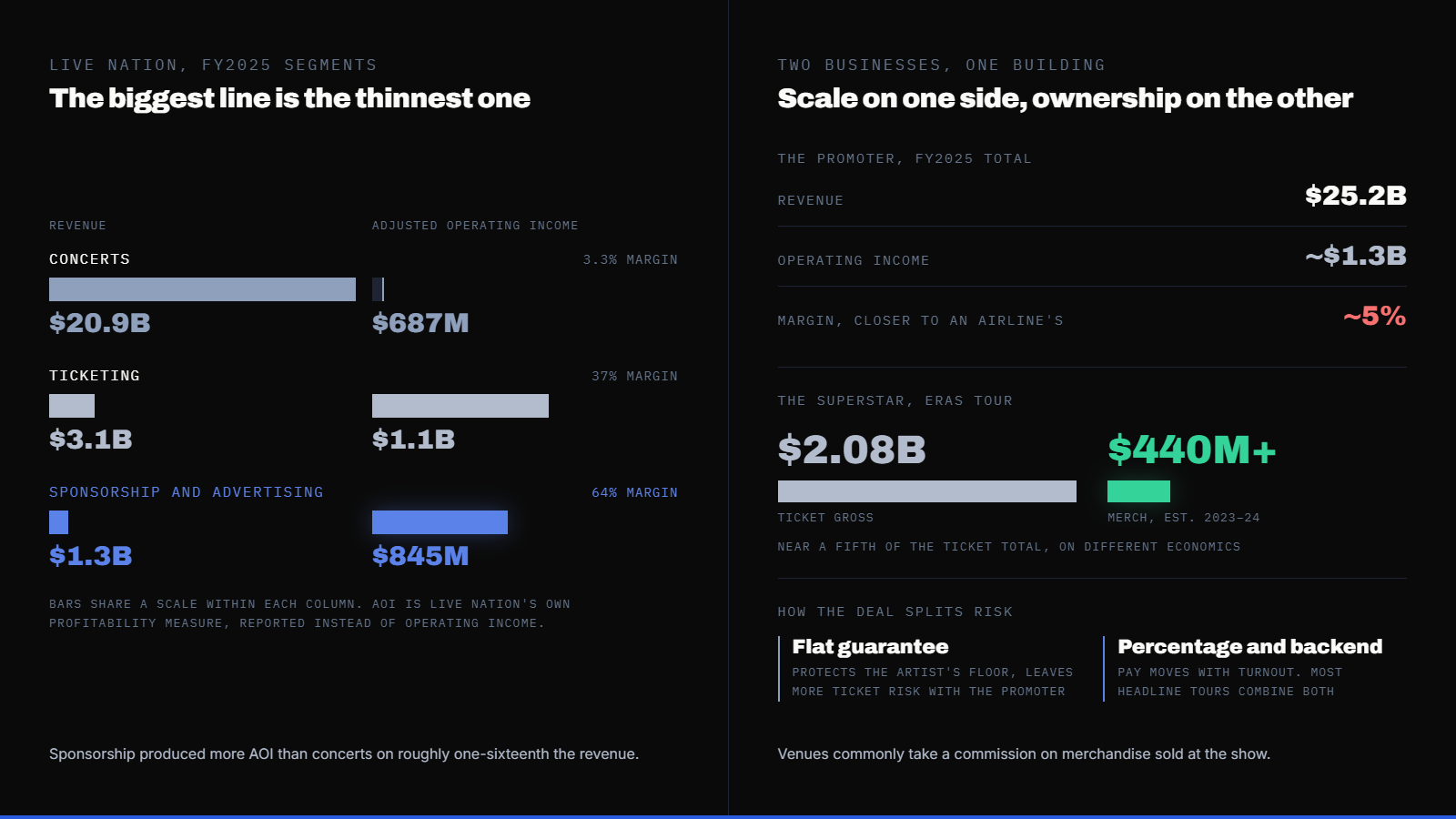
Concert deals are structured partly around how downside and upside get shared, not a clean transfer of all risk from one party to the other. A flat guarantee protects the artist's minimum payday and shifts more of the ticket-sales risk onto the promoter, who still carries production and marketing costs regardless of how the guarantee is structured. A percentage or backend deal gives the artist more exposure to how the show actually performs, since their pay now moves with turnout instead of being fixed. Many headline tours combine the two, a smaller guarantee plus a share of the profit once the show clears an agreed break-even point.
The mix an artist can negotiate comes down to leverage. An unproven act typically can't demand a large guarantee, because that would ask the promoter to absorb real financial risk on a draw nobody has confirmed yet. A superstar with a track record can demand a bigger guarantee, a bigger percentage, or both, because refusing to book them becomes the promoter's real risk at that point.
The Ticket Fee Itself Is a Separate Story
How much of a ticket's face value gets added on as fees, and who's responsible for that markup, is a different question from the settlement between artist and promoter, and it deserves its own explanation, covered in how Ticketmaster's fees actually break down, including the 2026 monopoly verdict against the company. That fee sits on top of the transaction. It isn't deducted from the artist's side of the settlement described above.
Merchandise Can Carry Attractive Economics, but It Isn't Frictionless
Merchandise gives an artist more direct control over the product and its pricing than ticket revenue usually does. A shirt sold at the merch table doesn't pass through the same artist-promoter ticket settlement, though it comes with its own costs.
Venues commonly take a commission on merchandise sold at the show, while production, staffing, logistics and payment processing all eat into the proceeds too. For an artist with enough demand and pricing power, that combination can still add up to a genuinely attractive margin. For a smaller act covering freight, staff and a venue cut out of a much smaller gross, the comparison looks very different.
The scale involved at the top of the market can still be large. The Eras Tour grossed roughly $2.08 billion from tickets, while Taylor Swift's merchandise sales have been estimated at more than $440 million through 2023 to 2024, near a fifth of the ticket total, from a separate product line with very different economics.
Sponsorship Has the Smallest Revenue and the Best Margin
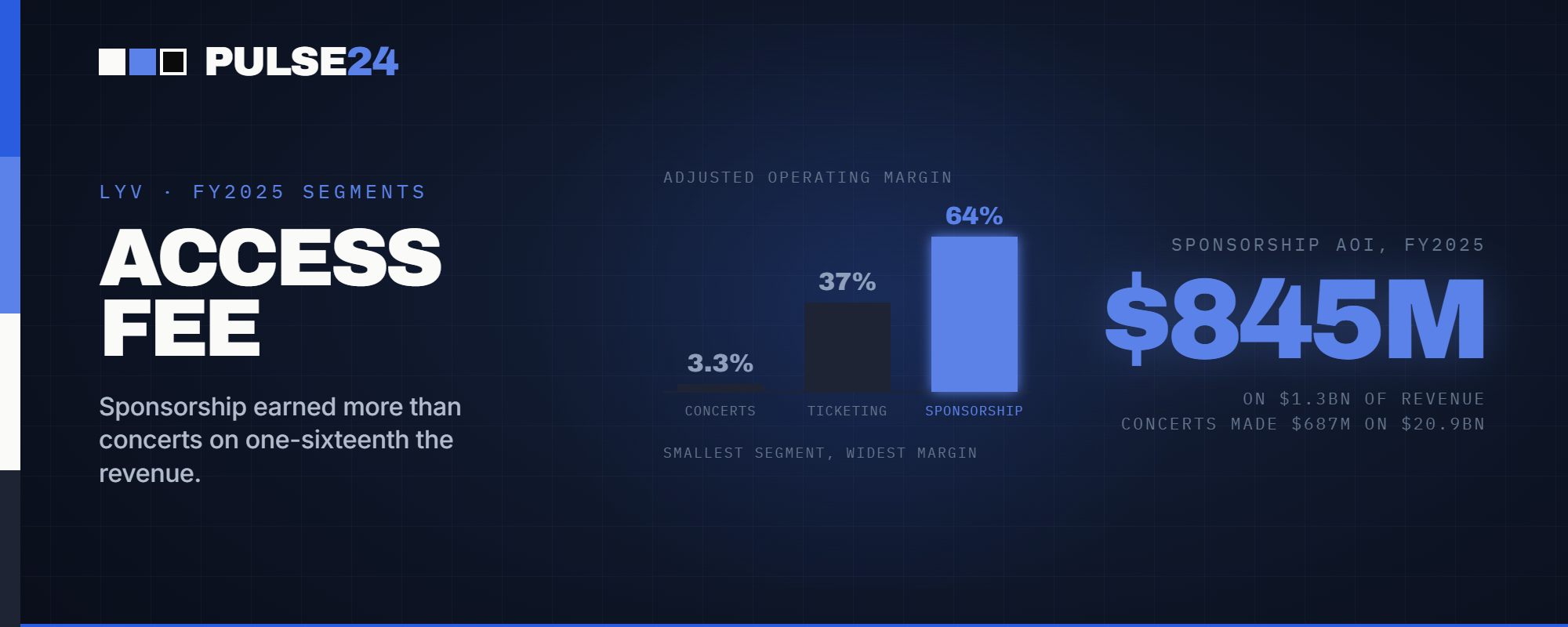
Live Nation's 2025 accounts show just how wide that gap can get. Concerts generated $20.9 billion in revenue and $687 million in AOI, equal to about 3.3% of revenue. Ticketing generated $3.1 billion in revenue and $1.1 billion in AOI, near 37%. Sponsorship and advertising generated just $1.3 billion in revenue, the smallest of the three segments, and $845 million in AOI, near 64%, the highest of the three by a wide margin.
Put another way, sponsorship generated more adjusted operating income than concerts despite producing roughly one-sixteenth as much revenue. The biggest revenue line isn't the most profitable one. The cost of selling another sponsorship dollar looks nothing like the cost of staging another show.
Why the Promoter's Business Looks Nothing Like the Superstar's
Live Nation, the largest promoter on the planet, turned $25.2 billion of 2025 revenue into roughly $1.3 billion of operating income, a margin close to 5%. That's a thin-margin, high-volume operation built on scale across thousands of shows, closer to an airline's economics than a headliner's payday.
A top-tier touring artist isn't playing that game. Their economics depend on how much of the ticket, merch and sponsorship layers their specific deal lets them own directly, and at superstar scale that ownership share is far larger than what a mid-tier act or a promoter's average show can capture. Same industry, two structurally different businesses, both operating inside the same building on the same night.
What VIP Reveals About the Whole Model
VIP is harder to assign to a single owner than any layer above it. Packages can combine premium ticket inventory, merchandise, hospitality and exclusive experiences, and which of those pieces the artist, promoter or venue controls depends entirely on how the specific package is built. That makes VIP a useful closing example of why there's no single "concert margin" to point to. Every layer of a show night has its own owner, and VIP is often several of those owners bundled into one line on a receipt.
The Pulse24 Take
A sold seat doesn't stop generating value once the fan sits down. But the interesting part isn't that the fan keeps spending after buying the ticket. It's who owns the next dollar.
The venue may capture concessions. The artist may control merchandise, minus its costs and sometimes a venue commission. Sponsorship rights can sit with the artist, promoter or venue. Ticketing has its own economics layered on top of all of it. Live Nation's own numbers show how differently those businesses perform at scale. Its concerts segment generated nearly $21 billion of revenue in 2025, and still produced less adjusted operating income than a sponsorship business one-sixteenth its size.
One fan walks into one building for one night. Several businesses are trying to monetize that same relationship, and they rarely make the same margin doing it.
How we read the data
Curious how we get from raw data to a take like this? Our Trader's Toolkit walks through the tools we lean on.
Explore the Toolkit