Pulse24 Original
Strategy Has Sold Bitcoin Five Times in 2026, Booking $102 Million in Losses to Do It. The Company Built on Never Selling Now Sells Coins to Pay Its Own Preferred Shareholders.
August 16, 2026
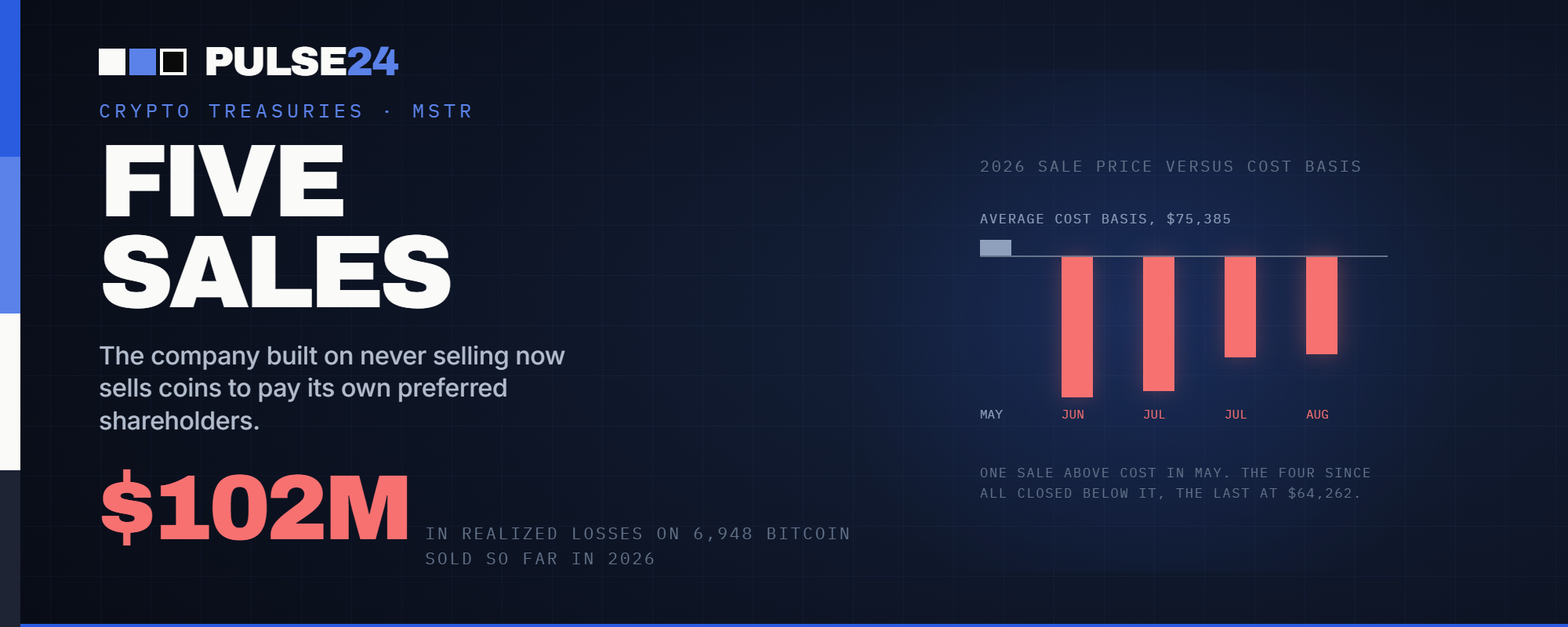
Strategy has sold Bitcoin five separate times in 2026, almost every sale below its own average cost basis, just to keep paying the 12% dividend on the preferred stock it issued to buy that Bitcoin in the first place. The company that spent years telling holders to never sell is now a recurring seller of its own.
Strategy sold 1,690 Bitcoin between August 3 and August 9, raising $108.6 million at an average price of $64,262 a coin. It was the fifth time this year that Michael Saylor's company sold Bitcoin instead of buying it, and the fourth time it did so at a loss. For a company that spent three years telling anyone who would listen that Bitcoin is an asset you never sell, that pattern is starting to look less like an exception and more like a business model.
What Changed
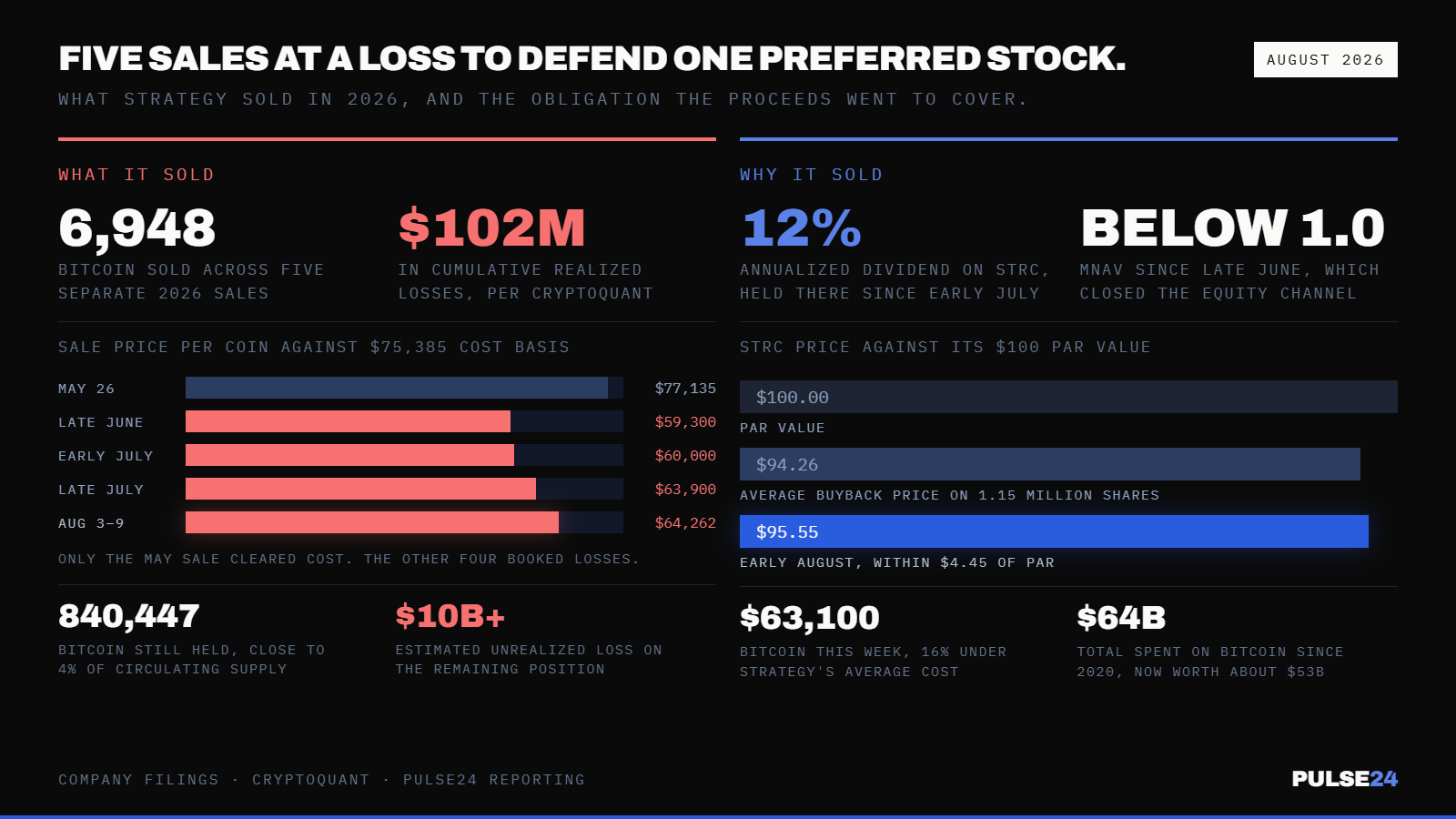
The sales stretch back to May. Strategy sold 32 Bitcoin on May 26 at $77,135 a coin, still above its cost basis, in a sale Saylor told analysts on an earnings call was meant to "inoculate the market and send the message that we did it." Every sale since has gone the other way. It sold 1,363 Bitcoin in late June for $80.8 million, 2,225 Bitcoin in early July for $135.2 million at around $60,000 a coin, 1,638 Bitcoin in late July and early August for $104.7 million, and the 1,690-Bitcoin sale earlier this month. Add it up and Strategy has sold 6,948 Bitcoin in 2026 against an average acquisition cost of $75,385 a coin, according to CryptoQuant, which puts the company's cumulative realized losses on those sales above $102 million.
None of this touches the core position. Strategy still holds 840,447 Bitcoin, worth roughly $53 billion at current prices, funded by close to $64 billion in total spending since 2020. What it does touch is STRC, the perpetual preferred stock Strategy uses to raise cash without diluting common shareholders. STRC pays a floating dividend that Strategy has held at 12% annualized since early July, up half a point from where it sat in June. The stock carries a $100 par value and spent much of the first half of the year trading well under it. By early August, after Strategy redirected sale proceeds into buybacks, roughly 1.15 million STRC shares at an average price near $94.26, the preferred had recovered to about $95.55, within $4.45 of par.
Saylor addressed the selling directly on social media in early August, distinguishing his own holdings from the company's. "I have never sold mine. Not one satoshi," he wrote, adding that "Strategy is a public company, not my wallet" and that the firm has disclosed since 2020 that it may buy or sell Bitcoin to manage its capital structure. That disclosure is accurate. What has changed is how often the option gets used.
Why It Matters
Strategy's entire model for years ran on a kind of financial flywheel. The stock traded at a premium to the value of the Bitcoin it held, because investors were willing to pay extra for leveraged, easy-access exposure to the coin through a normal brokerage account. Strategy used that premium to issue new shares and convertible debt above the value of its underlying Bitcoin, then used the proceeds to buy more Bitcoin, which supported the premium that let it do the whole thing again. In late June, that premium disappeared. The company's enterprise value dipped below the value of its Bitcoin holdings for the first time, a threshold analysts track as mNAV. Below 1.0, issuing new stock to buy Bitcoin would mean selling shares for less than the coins backing them are worth, which defeats the purpose. The flywheel stops.
Once that funding channel closes, the company still has fixed obligations. STRC dividends alone are a recurring cash cost, and Strategy has chosen to meet them, and to defend the preferred's price, using proceeds from Bitcoin sales rather than new equity. That is a rational response to a premium that no longer exists, but it also means the largest corporate Bitcoin buyer of the last two years has become a source of recurring sell pressure instead. Strategy is not alone in facing this squeeze. A meaningful share of the smaller Bitcoin treasury companies that copied its model, firms like Metaplanet and Nakamoto, are also trading below the value of their own coin holdings, which suggests the mNAV compression is a sector-wide repricing rather than a problem specific to one balance sheet.
The timing lines up with broader Bitcoin weakness. Bitcoin traded near $63,100 this week, extending the slide Pulse24 covered when gold and Bitcoin moved in opposite directions on the same cooling inflation data earlier this month. Strategy's average cost basis of $75,385 sits well above that level, which is why sales that were merely awkward in the spring look like realized losses by late summer.
What to Watch Next
Strategy's USD Reserve, the cash buffer it uses to cover STRC obligations without touching Bitcoin, stood at $4.65 billion as of August 9, which analysts estimate covers roughly 2.7 years of dividends at the current rate. That is not an imminent liquidity problem. The more useful signal going forward is which lever the company reaches for next. If Strategy returns to issuing new equity or convertible notes to fund fresh Bitcoin purchases, that would suggest the market premium investors once paid for its stock has come back. Continued Bitcoin sales to fund STRC instead would say the opposite, and the total holdings figure, currently 840,447 coins, becomes the number worth tracking every time a new sale is disclosed.
STRC's price relative to its $100 par value is the closest thing to a real-time read on that question, since Strategy's own buyback activity moves with it. Bitcoin's own path matters too. A recovery back above Strategy's $75,385 cost basis would turn every future sale profitable again and take the pressure off entirely, while a deeper slide toward the $60,000 area the coin has flirted with in recent weeks would make each additional sale, and each additional realized loss, more consequential to how the market prices Strategy's remaining pile.
The Pulse24 Take
It is easy to read this as a simple story about conviction cracking under pressure, and easy to be wrong about it. Strategy is not dumping its Bitcoin. Six months of selling has moved less than 1% of its total holdings, and 840,447 coins remains an enormous position by any measure. What has actually broken is the financing trick that let the company grow that position faster than its cash flow alone ever could, issuing stock at a premium to buy an asset that doesn't generate cash, and counting on the premium to keep paying for itself.
That distinction matters for how investors should think about every other company that adopted a version of the same playbook over the past two years. A Bitcoin treasury strategy built on cheap equity issuance works beautifully while the stock trades above the value of the coins backing it. It becomes a forced seller, quietly and mechanically, the moment that relationship reverses, regardless of how committed management is to holding for the long run. Saylor's public insistence that his personal conviction hasn't changed may well be genuine. It just isn't the variable that determines whether Strategy sells Bitcoin next quarter. The balance sheet is.
How we read the data
Curious how we get from raw data to a take like this? Our Trader's Toolkit walks through the tools we lean on.
Explore the Toolkit