Pulse24 Original
ByteDance and Tencent Each Got 10,000 Nvidia H200 Chips. That's Only 13% of What Washington Licensed.
September 26, 2026
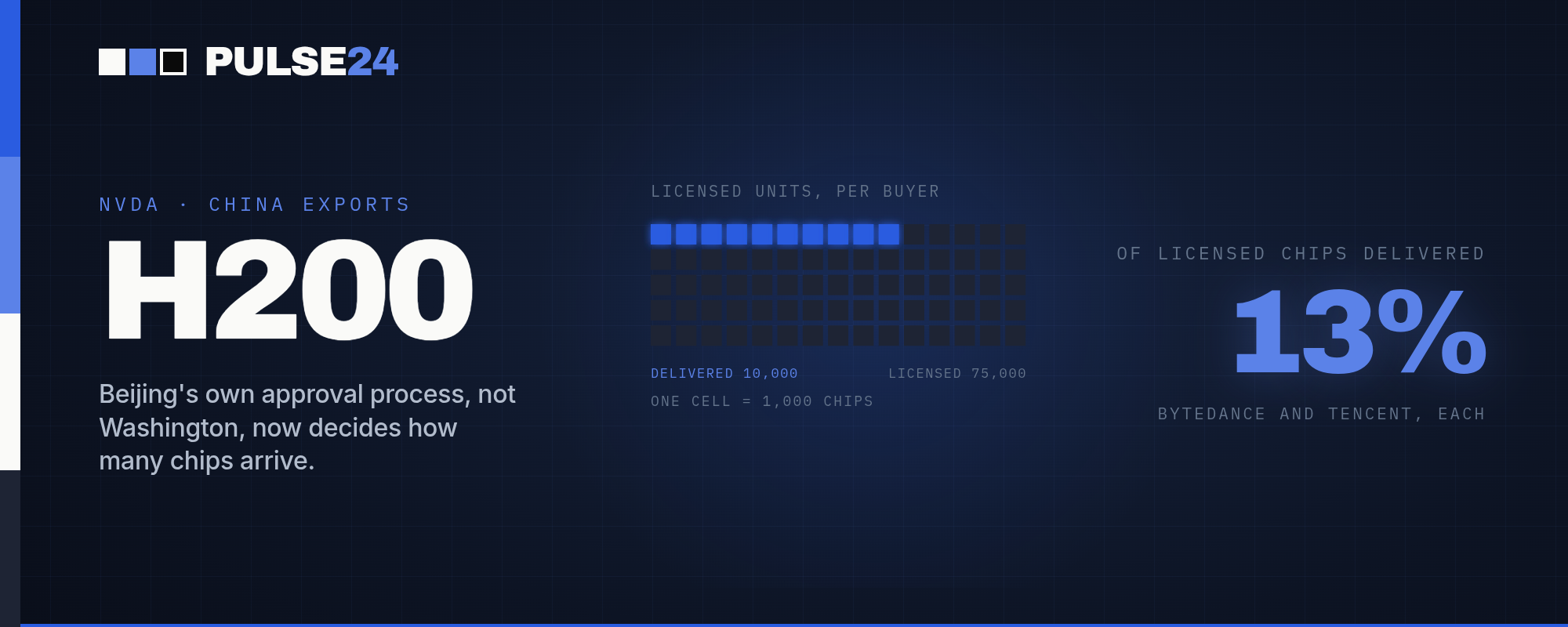
Nvidia's H200 chips are finally trickling into China, but ByteDance and Tencent have received only about 13% of what they're licensed to buy. Beijing's own approval process, not Washington's export rules, is now the bigger bottleneck, and Thursday's Trump-Xi summit left the standoff untouched.
Ten thousand. That's how many Nvidia H200 chips ByteDance has received so far this year, and Tencent got roughly the same. Compared to what Washington actually approved, up to 75,000 units for each company, that's only about 13%. The chips are moving, just barely, and the holdup isn't coming from the White House anymore. Thursday's summit between Trump and Xi Jinping in Washington didn't touch the subject at all. US Trade Representative Jamieson Greer told Bloomberg afterward that chip export controls were not a major topic in the talks, one of the few issues left, he said, where the two sides remain furthest apart.
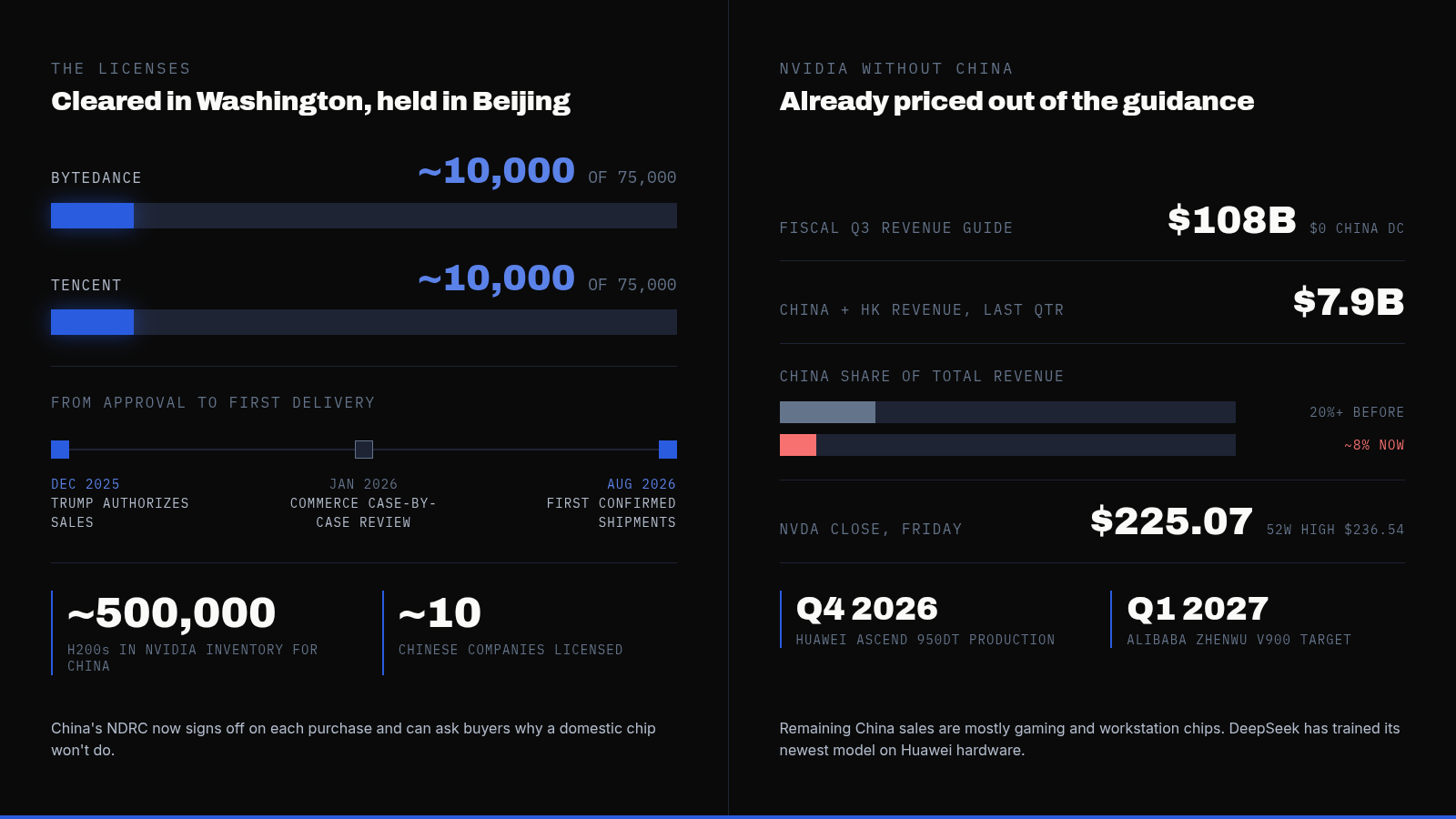
Nvidia has already priced that slow drip into its own numbers. The company's guide for its current fiscal quarter, $108 billion, assumes no AI data-center chip revenue from China at all. What's left is a standoff that has quietly changed shape over the past nine months. Washington cleared the sales back in December 2025. It's Beijing's own approval process, not any American rule, that now decides how much of that clearance actually reaches Nvidia's Chinese customers.
What Changed
The mechanics of the slowdown are almost bureaucratic in their specificity. About ten Chinese companies, Alibaba, Tencent, ByteDance and JD.com among them, hold US export licenses allowing each to import up to 75,000 H200 units, with Lenovo and Foxconn cleared as distributors. Trump authorized the sales in December 2025, and Washington's Commerce Department formalized a case-by-case review process the following month. Orders piled up for most of the year without shipping. It took until August, confirmed by Financial Times reporting, for ByteDance and Tencent to each receive their first real deliveries, about 10,000 units apiece.
The remaining 87% of each company's allowance is stuck behind a different gate. China's National Development and Reform Commission now requires individual sign-off on every purchase and can force a buyer to justify why a domestic chip won't do the job instead. Nvidia reportedly holds close to 500,000 H200 units in inventory earmarked for Chinese customers, and manufacturing isn't really the constraint either. TSMC's advanced packaging capacity limits how fast more chips can be built, but approval is the bigger ceiling right now. Beijing also wants most of each company's licensed allowance kept off the mainland entirely and steered toward Hong Kong instead, whose data centers have nowhere near enough power capacity to run that many chips at once.
Trump had signaled ahead of Thursday's summit that he saw little reason to revisit any of it, telling reporters this week that he wasn't pushing for new AI guardrails with Beijing. The two leaders did extend their broader trade truce by two months, to January 10, 2027, though chip policy stayed off that table entirely. One AI-related idea did surface, according to people briefed on the talks: a bilateral channel for reporting AI incidents serious enough to raise national-security concerns. People close to the talks called it the most concrete tech outcome likely to survive the visit, though nothing was finalized.
For Nvidia, the numbers already reflect how little of the China market has actually reopened. China and Hong Kong customers brought in $7.9 billion last quarter, around 8% of total revenue, almost entirely gaming and workstation chips rather than the data-center silicon at the center of the dispute. Two years ago, China accounted for more than a fifth of Nvidia's sales. One estimate suggests a full reopening at prices similar to the older H20 chip could add roughly $7 billion a quarter, about 7% on top of the current guide. At 13% of quota shipped and Beijing setting the pace, that math stays mostly theoretical.
Why It Matters
Every month Beijing keeps the flow this narrow is a month Chinese chipmakers get to close a gap that, until recently, looked out of reach, and that delay may well be the point. Huawei's Ascend 950DT chip has "produced good results" in early testing, enters production in the fourth quarter of this year, and Chinese AI developers are expected to start training models on it in 2027. The company still can't produce enough chips to satisfy its own domestic demand, so it's compensating with scale, linking up to 100,000 individual chips into single larger systems to make up for what any one chip lacks against Nvidia's best silicon. Alibaba's T-Head unit has unveiled its own answer, a chip called Zhenwu V900, targeting mass production in the first quarter of 2027 and a cluster design that Alibaba says can link up to 500,000 of them together. DeepSeek, meanwhile, has been training its newest large model on Huawei's chips rather than Nvidia's.
None of this means China has closed the gap. Analysts still put American frontier models roughly six months ahead, and China's overall chip production capacity is expected to trail the US-led ecosystem for years. But a six-month lead isn't a fixed one, and a customer base that spends a year or more building around Huawei and Alibaba while waiting on Beijing's own approval queue has less reason to switch back once that queue finally clears. That's a different kind of risk than a slow rollout. A market that learns to operate without a product, even temporarily, is harder to win back than one that's simply waiting its turn.
What to Watch Next
The pace of the next shipments is worth watching most closely. If deliveries to ByteDance and Tencent climb well past that 13% mark in the coming months, it would suggest Beijing's approval queue is actually clearing rather than processing a token batch for show. The AI incident-reporting channel floated at the summit deserves attention too, since it's unclear whether it becomes something formal or just another idea that got mentioned and went nowhere. Nvidia's next earnings call matters most of all. The company's guidance has assumed zero China data-center revenue for two straight quarters now, and any change in that language, in either direction, would likely move the stock more than another summit headline will.
The Pulse24 Take
Reading Thursday's summit as a non-event for chips is fair, in the narrow sense that nothing on paper changed. But treating this as simple stasis misses where the real story has moved. Washington isn't really the one holding this up anymore. Beijing is choosing, deliberately, how fast to let its own companies buy a product it would clearly rather they stop needing altogether. Nvidia trading near a 52-week high with China revenue still a rounding error tells you the market has already concluded this doesn't matter much to the current numbers, and for now that's a defensible read. A guide of $108 billion with no help from China is still a growth rate most companies would envy. The real risk isn't this quarter's print. It's whether Huawei's chip-linking approach and Alibaba's own cluster ambitions turn Beijing's slow-walk into a permanent one, the way a country that builds its own telecom equipment rarely goes back to buying it from somebody else. Nvidia still has time to answer that question. It doesn't have unlimited time, and a 13% trickle nine months after approval isn't the kind of number that buys much more of it.
How we read the data
Curious how we get from raw data to a take like this? Our Trader's Toolkit walks through the tools we lean on.
Explore the Toolkit