Pulse24 Original
Nvidia's China Chip Share Fell From 55% to 34% in a Year. Non-GPU Rivals Now Outship GPUs for the First Time.
October 18, 2026
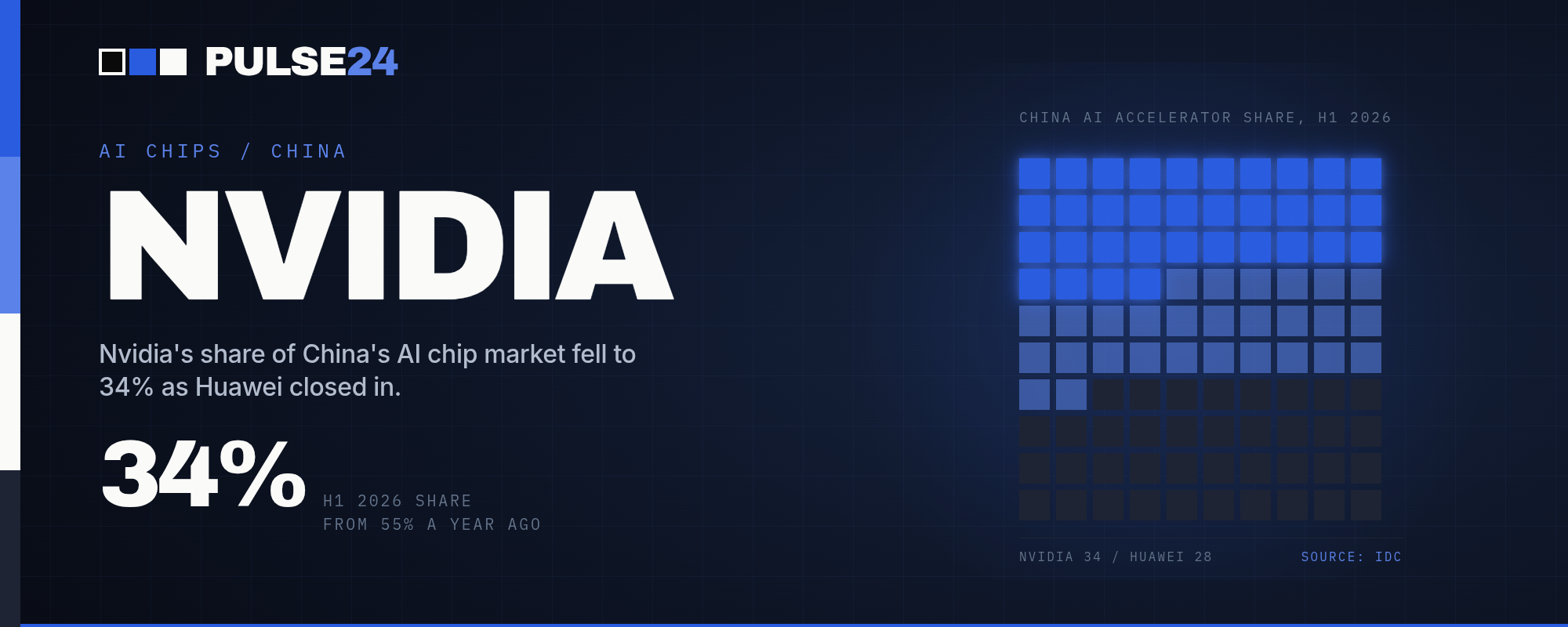
Nvidia's share of China's AI accelerator market has nearly halved in a year, falling to 34% as Huawei closes to within six points. For the first time, specialized inference chips outsold GPUs in China altogether, a shift that could matter well beyond one country's data centers.
Thirty-four percent. That's Nvidia's share of China's AI accelerator market in the first half of 2026, down from 55% a year earlier, according to research firm IDC. Shipments fell 44% year over year to 678,000 units. Huawei, meanwhile, nearly doubled its own shipments to 572,000, pulling its share to 28% and closing the gap with Nvidia to just six points. For a company that still dominates global AI chip sales by a wide margin, losing more than 20 points of share in the world's second-largest AI compute market inside a single year is not a rounding error.
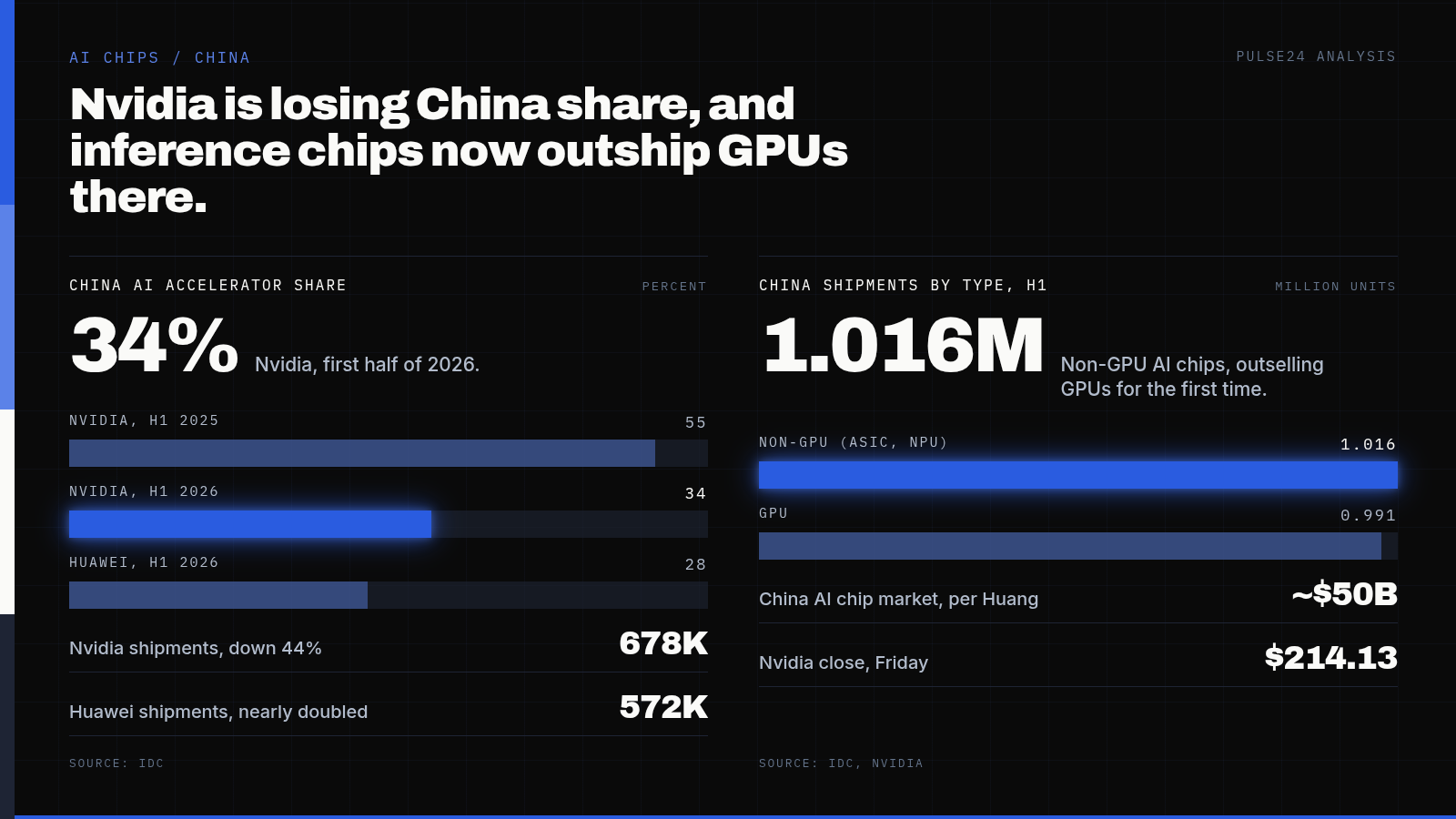
The headline number undersells what's actually happening underneath it. For the first time, AI chips built for specific workloads outsold general-purpose GPUs in China altogether. IDC counted 1.016 million non-GPU accelerators shipped in the first half, custom ASICs and NPUs tuned mostly for inference, up nearly 80% from a year earlier, against 991,000 GPU units, a 26% decline. Four companies, Huawei, Alibaba's T-Head, Cambricon and Baidu's Kunlunxin, now account for close to 95% of that non-GPU segment. Deloitte expects inference workloads to make up roughly two-thirds of global AI compute volume by the end of 2026, and inference is precisely where purpose-built chips tend to beat general-purpose ones on cost per query.
That matters because Nvidia's real moat has never been the silicon itself. It's CUDA, the software layer that ties developers to Nvidia hardware and makes switching expensive. Huawei's answer, a toolkit called CANN, is still considered harder to work with, but the company is reportedly using AI tools to help convert CUDA code into CANN automatically, and DeepSeek is said to be collaborating with Huawei directly on the problem. Software moats tend to erode slowly until they don't. If conversion tooling closes the usability gap even partially, the case for sticking with Nvidia chips in China weakens just as cheaper, purpose-built alternatives are already winning the inference race on price.
A Familiar Script, Different Chip
China's domestic chip industry chasing down a foreign incumbent is not a new story this month. Samsung and SK Hynix both sold off earlier in October after a Chinese rival's new memory chip design rattled confidence in their pricing power, even as both companies posted record profits. The chips involved are different, DRAM there, AI accelerators here, but the underlying pressure is the same. Years of export restrictions and domestic subsidy spending have given Chinese chipmakers both the incentive and, increasingly, the capability to build adequate substitutes rather than wait for sanctioned foreign supply to loosen.
Nvidia CEO Jensen Huang has made this argument publicly for more than a year, warning that U.S. export controls are effectively handing China's roughly $50 billion AI chip market to Huawei rather than keeping advanced technology out of Chinese hands. The new IDC numbers give that argument hard data to point to. Washington's restrictions have kept Nvidia's most advanced data center GPUs out of China, but they haven't stopped a domestic ecosystem, Huawei's Ascend chips above all, from filling the gap at a pace that has surprised even people who track the industry closely.
Nvidia's Answer: A Chip Built to Fit the Rules
Nvidia isn't conceding the market. The company is preparing the RTX Pro 5500, a workstation chip that uses GDDR7 memory rather than the high bandwidth memory, or HBM, that powers Nvidia's top-tier data center GPUs, a design choice that keeps it within U.S. export rules while still packing enough memory, 84 gigabytes of it, to run large AI models for inference without splitting them across multiple cards. The chip is expected to sell in China for roughly CNY 85,000 to 90,000, in the same range as Huawei's competing Ascend 950PR. China's Ministry of Industry and Information Technology has reportedly signaled it may approve purchases by companies including ByteDance and Alibaba, with Nvidia said to be planning shipments of around 500,000 units per quarter starting in late December. ByteDance alone is reportedly considering orders near a million units.
None of this is unfolding in isolation from the rest of the chip trade. Semiconductor stocks broadly are in their eighth straight losing session, the longest stretch since 2015, as investors reassess how fast AI infrastructure spending can pay for itself. Nvidia shares closed Friday at $214.13, down 1.43% on the day, caught up in that broader pullback even though the China share figures describe an older, slower-moving shift than the daily swings suggest. Worth watching from here: whether Beijing formally signs off on RTX Pro 5500 purchases and Nvidia hits its promised shipment pace, whether Huawei's Ascend roadmap keeps closing the remaining six-point gap, and whether non-GPU chips keep gaining share outside China as inference workloads scale globally.
The Pulse24 Take
Losing share in China was always going to happen once Washington restricted what Nvidia could legally sell there. That part isn't surprising. What deserves more attention is the second finding buried in the same report: non-GPU chips overtaking GPUs in China, even temporarily, previews an argument that doesn't stop at China's border. If specialized inference silicon can out-compete general-purpose GPUs on cost once the software gap narrows even slightly, every company building custom AI chips, not only in China, has a reason to keep pushing.
Nvidia's response, a compliant chip built around exactly the rules it has to operate under, shows a company still adapting rather than one losing its grip on the market. The RTX Pro 5500 bet and the CUDA moat it depends on are both testable within a couple of quarters. If the chip ships at the volumes Nvidia is promising and Chinese approval actually materializes, this cycle may end up reading as a temporary dip rather than a structural shift. If it doesn't, 34% could keep falling before it finds a floor.
How we read the data
Curious how we get from raw data to a take like this? Our Trader's Toolkit walks through the tools we lean on.
Explore the Toolkit