Pulse24 Original
McLaren Won Both F1 Championships in 2025. Ferrari Still Got Paid More.
August 8, 2026
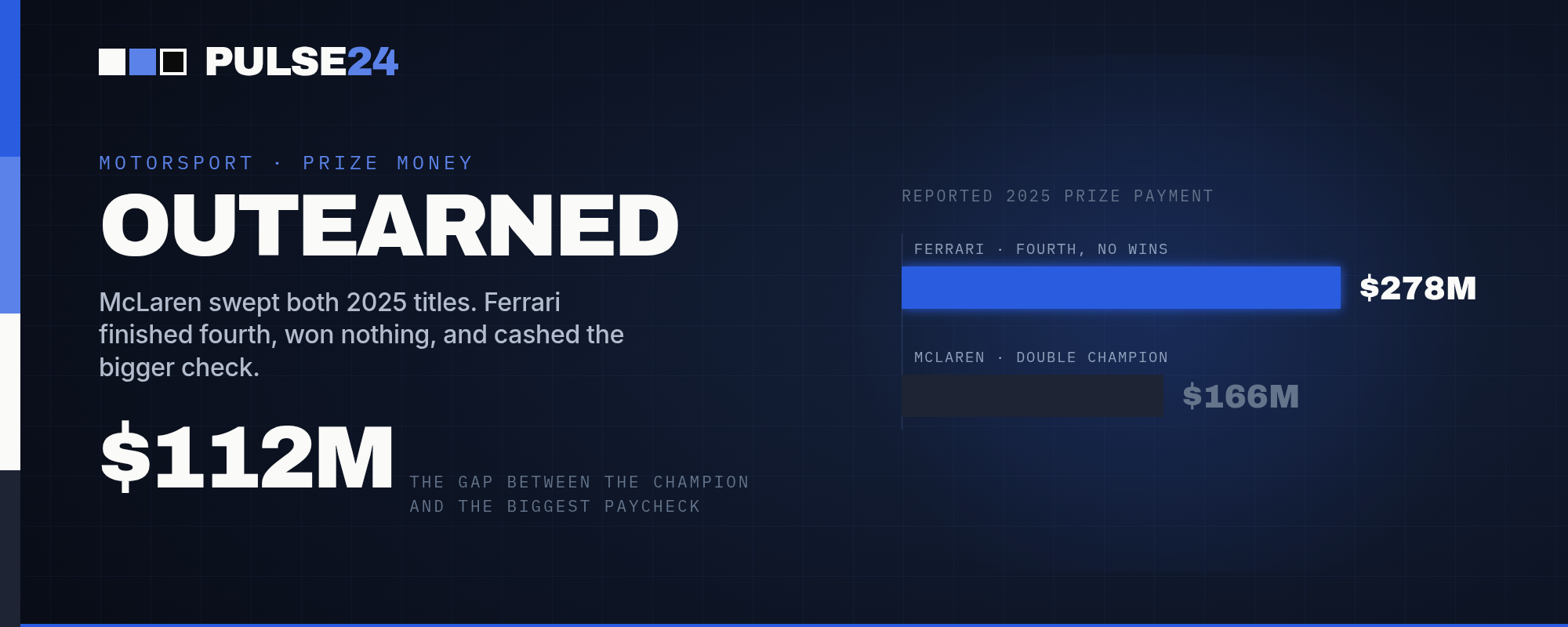
F1's prize money isn't just about who wins. A decade-long performance formula and a Ferrari-only heritage payment mean the sport's biggest paycheck doesn't always go to the team that actually won it. McLaren swept both 2025 titles and still wasn't the highest earner on the grid.
McLaren won every title on offer in 2025. The team took both the Drivers' and Constructors' Championships, its 10th constructors' crown, and still finished the year with only the fourth-largest prize check on the grid. Ferrari finished fourth in the standings, didn't win a single race all season, and reportedly collected the largest payment of any team. That gap is not a reporting error. It's what F1's prize money formula is built to produce, because on-track performance this season is only part of how the money gets divided.
The Team That Won Wasn't the Team That Got Paid Most
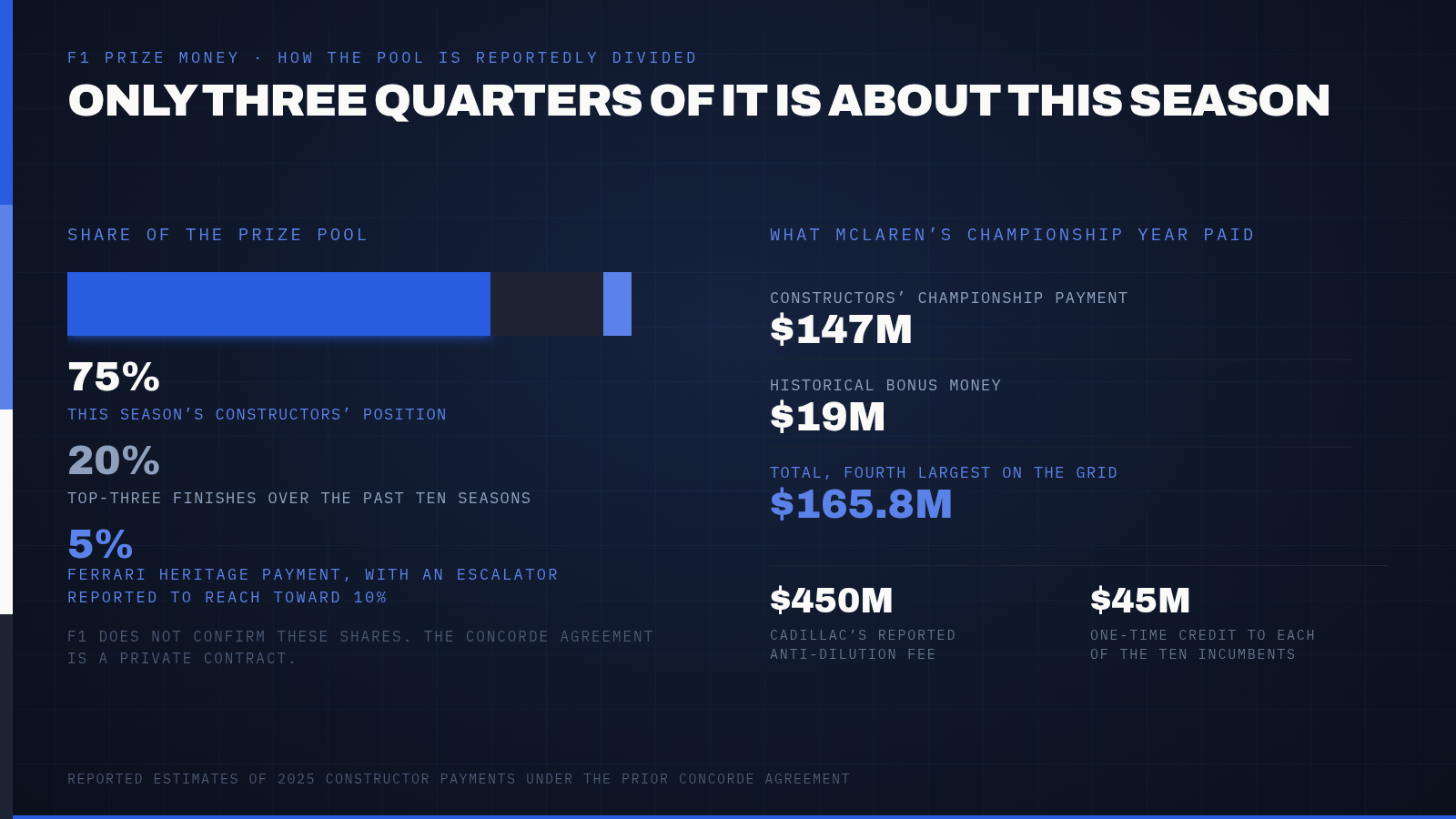
McLaren's total for 2025 is reported at around $165.8 million: about $147 million for winning the Constructors' Championship, plus close to $19 million in historical bonus money. Ferrari's total is reported at roughly $277.7 million, the highest of any team on the grid. The formula behind that gap treats current-season position as only 75% of the payout. The other 25% is either backward-looking or, in Ferrari's case, doesn't look at the season at all.
Why 20% of the Pool Doesn't Care What Happened This Year
The historical-performance slice rewards a team's top-three finishes across the preceding ten seasons. A team that has fallen off recently can still collect real money for success that happened years earlier. Most single-season coverage skips past this part, since it never shows up on a current standings sheet. It is a ten-year memory built directly into how the money gets divided. A team rebuilding after a bad stretch is not just racing for next year's points. It is also managing how quickly its ten-year window forgets its better years.
The 5% Nobody Else Gets
Ferrari's heritage payment is the most scrutinized line item in the Concorde Agreement, and the most defended. It exists because Ferrari is the only constructor to have competed in every F1 season since 1950, a form of continuity no other team on the grid can claim. Reporting on the prior Concorde Agreement, which covered the 2025 season, describes the payment as starting around 5% of the prize pool with an escalator that can push it toward 10% as F1's overall revenue grows past roughly $1.6 billion. F1's revenue is now well above that mark, so treating Ferrari's bonus as a flat 5% likely understates it. Whether that formula fairly compensates Ferrari for what its presence has meant to F1's commercial value, or simply puts a permanent thumb on the scale in a sport that ties nearly every other payment to results, is a genuinely contested question in the paddock, not a settled one.
What 2026's Eleventh Team Actually Changes
Cadillac's arrival as F1's eleventh constructor for 2026 does more than add a car to the grid. It changes the arithmetic for everyone else, since the same prize pool now divides eleven ways instead of ten. The reported $450 million anti-dilution fee, paid out as a one-time $45 million credit to each existing team, exists specifically to offset that dilution rather than leave the ten incumbents absorbing a smaller slice on their own. That offset is one-time. F1's commercial revenue has been growing quickly, and if that continues, the larger pool likely absorbs an eleventh team without anyone actually feeling poorer. If growth slows, the dilution shows up for real in a way a single anti-dilution check does not cover twice.
The Pulse24 Take
The cost cap sets a ceiling on what a team can spend. The prize money formula is the other half of the same financial system: what a team actually earns. Both are built with the same instinct, rewarding current performance without letting it be the only thing that matters. A ten-year memory and a Ferrari-only heritage payment both exist to smooth out a sport where one bad season, or one missed decade, could otherwise wipe out a team's financial standing overnight. McLaren's 2025 championship shows the formula working exactly as designed. It also shows that in F1, winning the season and winning the money are two different competitions, running on two different clocks.
*How we read the data. Curious how we get from raw numbers to a take like this? Our Trader's Toolkit walks through the tools we lean on. Explore the Toolkit*
How we read the data
Curious how we get from raw data to a take like this? Our Trader's Toolkit walks through the tools we lean on.
Explore the Toolkit