Pulse24 Original
Every Christopher Nolan Movie, Ranked From a $6,000 Debut to a Best Picture Winner. Interstellar Takes the Top Spot.
August 7, 2026
Twelve features, from a $6,000 black-and-white debut to a $983 million Best Picture winner, ranked from Following to Oppenheimer. Interstellar takes the top spot, and The Odyssey's record-breaking opening earns an honorary mention outside the countdown.
Twelve feature films since 1998, one Best Picture Oscar, and a director who still insists on shooting film stock and building practical sets in an industry that mostly gave up on both. Pulse24 named him the single most influential filmmaker of the 21st century earlier this year, and the case for that ranking is really the case being made below, just narrowed down to his own filmography instead of the whole industry around it. Christopher Nolan's filmography is unusual less because every entry works, a few clearly don't reach as far as they aim, and more because his misses are still swinging at something most studio filmmaking doesn't attempt anymore.
Ranking these twelve isn't a box office exercise, and it shouldn't be. Tenet made more money than Memento ever will and belongs well below it here. The list below weighs ambition, craft, rewatchability, and the size of the idea each film is actually chasing, not just what it earned on opening weekend. At the very top sits the one that splits audiences the most, a three-hour space epic that some critics found overwritten and undeniably beloved by the people who watched a father and daughter lose twenty-three years to each other across a wormhole. That case gets made properly below.
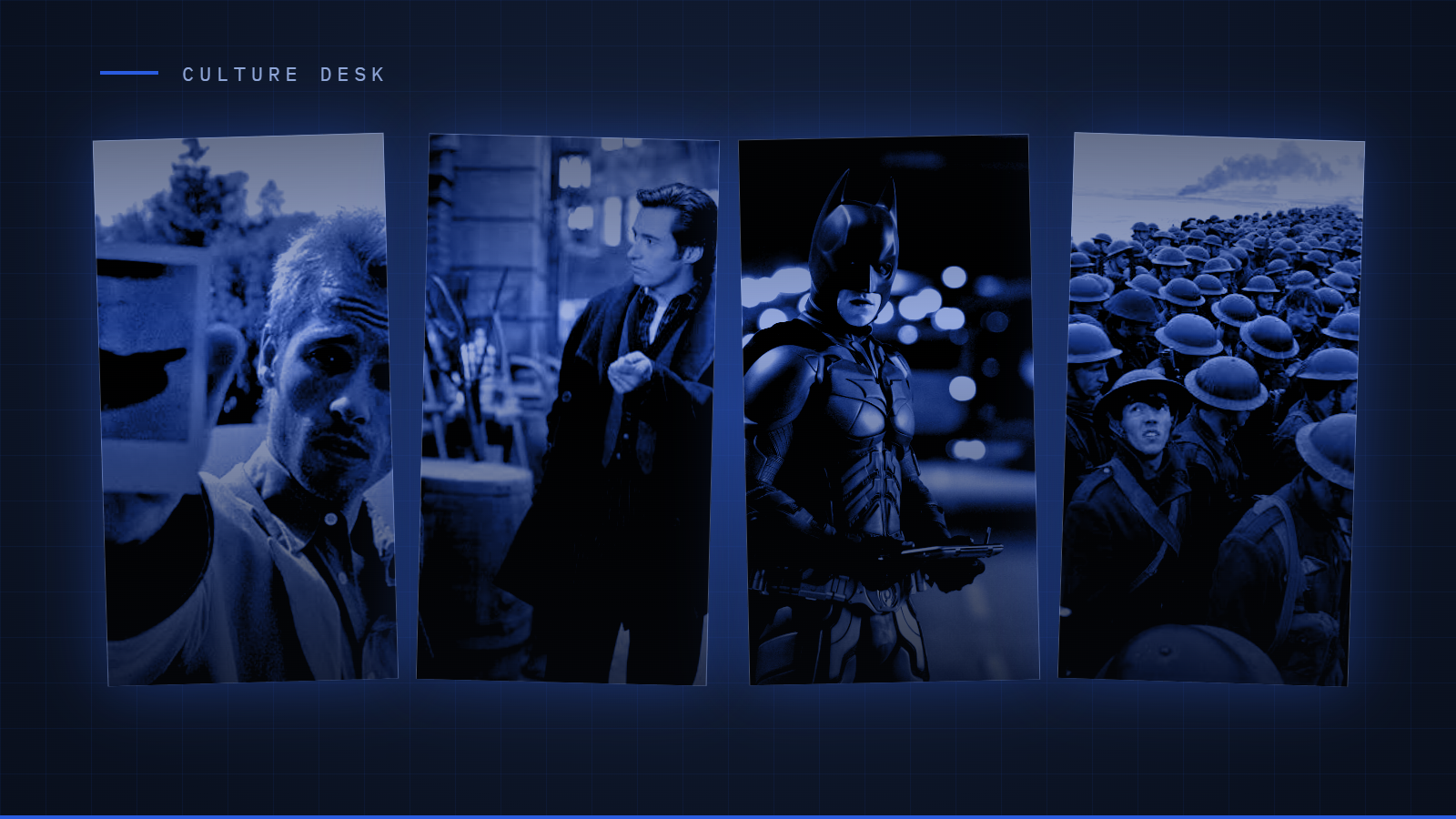
12. Following (1998)
Nolan shot his debut on weekends over roughly a year, using a cast and crew who mostly held day jobs, for a reported budget of about $6,000. Following is a black-and-white noir about a young writer who starts tailing strangers through London for material and gets pulled into a burglary ring, told out of chronological order the way nearly every Nolan film since has been in one form or another.
It's the rawest thing he's made and, by a wide margin, the smallest. What it shares with Interstellar, made sixteen years and a few hundred million dollars later, is the same structural instinct: withhold information, then reorganize the story so the audience has to do real work to assemble it. Following is where that instinct started, on a budget that left no room for anything except the idea itself.
11. Insomnia (2002)
Nolan's first studio film, and his only one built entirely around someone else's screenplay, was a remake of a 1997 Norwegian thriller. Al Pacino plays a detective investigating a murder in an Alaskan town where the sun never sets, accidentally kills his partner in a fogbound shootout, and spends the rest of the film unraveling from guilt and sleep deprivation while Robin Williams's killer needles him from the other side of the case. It grossed $113.6 million worldwide against a $46 million budget.
Insomnia is the most conventional film Nolan has directed, a straight psychological procedural without a structural trick, and that's exactly why it sits here. It proved he could work inside a studio system and someone else's material without losing what made his first film interesting, guilt as a slow-motion crime rather than a single act, but it's also the Nolan film with the least of Nolan actually in it.
10. Tenet (2020)
Tenet asked audiences to track a plot running in two time directions simultaneously, in theaters that had barely reopened during a pandemic, and it made $365.3 million worldwide against a $205 million budget under about as difficult a release environment as a film can face. John David Washington's unnamed Protagonist and Robert Pattinson's Neil chase "inverted" objects and people moving backward through time, in sequences that reverse mid-scene without warning.
The mechanics are the whole point and also the film's biggest obstacle. Dialogue mixed low under Ludwig Goransson's score made key exposition hard to catch even for viewers paying close attention, and Nolan has since said he'd adjust the sound mix if he could revisit it. The inverted freeway chase and the sequence where two versions of the same fight run in opposite directions are as technically accomplished as anything in his filmography. They just arrive inside a plot that asks more patience than it repays on a first viewing.
9. Batman Begins (2005)
Batman as a franchise was commercially dead in 2005, five years removed from Batman & Robin's neon nadir, when Nolan and co-writer David Goyer rebuilt it from an origin story nobody had put onscreen with any real weight before. Christian Bale trains with the League of Shadows, loses his parents in the film's opening act rather than treating it as a flashback, and becomes Batman roughly two hours into his own first movie. It made $356.8 million worldwide on a $150 million budget, respectable rather than record-setting, and set up everything that followed.
What Batman Begins actually did was prove a comic book movie could be shot and scored like a crime drama, with Cillian Murphy's Scarecrow and Liam Neeson's Ra's al Ghul playing more like genre-thriller villains than costumed ones. Murphy's small role here turned into a nineteen-year working relationship that ended with him winning an Oscar for Nolan in 2024. The trilogy it launched would outgross this entry many times over, but the origin film is where the tone that made the other two possible got established.
8. The Dark Knight Rises (2012)
Closing a trilogy this beloved without disappointing anyone was close to impossible, and The Dark Knight Rises doesn't fully escape that trap, an overstuffed plot juggling Bane's occupation of Gotham, Catwoman's introduction, and Bruce Wayne's physical and financial ruin all at once. It still made $1.082 billion worldwide on a $230 million budget, becoming the third-highest-grossing film of 2012 globally.
Tom Hardy's Bane, voice distorted through a mask that muffled his dialogue in early test screenings badly enough that Warner Bros. had it re-mixed before release, became one of the more quotable villains in the trilogy despite the handicap. Anne Hathaway's Catwoman gave the film its lightest, most purely enjoyable scenes. The ending, Bruce Wayne alive and finally free of the cowl, gave the trilogy the clean finish The Dark Knight's darker conclusion had denied audiences four years earlier, even if the plot mechanics getting there ask a lot of goodwill.
7. Dunkirk (2017)
Dunkirk has almost no conventional dialogue for long stretches and follows three separate timelines, one week on land, one day at sea, one hour in the air, that don't sync up until the film's final act. It made $528.1 million worldwide on a $150 million budget and picked up eight Oscar nominations, winning three: Film Editing, Sound Mixing, and Sound Editing.
Hans Zimmer's score does as much narrative work as the visuals, built around a Shepard tone that seems to rise in pitch forever without actually going anywhere, mimicking the trapped, ticking-clock dread of soldiers waiting on a beach for evacuation. Nolan shot most of it with practical boats and planes rather than digital doubles, and the result is a war film built almost entirely on tension and geography instead of the usual battlefield spectacle. It's the closest he's come to pure formal experiment inside a studio tentpole.
6. The Prestige (2006)
Two magicians, played by Christian Bale and Hugh Jackman, destroy each other's lives over a stage trick across more than a decade, in a film that hides its own method the same way its characters hide theirs. The Prestige made $104.4 million worldwide on a $40 million budget, modest next to Nolan's later work, and remains the film of his most devoted fans point to as the one where the twist actually earns its reveal on a second viewing rather than just surprising you once.
Based on Christopher Priest's novel, the film is as much about obsession and the cost of craft as it is about magic itself, and its final twist, hiding in plain sight from the opening scene if you know to look for it, rewards exactly the kind of close attention Nolan's films have asked for since Following. David Bowie's turn as Nikola Tesla, playing a role few other actors of his stature would have taken seriously, is one of the odder, better pieces of stunt casting in Nolan's filmography.
5. Inception (2010)
Inception invented its own vocabulary, dream levels, totems, kicks, well enough that a decade and a half later people still argue about whether the spinning top at the end falls. It made $826.9 million worldwide on a $160 million budget and won four Oscars from eight nominations, including Best Cinematography and Best Visual Effects, though it lost Best Picture and Best Original Screenplay.
The hallway fight, shot in a rotating practical set rather than through digital trickery, is still cited by stunt coordinators as one of the hardest sequences to choreograph in modern blockbuster filmmaking. What holds the film together underneath the spectacle is a genuinely simple emotional core, a man trying to get home to his kids, buried under enough architecture that some viewers miss it entirely on a first watch. That's Nolan's signature move in miniature: hide the feeling inside the mechanism, and trust the audience to find it. Ranking it just behind Memento here is close enough to a coin flip that a different day could flip the two; Memento wins this one because its structure is load-bearing rather than spectacular, but Inception's case, more craft on screen, a bigger cultural footprint, four Oscars to Memento's zero, is just as real.
4. Memento (2000)
Leonard Shelby can't form new memories, so Memento tells his story in two interleaved timelines, one running forward in black and white, one running backward in color, meeting in the middle at the film's final scene. It was adapted from a short story, "Memento Mori," written by Nolan's brother Jonathan, and made for just $5 million, grossing $39.7 million worldwide, still the cheapest and among the most profitable films on this list relative to budget.
The structure isn't a gimmick bolted onto a normal story. It's the only way this particular story could work, forcing the audience to experience Leonard's own disorientation rather than just watch it happen to him, discovering each new scene with as little context as he has. Memento earned Nolan his first Oscar nomination, for Original Screenplay, alongside a second nomination for editor Dody Dorn, and put him on the industry's radar as someone willing to bend a film's basic grammar rather than just its plot.
3. Oppenheimer (2023)
Oppenheimer is the most decorated film Nolan has ever made, by a wide margin: seven Academy Awards from thirteen nominations, including Best Picture and Best Director, both firsts for him after a single prior Best Director nomination, for Dunkirk, that didn't win. Cillian Murphy won Best Actor and Robert Downey Jr. won Best Supporting Actor, giving the film two acting wins in a single ceremony. It grossed $983.1 million worldwide on a $100 million budget, an unusually low budget for a Nolan film that size, and became one of the highest-grossing R-rated films ever made, trailing only a handful of titles like Joker and Deadpool & Wolverine.
Three hours of dialogue-heavy biographical drama, shot largely in tight closeups on Murphy's face, shouldn't have worked as a summer tentpole opposite Barbie the same weekend. It became a cultural event anyway, the "Barbenheimer" phenomenon pulling audiences into theaters for both films the same day, and Oppenheimer's own achievement got a little obscured by how much fun that pairing was to talk about. The film itself is a portrait of a man who built something he couldn't uninvent and spent the rest of his life answerable for it, told with more moral seriousness than nearly anything else in Nolan's catalog.
2. The Dark Knight (2008)
The Dark Knight made just over $1.01 billion worldwide on a $185 million budget and remains, eighteen years later, the film most often cited as the one that made comic book movies a genre critics had to take seriously. Heath Ledger's Joker, filmed the year before his death, won Best Supporting Actor posthumously, one of only two acting Oscars any Nolan film has ever produced.
What makes it hold up isn't the spectacle, considerable as it is, but the fact that Ledger's performance never plays like a comic book villain doing bits. He's an agent of pure chaos with no origin story the film bothers explaining, because the point is that chaos doesn't need one. Aaron Eckhart's Harvey Dent gets one of the more genuinely tragic arcs in the trilogy, a good man's fall told with as much care as the villain's rise. It's the film that convinced a skeptical industry Nolan could do commercial spectacle and genuine drama in the same two and a half hours, and the number two spot on this list is really a testament to how good it is that a film this strong doesn't take the top slot.
1. Interstellar (2014)
Interstellar made $642.5 million worldwide on a $165 million budget, including a limited 2024 IMAX re-release for its tenth anniversary, and it won a single Oscar, Best Visual Effects, for a black hole visualization built on real general relativity equations supplied by physicist Kip Thorne. The film treats hard science as load-bearing rather than decorative: the seven years lost for every hour Cooper's crew spends near Miller's planet isn't dramatic exaggeration, it's Thorne's own gravitational time dilation math for a world orbiting close to a supermassive black hole, worked out before a frame was shot. Double Negative's rendering of Gargantua was accurate enough that Thorne and the visual effects team published the light-bending method in the peer-reviewed journal Classical and Quantum Gravity, and it later revealed details about how a spinning black hole's accretion disk would actually look that astrophysicists hadn't visualized correctly before. Few films have functioned this literally as a science textbook smuggled inside a story.
What makes that science worth citing is that Nolan mostly refuses to explain it out loud. The tesseract sequence near the end takes an idea that only exists as equations, that time might be navigable the way space is, and turns it into a physical room Cooper can walk through, giving the audience a way to see a concept most films would need three pages of dialogue to gesture at. Elsewhere, the docking sequence with the rotating Endurance station was shot largely with a 14-foot practical miniature spun on a motion-control rig rather than built from scratch in a computer, because Nolan wanted the tumbling disorientation to read as real weight and real momentum, not simulated. Hans Zimmer's score supplies the ambiance that ties it together: Nolan sent him a page about fatherhood, not the script, and Zimmer wrote the piece blind before he even knew he was scoring a space movie. Recorded on the pipe organ at Temple Church in London, it gives Interstellar a spiritual, almost liturgical register no other Nolan film reaches for, one that turns a docking sequence into something closer to a hymn than an action beat.
The characters carry their own arguments, and the film is willing to let them be wrong before it lets them be right. Matt Damon's Dr. Mann is introduced as the mission's best hope and turns out to be a scientist so afraid of dying alone that he falsified his own data to guarantee a rescue, a betrayal dressed up as survival instinct. Anne Hathaway's Brand argues early on that love might be a force that transcends the dimensions the crew can measure, and Cooper dismisses it as unscientific wishful thinking. The film spends its third act proving her right on her own terms: it's Cooper's bond with his daughter, not a new equation, that lets him find the coordinates to send home. That's a rarer trick than it sounds, an emotional thesis a character states out loud, gets mocked for, and then watches the plot itself get engineered to validate rather than just feel true by the end.
Critics were split on it in 2014, and some of that critique holds up: the exposition is dense in places, and Hathaway's love speech reads as either the film's thesis statement or its most overwritten line depending who you ask. That critique is about execution, though, not ambition, and ambition is the real tiebreaker at the top of this list. The Dark Knight and Oppenheimer are extraordinary films, and their case rests on things you can count: box office records, acting Oscars, a genre or a subject nobody expected to work at that scale. Interstellar's case rests on something harder to pull off at all, hard astrophysics, unresolved grief, formal visual invention, and a genuine moral argument about love and self-interest, operating inside the same three hours without any single element crowding out the others. It doesn't land every beat. It's still the only film on this list attempting that many difficult things at once and mostly getting away with it, and eleven years on, it's the Nolan film people describe crying at, not just admiring. That's the case for number one.
Honorary Mention: The Odyssey (2026)
The Odyssey doesn't get a ranked slot here, and that's about timing, not doubt. Nolan's $250 million adaptation of Homer's epic, led by Matt Damon as Odysseus with Anne Hathaway, Tom Holland, Zendaya, and Robert Pattinson in supporting roles, opened July 17 to $123.5 million domestically and $263.7 million worldwide, the biggest global opening of his career. It carries a 94% Rotten Tomatoes score from 483 reviews, tied for the best of any Nolan film, and an A CinemaScore. The film also became the fastest ever to reach one million logged watches on Letterboxd, hitting the mark in six days, half the time Barbie needed to do it.
Three weeks into release, the film has already crossed $922 million worldwide and is still climbing toward Nolan's first $1 billion global total. That already tops what Interstellar earned across its entire original theatrical run, on top of a career-best critical score. It's simply too early to know if The Odyssey will hold up on rewatch the way the films above it have, and this list only ranks films that have had time to prove that. Revisit this piece in a year or two, and it may well have earned the number itself.
The Pulse24 Take
Rank these by box office and the order looks nothing like this. Rank them by which ones people still watch on purpose, years after they left theaters, and Interstellar's spot at the top gets a lot easier to defend. Nolan has spent nearly three decades making the same basic bet: that audiences will do real work, track a reversed timeline, sit with dialogue mixed low under a droning score, follow a plot that runs in two time directions at once, if the idea underneath is big enough to be worth the effort.
Most directors get that bet wrong occasionally and stop taking the risk. Nolan's batting average is unusually high precisely because he keeps making it anyway, from a black-and-white debut shot on weekends to a three-hour Homer adaptation that just became the fastest film in Letterboxd history to reach a million watches. The idea that anchors Interstellar, that love and memory can outlast time itself, is the biggest bet of his career, and it's the one that paid off the most completely.
How we read the data
Curious how we get from raw data to a take like this? Our Trader's Toolkit walks through the tools we lean on.
Explore the Toolkit