Pulse24 Original
Hackers Stole $89 Million From Bitcoin Wallets This Week Using a 2021 Coding Error. It's the Third Time in a Decade a "Random" Number Wasn't Random Enough.
August 3, 2026
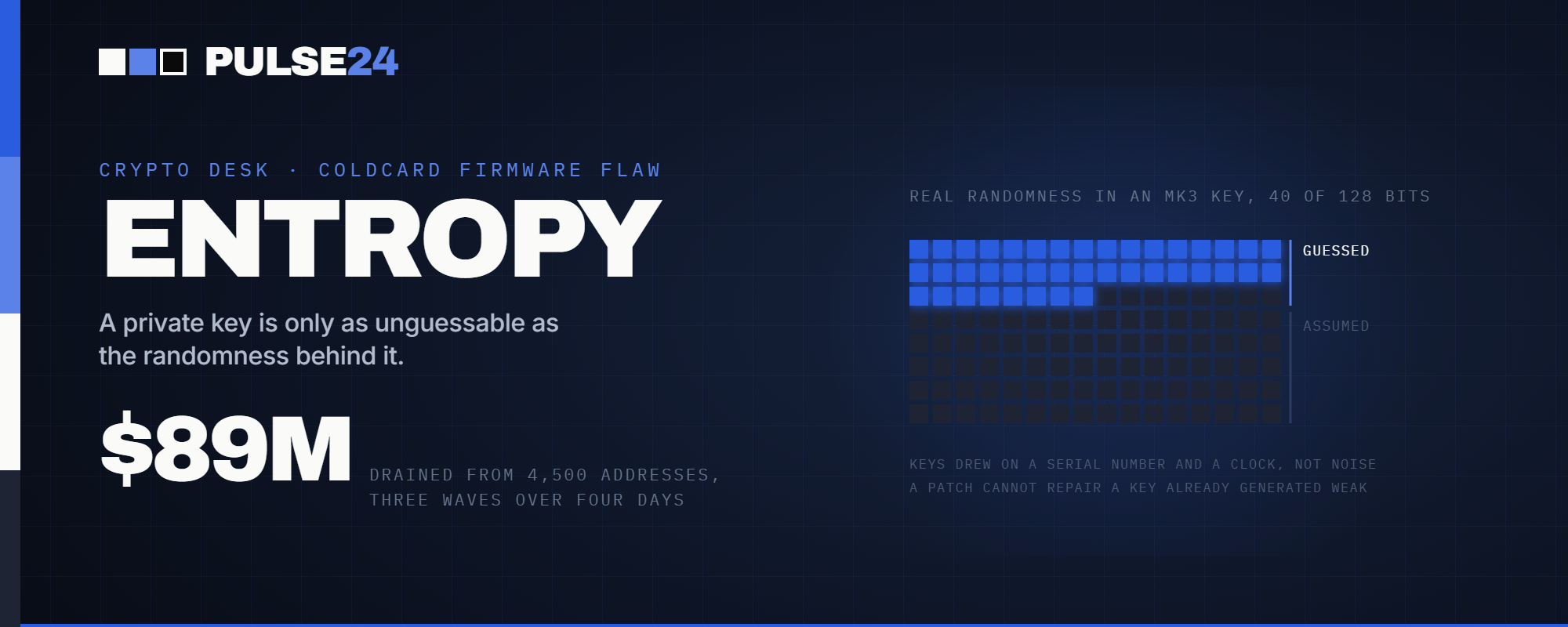
A five-year-old Coldcard firmware bug let hackers drain an estimated $89 million from Bitcoin wallets this week, the third time in just over a decade that a "random" number generator wasn't random enough. Here's the technical story, the history it rhymes with, and what it actually means for Bitcoin self-custody security.
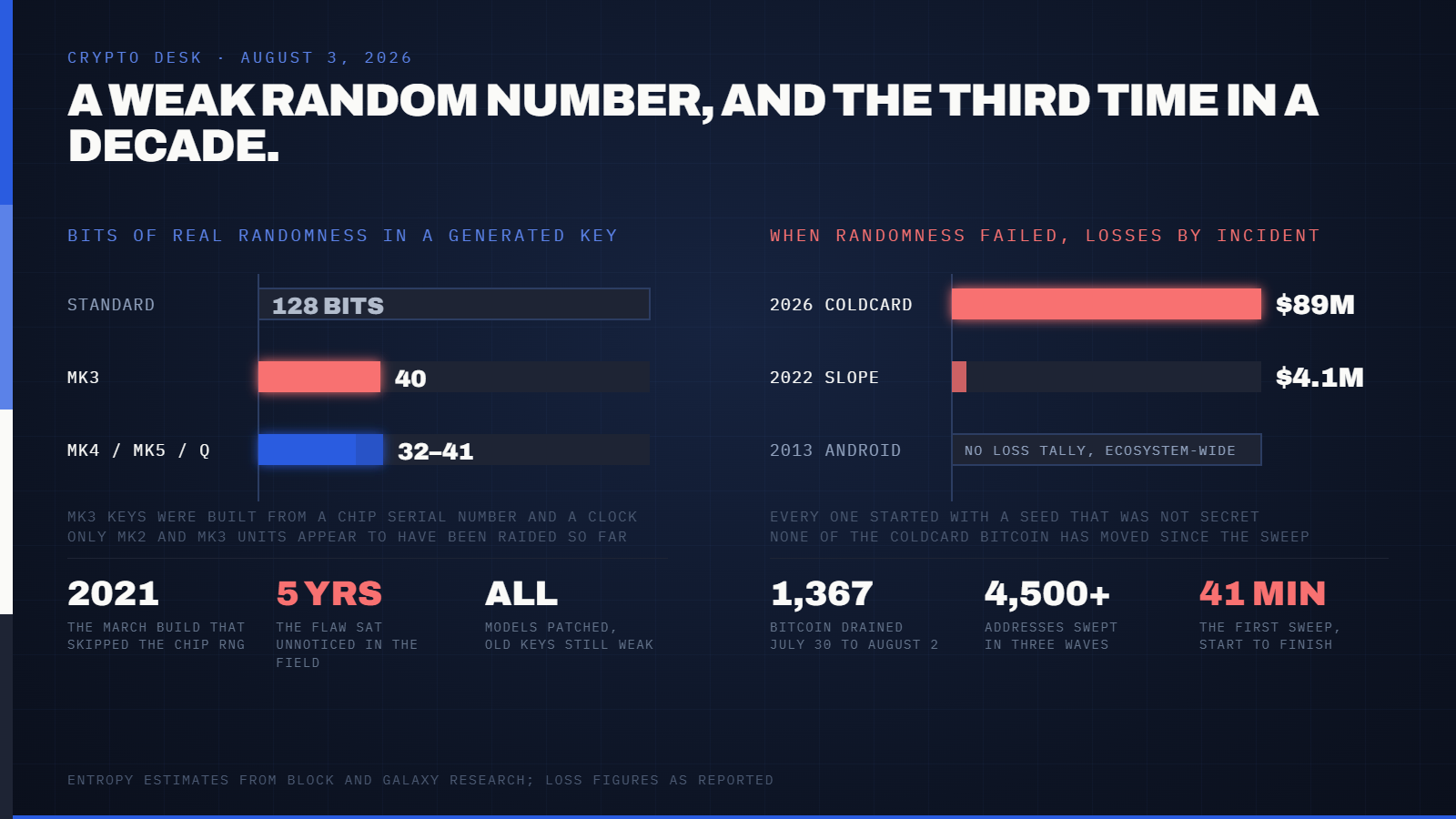
Coinkite, the maker of the Coldcard hardware wallet, shipped a firmware update in March 2021 that quietly broke one of the most important guarantees in all of cryptography: that a private key is unpredictable. A build setting told the device to skip its own hardware random number generator, and the code meant to verify that setting only checked whether it existed, not whether it was actually switched on. From that point forward, some Coldcard devices generated seed phrases in software instead, built from a couple of pieces of data that weren't secret at all: the chip's serial number and its internal clock, both things an attacker could plausibly work out.
Nobody noticed for five years. Then, over three waves of attacks between July 30 and August 2, someone who had apparently already reverse engineered the flaw drained roughly 1,367 BTC, worth about $89 million, from more than 4,500 wallets. The first sweep alone took 41 minutes. Bitcoin was trading in the low $60,000s at the time, which is part of why a bug from five years ago suddenly mattered enough to act on.
What Changed
The entropy math is what makes this different from an ordinary hack. Bitcoin's security model assumes a private key is chosen from roughly 2 to the 128th power possibilities, a number large enough that guessing correctly isn't a realistic strategy for anyone, ever. Security researchers at Block found that Coldcard's Mk3 devices, the ones actually drained, were effectively choosing from a pool with only about 40 bits of real randomness, a difference so large it's hard to put in everyday terms. It's the difference between a lock with more combinations than atoms in the observable universe and one a determined attacker can search through on their own hardware, checking each guess against Bitcoin's public ledger until one matches a funded address. Coinkite's newer Mk4, Mk5, and Q models carried a related but smaller flaw, which researchers estimate leaves somewhere between roughly four billion and a few trillion possible outcomes depending on how it's measured, still far short of the 128-bit standard, which is why Coinkite patched all of them even though only the weaker Mk2 and Mk3 units appear to have actually been raided so far.
This Isn't the First Time
Bitcoin has been here before, and so has the rest of crypto. Google patched a flaw in Android's random number generator in August 2013 that had been quietly weakening every Bitcoin wallet app built on top of it, including Bitcoin Wallet, Blockchain.info's app, and Mycelium, forcing a wave of emergency key rotations across the ecosystem. Roughly 9,231 Solana wallets tied to the Slope app were drained of about $4.1 million in August 2022 after the app was found to be transmitting users' private keys to an external logging service, a different failure with the same result: a seed that was supposed to be secret wasn't.
The Self-Custody Debate, Reignited
Bitcoin's founding promise was that you don't need to trust anyone else with your money. This week's incident is a reminder of what that promise actually costs. ARK Invest's Lorenzo Valente put it bluntly: self-custody holders have "traded counterparty risk for software risk, hardware risk, supply-chain risk, phishing risk, backup risk." Casa CEO Nick Neuman went further, arguing "you just can't ask people to roll dice to be secure with your self custody," a pointed reference to the randomness at the center of this exact bug. Not everyone agrees the fix is to hand custody to someone else; Bitcoin commentator Guy Swann called it a failure of implementation, not of the self-custody idea itself. Both readings fit the same facts. What's less debatable is where capital tends to go after events like this: Bitcoin ETFs had already seen roughly $265 million leave in a single session the week this story broke, and Amicus co-founder David Lawrence expects incidents like this one to push new investors further toward regulated products like spot Bitcoin ETFs rather than toward learning to manage a seed phrase themselves.
What to Watch Next
Coinkite has patched every affected model, but a patch can't fix a key that was already generated insecurely, only prevent new ones from inheriting the flaw. Anyone running an older Coldcard, or honestly any hardware wallet purchased years ago and never rotated, has homework to do: update firmware, generate a brand new seed on the patched version, and move funds over, testing with a small amount first. Also worth watching is whether the roughly $89 million sitting untouched in attacker-controlled addresses ever moves. Stolen funds that stay put for weeks are often waiting for scrutiny to fade or a route to cash out that doesn't immediately flag every major exchange, and Galaxy Research has already passed address clusters to compliance firms and investigators.
The Pulse24 Take
Randomness is one of the few places in finance where you can't verify the thing you're relying on just by looking at it. A private key generated from a weak random number generator looks exactly like one generated correctly, right up until someone with the right insight reconstructs it. That's what makes this class of bug so uncomfortable. You can't learn to spot it the way you'd spot a phishing email, and you can't strengthen it the way you'd strengthen a password. It's a property of software sitting underneath crypto's central promise, often summarized as not your keys, not your coins, that only holds if every layer beneath it actually works as advertised, and there's no way for an ordinary user to audit that layer directly.
None of that makes self-custody the wrong choice, just as the 2013 Android bug and a decade of exchange collapses never made custodial accounts the wrong choice. Every option in this asset class rests on assumptions about some specific piece of software or some specific institution, assumptions almost nobody using it ever actually checks. Checking them is the discipline that protects you, not the custody model itself. That discipline mattered in 2013, mattered again in 2022, and was worth $89 million this week.
How we read the data
Curious how we get from raw data to a take like this? Our Trader's Toolkit walks through the tools we lean on.
Explore the Toolkit