Pulse24 Original
China's Copper Premium Hit $200 a Ton This Week, the Highest on Record. The Metal It Needs Is Piling Up in US Warehouses.
November 1, 2026
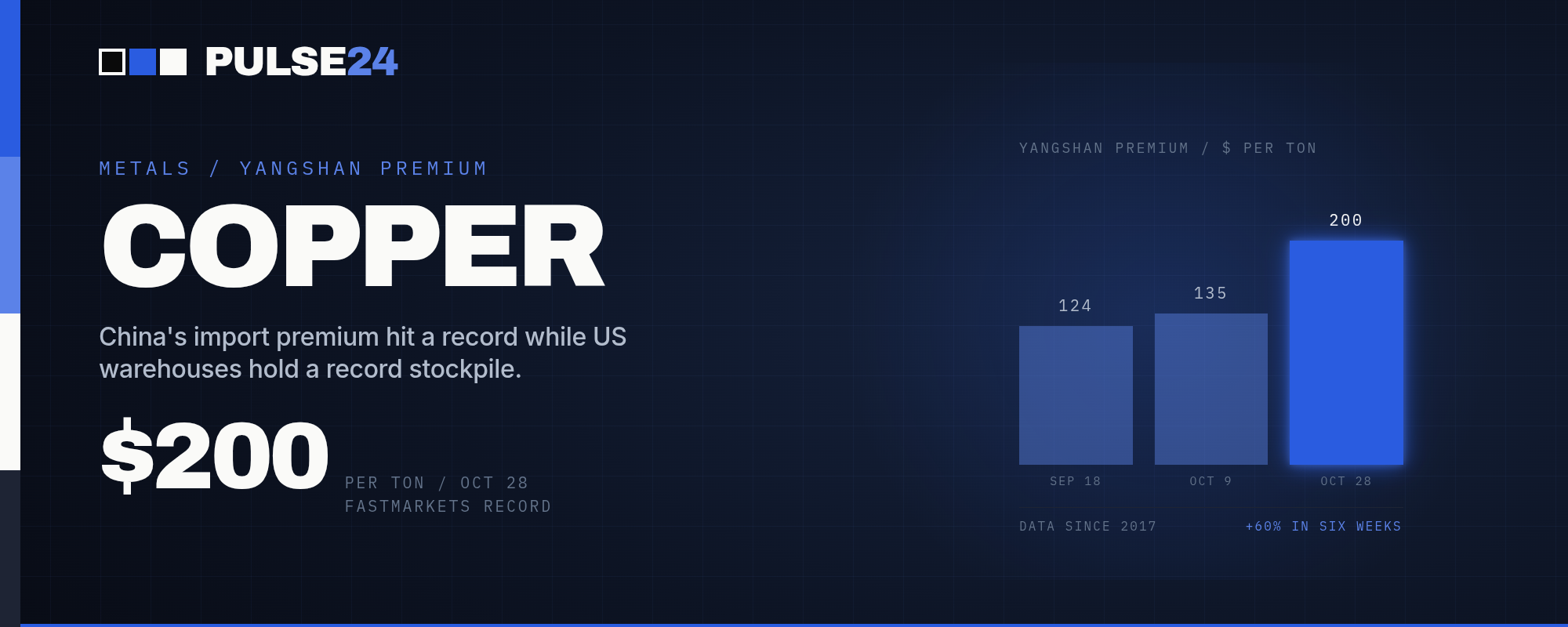
The Yangshan import premium that measures China's hunger for physical copper spiked past $200 a ton this week, the highest level Fastmarkets has recorded since its data began in 2017. The copper causing the shortage hasn't vanished. It's sitting in COMEX warehouses that are already at a record high.
Two hundred dollars a ton. That's what buyers in China paid this week just to get copper shipped into Yangshan, the import hub whose premium over the benchmark price works as a real-time gauge of how badly the country needs the metal. Fastmarkets has tracked the number since 2017. It has never printed this high before.
What Changed
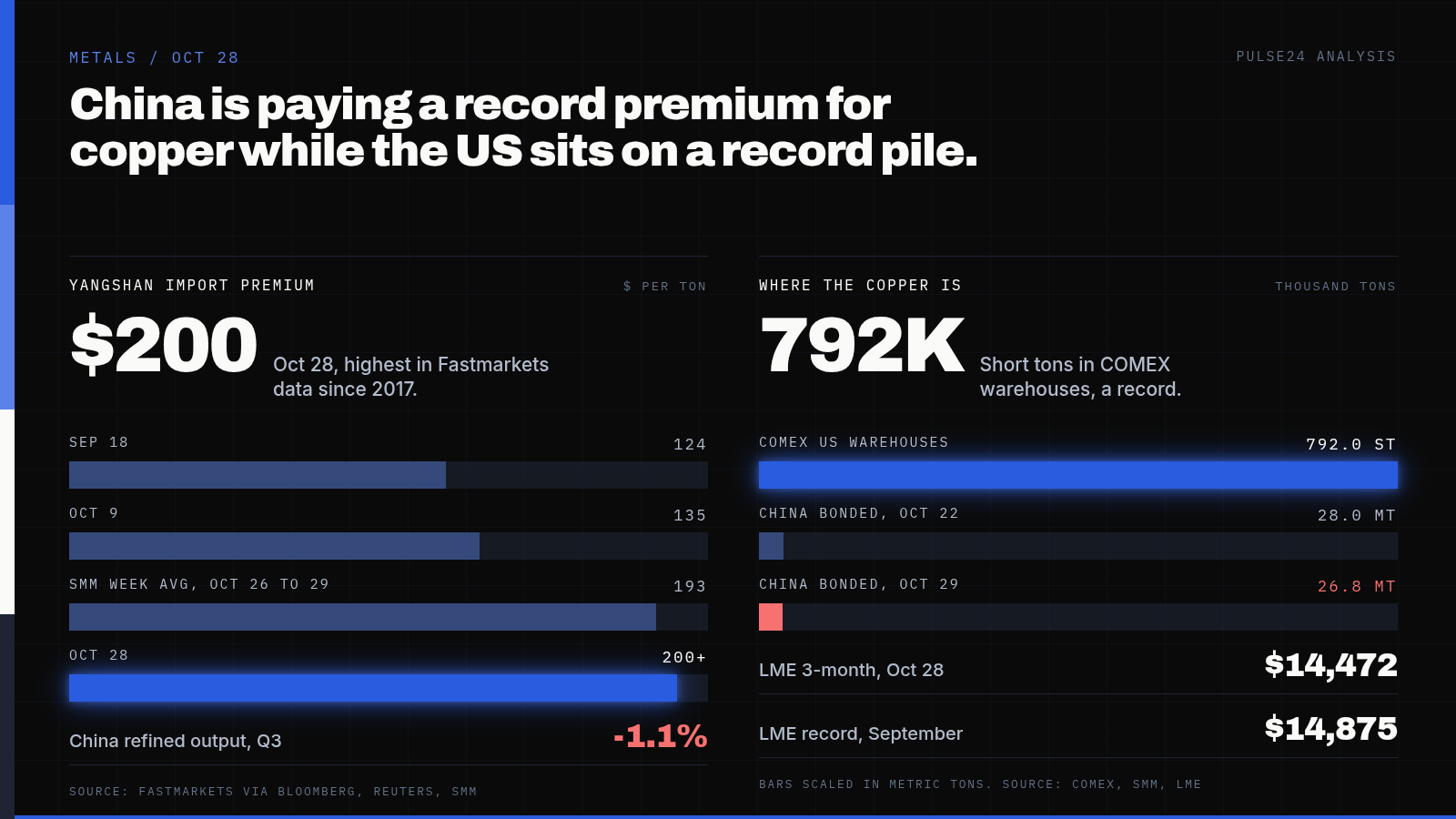
The jump didn't happen overnight, even if the headline number makes it look that way. Reuters tracked the Yangshan premium at $124 a ton on September 18, already its highest level since November 2022. Three weeks later, on October 9, it had edged up to $135. By October 28, it had cleared $200, according to Bloomberg, a level Fastmarkets has never recorded in data stretching back to 2017. Shanghai Metals Market's own weekly survey tells the same story from a different angle: warrant premiums for the week of October 26 to 29 averaged $193 a ton, with the high end of the range touching $205, in a report the firm titled, plainly, a historic high.
Three forces are doing most of the pushing. Chinese refined copper output fell 1.1% in the third quarter from a year earlier, as smelters already squeezed by higher processing costs cut production and threatened further cuts. Shipping delays tied to typhoon weather slowed what cargo was moving. And bonded-zone inventories, the copper sitting in Chinese ports waiting to clear customs, fell to 26,800 metric tons on October 29, down 1,200 tons from the week before, with Shanghai's share alone dropping to 24,200 tons. None of that is a large absolute number next to global copper demand. It's the direction that matters: supply inside China keeps tightening at the exact moment global prices are already elevated.
The irony is that copper hasn't actually gotten more expensive in the way that number might suggest. LME three-month copper traded near $14,472 a ton as this week's premium spike hit, up 16% for the year but still a few percent under September's record of $14,875. The premium is a separate, more specific signal. It's the price of getting physical metal into China right now, on top of whatever the benchmark happens to be, and right now that extra cost is doing something the benchmark price alone isn't.
Why It Matters
Pulse24 flagged the other half of this story on October 22: COMEX-approved warehouses in the US were sitting on a record 792,000 short tons of copper, stockpiled there mostly because traders moved metal ahead of US tariff rules that are still being finalized. Goldman Sachs' read at the time was that the pile is effectively stranded supply, metal that counts in global inventory statistics but can't easily reach buyers in Europe or Asia. China's record premium is close to a real-time confirmation of that thesis. The copper exists. It's sitting on the wrong side of a trade that's been running in one direction for most of this year, and reversing it isn't simple or cheap.
A premium this size isn't just a trading curiosity. It flows directly into costs for the Chinese manufacturers that turn copper into wire, motors and circuit boards, many of which compete on thin margins against exporters elsewhere. The LME's own near-dated market is flashing a related signal: the spread between cash copper and three-month contracts widened to $204.66 a ton this week, a level of backwardation that typically shows up when buyers want metal now and are willing to pay up rather than wait. That's a market pricing in scarcity today, not scarcity six months from now.
There's a structural layer underneath the immediate squeeze, too. The copper that AI data centers, grid upgrades and electric vehicles are expected to need keeps growing faster than mine supply has managed to keep pace with, a trend Pulse24 has tracked through falling output at major miners and rising long-term demand forecasts. A short-term logistics and tariff story is colliding with a multi-year demand story, and when those two overlap, premiums tend to overshoot before they correct.
What to Watch Next
Three things will say more than this week's premium print on its own. First, how fast Chinese smelters bring maintenance-related production back online, since that's the most direct lever on domestic supply. Second, whether African copper, which traders say could reach Asia within one to two months, actually shows up at Chinese ports on that timeline or slips further. Third, whether Washington settles its tariff treatment of refined cathode one way or the other, since a clearer rule in either direction would change whether US warehouses keep absorbing metal or start releasing some of it back into global trade.
Shanghai Metals Market's own analysts expect the tight-supply logic to persist in the near term, and they flag the unfavorable exchange ratio between Shanghai and London prices as a limit on how much further the import premium can climb before Chinese buyers simply stop paying up. A premium that keeps setting records into November would say the squeeze is getting worse, not just peaking. A plateau or a slight easing would be closer to confirmation that this was a sharp but temporary mismatch.
The Pulse24 Take
Copper's headline price has looked almost boring this year next to gold's swings or Bitcoin's drawdowns, up 16% and sitting a few percent below its own record. The premium underneath that number tells a less boring story. When the cost of simply getting physical metal to where it's needed climbs more than 60% in six weeks and sets a record going back to 2017, that's not noise sitting on top of a calm market. It's the market's way of saying the calm headline price isn't showing the whole picture.
None of this means a shortage is guaranteed to spread or that prices are about to break out. Goldman's stranded-supply thesis and CRU's surplus forecast can't both be fully right, and this week's premium spike is new evidence for one side of that argument without settling it outright. What it does mean is that the gap between where copper sits and where it's wanted keeps widening, not narrowing, and that gap has a habit of being a better early signal than the benchmark price most investors are actually watching.
How we read the data
Curious how we get from raw data to a take like this? Our Trader's Toolkit walks through the tools we lean on.
Explore the Toolkit