Pulse24 Original
The Bank of Japan Has All But Locked In a December Hike. The Fight Now Is Over What Comes After It.
November 5, 2026
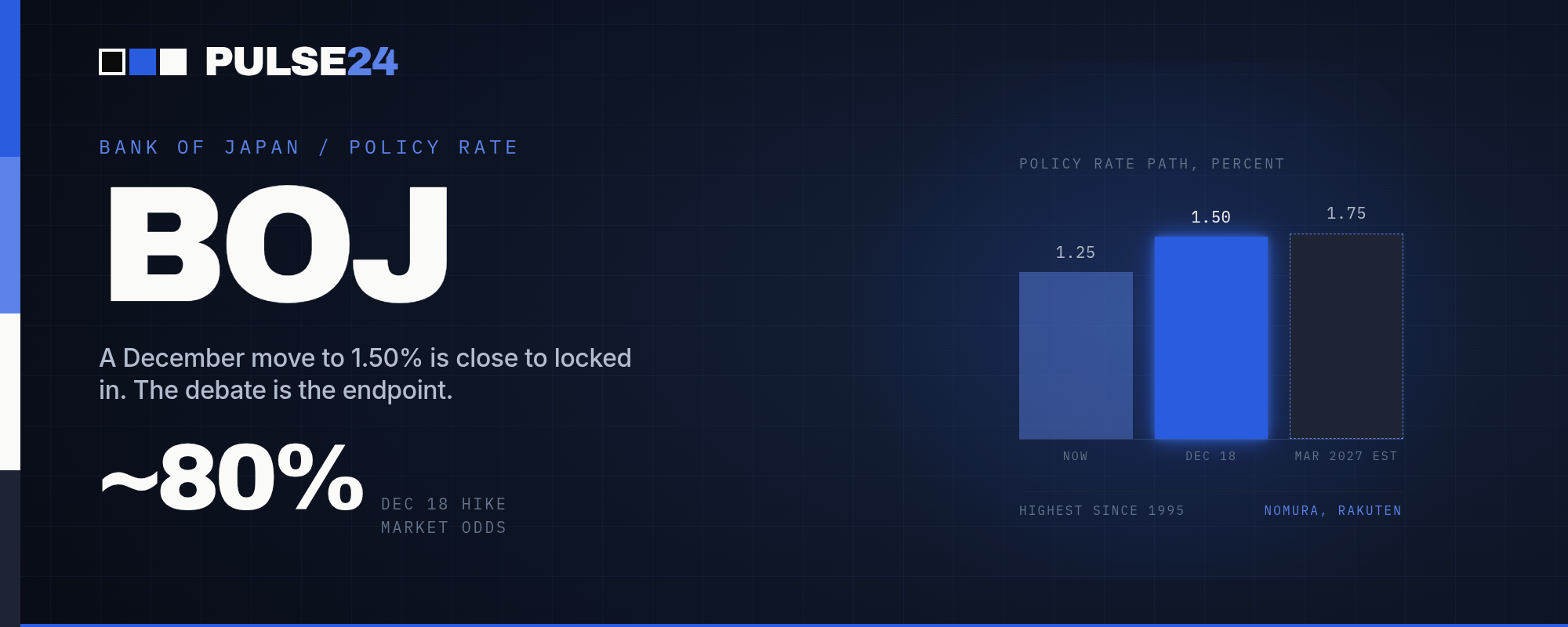
The Bank of Japan has all but locked in a December hike to 1.50%, with Governor Kazuo Ueda signaling the move after years of resistance. The real debate inside the bank has already moved to how fast rates climb toward 1.75% by next spring, and what that means for a yen carry trade that has been unwinding in slow motion.
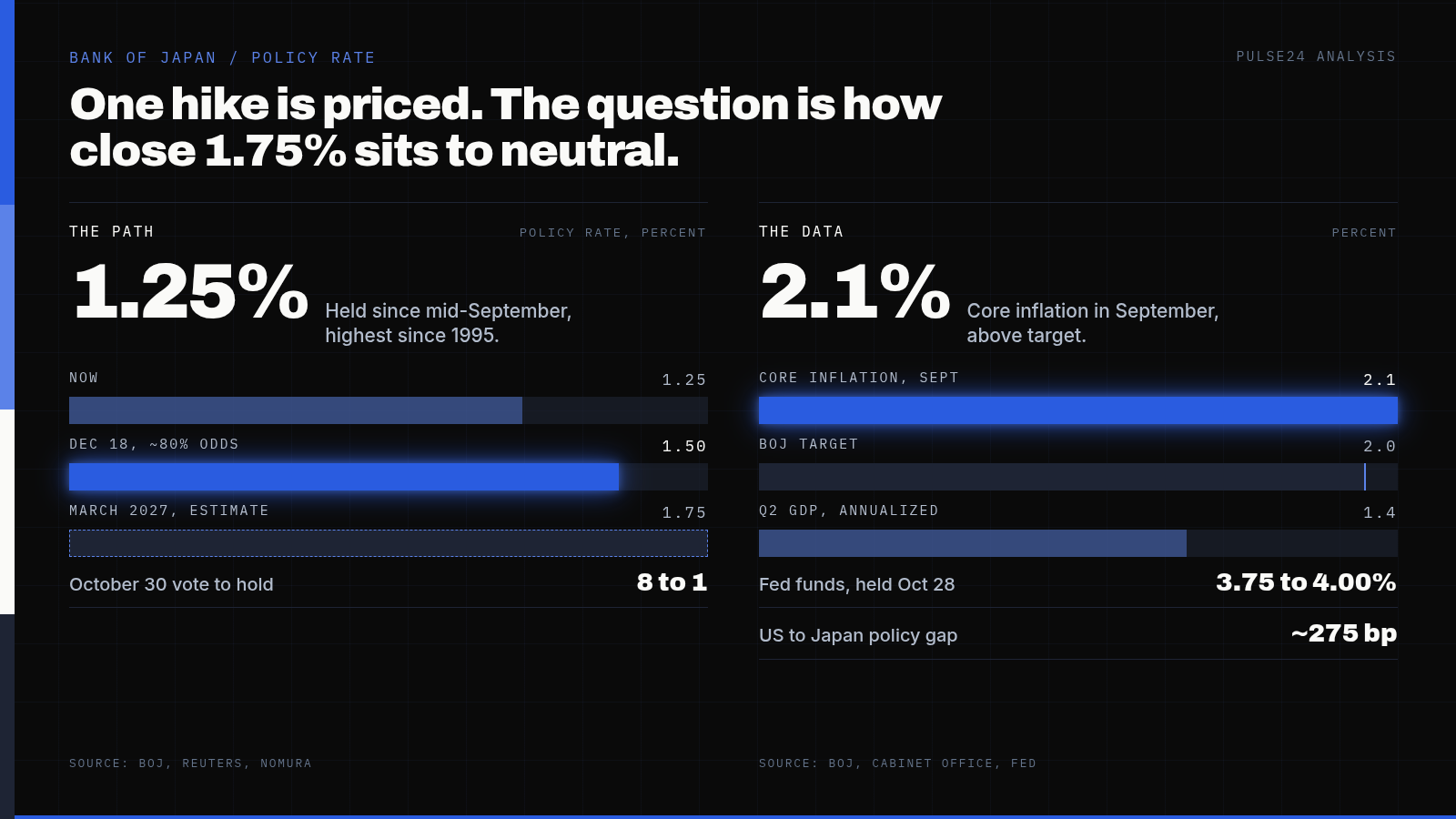
Japan's benchmark interest rate has sat at 1.25% since mid-September, the highest level the country has seen since 1995. That level is not expected to hold much longer. Bank of Japan Governor Kazuo Ueda spent the first days of November signaling a high probability of raising it to 1.50% at the board's December 18 meeting, and traders have pushed the odds of that outcome to roughly 80%, according to Reuters reporting published November 2.
What Changed
The board was far more divided just days earlier. On October 30, members voted 8 to 1 to leave rates unchanged, with Hajime Takata dissenting in favor of an immediate move to 1.50%. Ueda explained the majority's caution by saying it echoed remarks he made back in July, before the bank's September increase, essentially asking the board to watch incoming data a bit longer before acting. Within days, that caution had largely dissolved. Nobuyasu Atago, a former BOJ official now at Rakuten Securities, called a December hike "pretty much a done deal" based on the bank's own recent communication.
The shift followed directly from a decision the bank had defended only a week earlier: holding rates steady even after inflation reached its 2% target. That defense got harder to maintain as the data kept arriving. Core inflation ran at 2.1% in September, its first reading above target since December and a sharp jump from 1.7% in August, while the economy grew at a 1.4% annualized pace in the second quarter despite a difficult global backdrop for corporate spending. Last week the BOJ confirmed that underlying inflation had durably reached its 2% target, more than 13 years after adopting that goal in 2013, and reframed its own job as preventing an inflation overshoot rather than chasing a target it had pursued for over a decade.
Why It Matters
A quarter-point move looks modest next to a Federal Reserve that held its own rate at 3.75% to 4.00% on October 28, with two governors dissenting in favor of a hike of its own. But the gap between the two central banks, not the absolute level, is what actually moves money. That gap currently runs near 275 basis points, and the 10-year yield spread between the two countries' government bonds sits close to 214 basis points, with the US note near 4.91% against Japan's 2.77%. Every quarter point the BOJ adds narrows that spread, and a narrowing spread is precisely what unwinds a crowded yen carry trade, the decades-old practice of borrowing cheaply in yen to fund higher-yielding positions in dollar assets, Japanese equities, and beyond.
The yen has already priced in part of this. USD/JPY traded near 157.85 earlier this week, with 160 widely treated as the level where Japanese officials have historically started issuing verbal warnings about intervention. A BOJ that keeps moving, even in small increments, puts a floor under the currency that wasn't there a year ago. That tends to spill into trades built on cheap yen funding well beyond Japan's own equity market, including leveraged positions across parts of the broader carry complex.
What to Watch Next
December 18 is the date that matters most, with the BOJ's Summary of Opinions from the October meeting due for release shortly before it, offering an early read on how united the board actually is. The bigger argument has already moved past that single decision. BOJ staff estimate Japan's neutral rate, the level that neither stimulates nor restrains the economy, somewhere between 1.1% and 2.5%, a range wide enough to sustain real disagreement. Nomura's Mari Iwashita and Rakuten Securities' Atago both expect a further hike to 1.75% by around March, a level hawkish board member Naoki Tamura considers close to neutral outright. Two of Prime Minister Sanae Takaichi's own appointees dissented against the September hike, so a December move would narrow the debate without ending it.
The Pulse24 Take
Central bank decisions in Tokyo rarely move markets the way a Fed meeting does, and that's exactly why this one is easy to underweight. The yen carry trade has quietly supported parts of global markets for the better part of two decades, and it loses a little more support with every 25 basis points the BOJ adds. A December hike, if it lands the way the odds now suggest, will not by itself trigger a disorderly unwind. What it does is tighten the rate spread further, give the yen more support, and remind anyone still running yen-funded positions that their cost of capital has nearly quadrupled in under three years. The question worth tracking isn't December. It's whether the BOJ actually reaches 1.75% by spring, and whether an unwind that has stayed orderly so far keeps behaving at a meaningfully narrower gap.
How we read the data
Curious how we get from raw data to a take like this? Our Trader's Toolkit walks through the tools we lean on.
Explore the Toolkit