Pulse24 Original
$1.16 Billion Left US Bitcoin ETFs in Three Days. Bitcoin Rose to $78,000 Anyway.
November 4, 2026
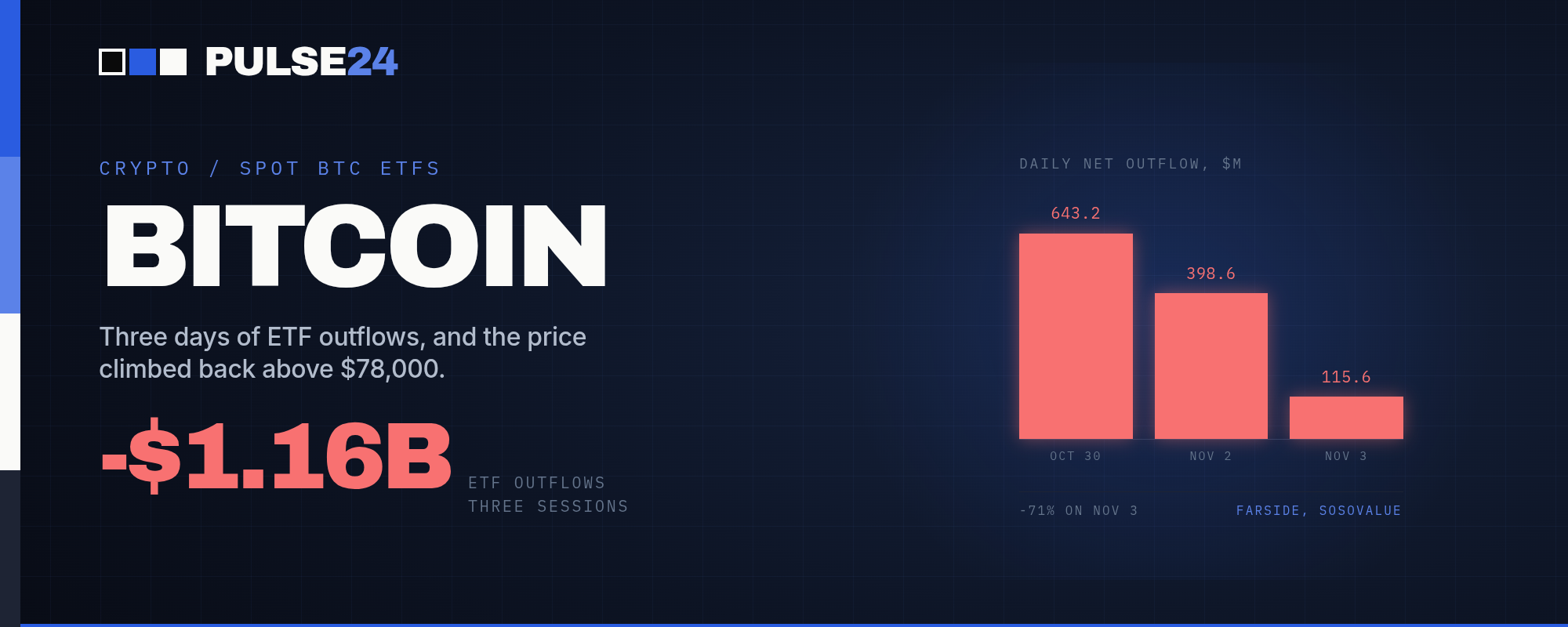
US spot bitcoin ETFs have now bled money for three straight sessions, about $1.16 billion combined, even as the token rebounded to near $78,000 after the midterm elections. BlackRock's IBIT accounts for most of the exit.
BlackRock's iShares Bitcoin Trust bled money for a third straight session on Tuesday, shedding about $95 million even as bitcoin itself was clawing back toward $78,000 by the next morning. The fund, known by its ticker IBIT, has been the single biggest source of a broader outflow that has pulled roughly $1.16 billion out of US spot bitcoin ETFs since October 30, according to data compiled by Farside Investors and tracked separately by SoSoValue.
What Changed
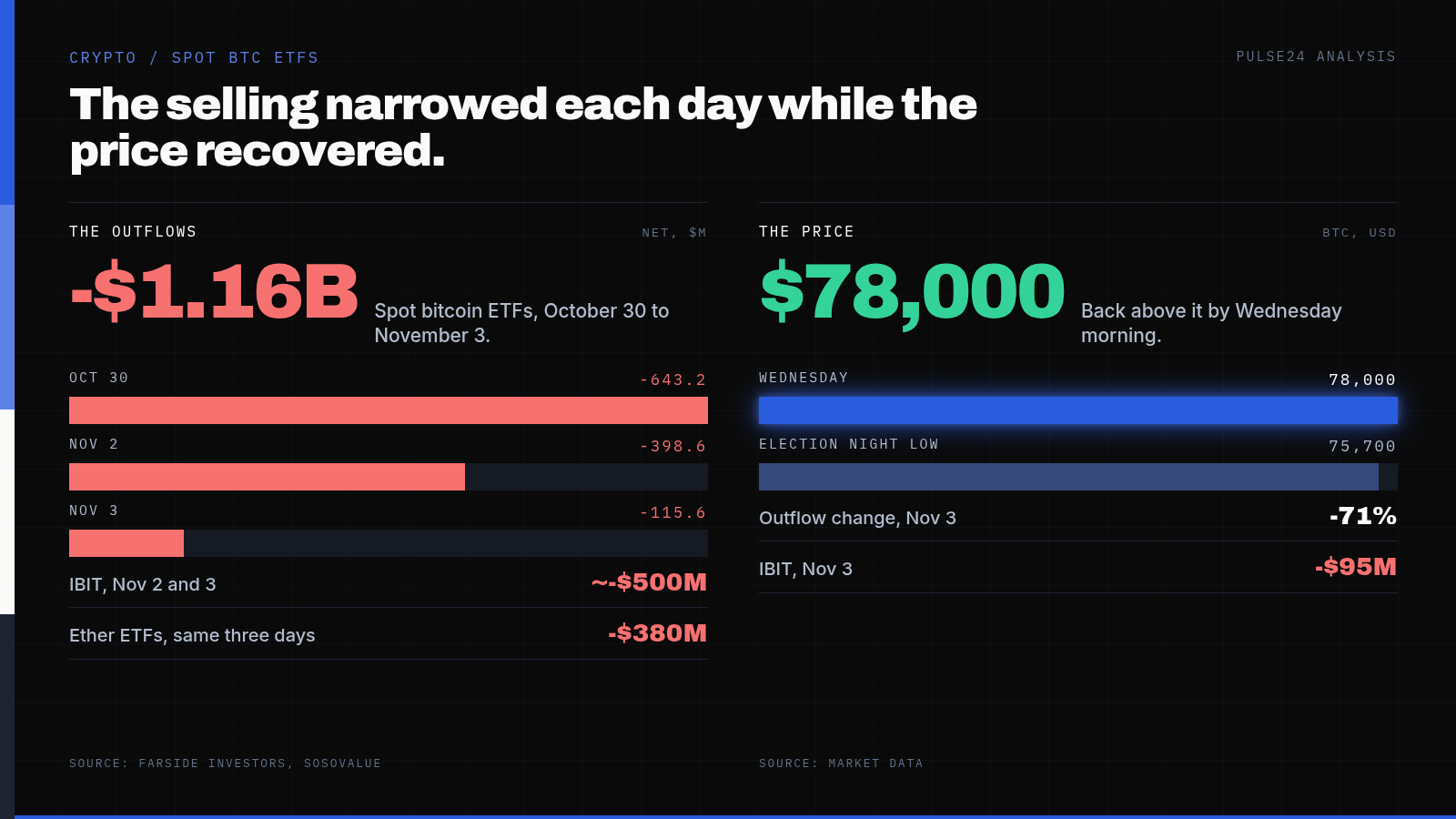
The outflow built in stages. Spot bitcoin ETFs shed $643.2 million on October 30, the single heaviest session of the three. That eased to $398.6 million on November 2, then to $115.6 million on November 3, a decline of roughly 71% in a single day. IBIT led outflows on November 2 and November 3, losing $405.3 million and then $95 million, for a confirmed two-day total near $500 million. Data providers differed on exactly how much of Monday's $643.2 million system-wide total came from IBIT specifically, though it was again among the largest contributors. On November 3, Grayscale's smaller BTC fund gave back another $52.6 million, while Bitwise's BITB and Fidelity's FBTC took in money instead.
Bitcoin's price told a different story. The token slid to roughly $75,700 on election night as early returns were still being counted, then reversed as it became clear Democrats had swept both chambers of Congress. By Wednesday it was trading near $78,300, up more than 3% from the low and modestly higher on the day. That rebound followed a rough October that left bitcoin down for a second year running, the kind of stretch that tends to leave positioning thin on both sides of the market.
Why It Matters
IBIT alone holds roughly $62.5 billion of the $99.2 billion sitting in US spot bitcoin ETFs, so its flows are as close to a real-time read on institutional conviction as this market offers. When it sheds half a billion dollars in two sessions while the spot price is recovering, that is a fund base trimming exposure into strength, not chasing it. That is not necessarily bearish. Big allocators often use a bounce to lighten up after a rough month, especially when the bounce is being driven by options positioning and short covering rather than fresh buying.
The category has taken in $56.5 billion since the first funds launched in January 2024, so three red sessions do not erase that track record. But the mechanics of this particular move matter. A price rally built on a thin, election-driven short squeeze looks different from one built on steady ETF accumulation, and the two tend to behave differently once the catalyst passes. Ether ETFs showed the same pattern on a smaller scale, losing $155.7 million, $139.7 million, and $85.3 million over the same three sessions, a reminder that the outflows were not a bitcoin-specific story.
What to Watch Next
Friday's nonfarm payrolls report is the next scheduled catalyst for risk assets broadly, bitcoin included, and a soft number would test whether this week's bounce has real legs. Several trading desks have pointed to the $80,000 to $82,000 range as the level bitcoin needs to clear before the rally looks confirmed rather than reflexive. The more useful signal may be simpler: whether IBIT and its peers start taking in money again, or whether the outflow streak extends into a fourth session. Liquidations ran to roughly $462 million over the past day as the price whipsawed, a sign that leveraged positioning is still getting flushed out in both directions.
The Pulse24 Take
Price and flows are not always telling the same story, and this week is a clean example of why that gap is worth watching. Bitcoin's bounce off $75,700 is real, but it is happening while the fund base that has absorbed most of this cycle's institutional demand is still net selling. That combination has shown up before major pullbacks and before healthy consolidations alike, so it is not predictive on its own. What it does argue for is patience. A market that needs a short squeeze to rally is a different animal from one pulling in fresh capital, and the next few sessions of ETF data should make clear which one this is.
How we read the data
Curious how we get from raw data to a take like this? Our Trader's Toolkit walks through the tools we lean on.
Explore the Toolkit